Part of the Marketing Attribution Guide
Marketing Attribution: Models, Measurement & Revenue Impact →Beyond marketing attribution: a B2B measurement framework

Attribution assigns credit but can't prove causation. See how B2B teams combine attribution, incrementality, and MMM into one measurement framework.
Every CMO and marketing leader has experienced the same executive meeting.
Marketing presents strong pipeline influence. Sales questions the numbers. Finance asks which investments actually drove incremental revenue. Everyone arrives with data. No one arrives with the same answer.
The problem isn't the dashboards.
It's that today's buying journey has become far more difficult to measure than the systems we rely on were designed to capture.
Marketing leaders aren't facing an attribution problem. They're facing a measurement problem.
Over the past decade, the foundations of marketing measurement have shifted. Privacy regulations have reduced observable customer signals. AI search is changing how buyers discover and evaluate vendors. Buying committees conduct research across private communities, messaging platforms, peer networks, and internal conversations that analytics platforms never see. Long B2B buying cycles only widen those blind spots.
Attribution didn't fail. The environment around it changed.
For years, attribution provided marketing leaders with a practical way to understand which activities appeared to influence revenue. It became a valuable tool for strategy adjustments, campaign optimizations, investment planning, budget allocation, and executive reporting. But today's buying journey extends well beyond what attribution alone can observe. The question is no longer whether attribution works. The question is where attribution fits within a modern measurement strategy.
Why Measurement Broke: Privacy, Fragmented Paths, and Buying You Can't See

The observational model of measurement assumed one buyer, one device, a consented trail of clicks, and a purchase inside the lookback window. Every one of those assumptions has eroded. Privacy regulations, consent requirements, and the loss of third-party cookies continue to reduce the signals marketers can measure. AI search now answers questions that once generated website visits. And B2B buying was never a single trail to begin with: a deal can close six to 18 months after the first marketing touch, and the committee doing the buying research in places no tag reaches.
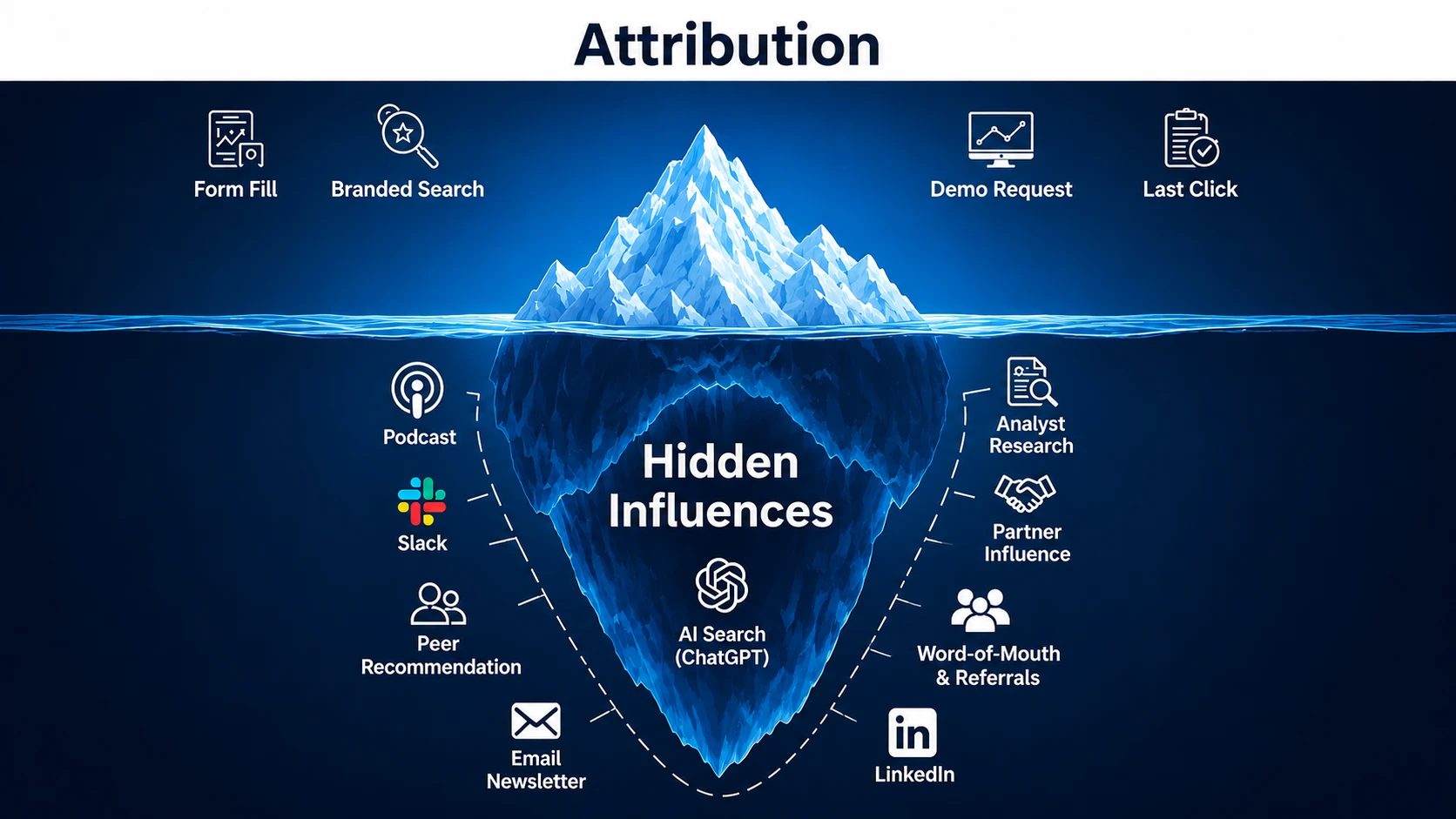
This is where the measurement gap becomes most visible. As observable signals decline, an increasing percentage of buyer influence shifts into environments that analytics platforms simply cannot see. Those conversations still shape purchasing decisions, they just don't appear in attribution reports.
One of the largest contributors to this blind spot is dark social. Recommendations shared through DMs, private communities, podcasts, forwarded emails, Slack channels, and executive peer networks rarely appear in attribution reports. Your CRM tracks the contact who filled out the form; the five colleagues who read the pricing page, asked around in a Slack community, and forwarded a pricing comparison to the CFO never appear in HubSpot at all. Teams that watch branded search volume and direct traffic as demand proxy metrics are working around exactly this blindness. A free Visibility Audit is a quick way to check where your brand shows up beyond the channels your click data covers.
The result is a familiar debate inside every revenue organization. Marketing, sales, and finance all report different versions of performance because each measures a different part of the customer journey. No attribution model can solve what it cannot see.
Attribution's Role in a Broader Measurement Framework
Attribution models provide fast, directional insight into marketing performance, helping teams optimize campaigns, channels, and investment decisions. However, they measure observable customer interactions — not causation. They assign credit across the buying journey they can see, but they cannot account for the growing number of buyer signals that occur outside traditional tracking. At RankWorks, we view attribution as one layer within a broader Decision Intelligence framework that combines attribution, incrementality testing, marketing mix modeling, and revenue validation to provide a more complete view of marketing performance.
Treat attribution as the optimization layer it is. Keep last click only where the path to purchase runs one or two interactions, use the algorithmic model when your account clears Google's volume bar, and send every causal question to a different instrument. Our multi-touch attribution guide covers the implementation mechanics, and our full marketing attribution software guide covers the model families in detail.
Where Attribution Stops, Incrementality Begins
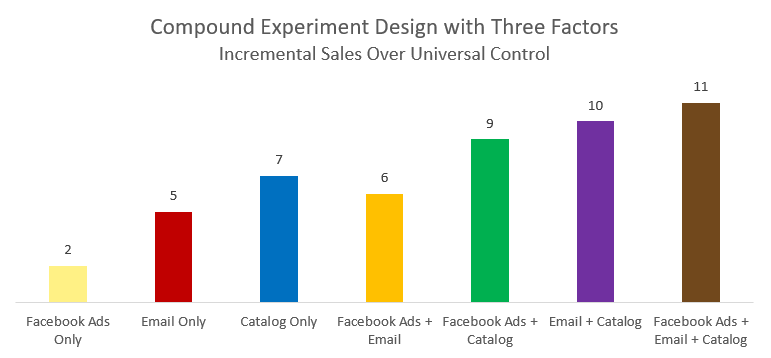
Attribution tells you what happened. Incrementality helps determine what actually changed because of marketing. That's an important distinction. Attribution assigns credit across the observable customer journey. Incrementality asks a different question: Would this conversion have happened if the campaign had never run?
It answers that question through experimentation rather than observation. By comparing a test group exposed to marketing with a control group that wasn't, marketers can measure the true incremental lift generated by a campaign.
For many B2B organizations, attribution and incrementality complement one another. Attribution helps optimize campaigns every day. Incrementality validates whether major marketing investments are genuinely creating new demand.
Consider retargeting. Attribution may report exceptional performance because many conversions include a retargeting interaction. An incrementality test may reveal that most of those buyers would have converted anyway. Neither result is wrong — they simply answer different business questions.
Because experiments require time, budget, and statistical confidence, they aren't practical for every campaign. They're most valuable for evaluating significant marketing investments where understanding true causal impact will influence future budget decisions. Incrementality doesn't replace attribution, it complements it. Attribution explains what influenced a conversion. Incrementality validates what marketing actually caused.
Where Marketing Mix Modeling Fits for Mid-Market B2B
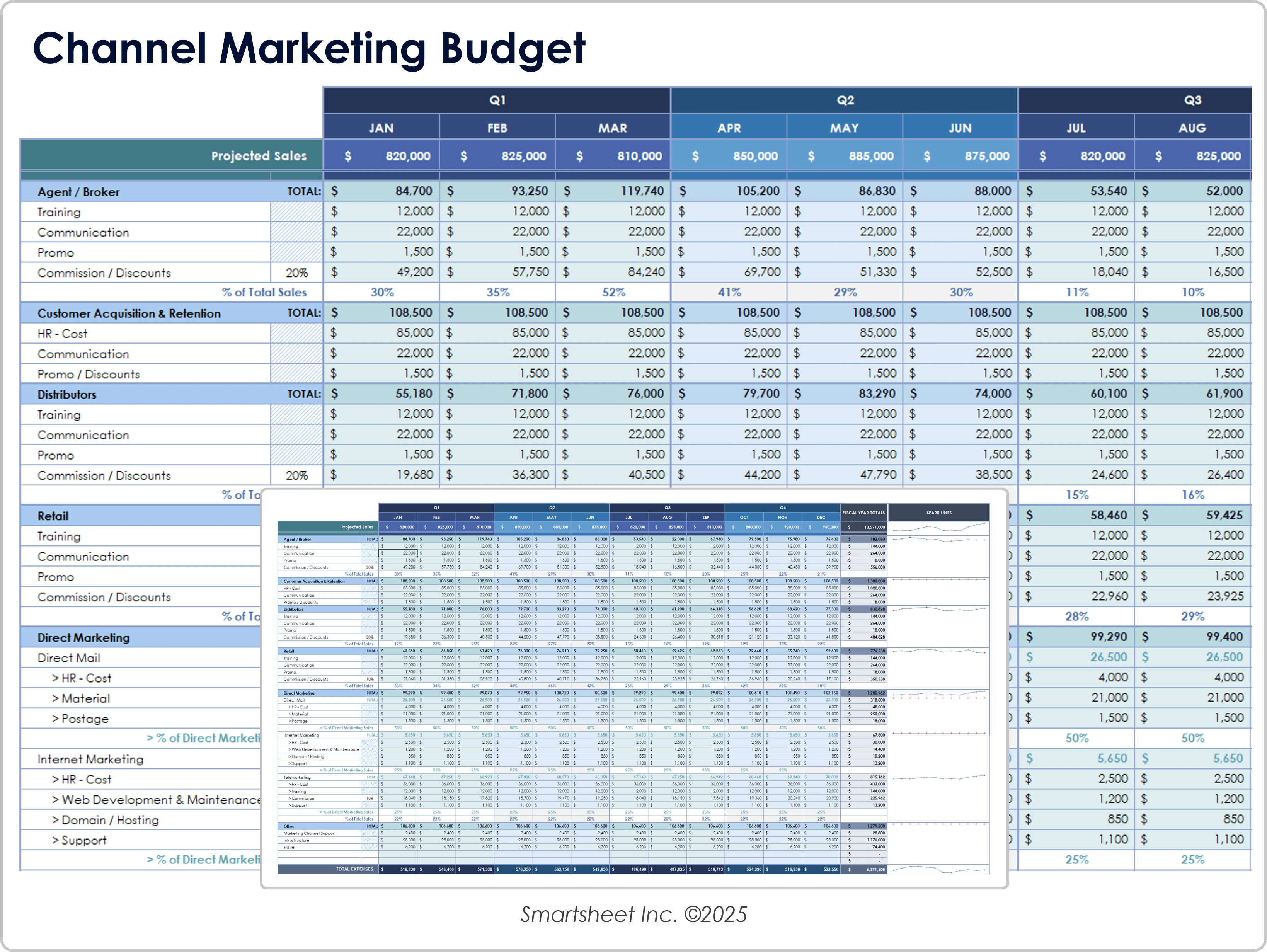
Marketing mix modeling (MMM) approaches measurement from the top down. Instead of following individual users, it analyzes historical marketing investments alongside business outcomes — such as revenue, pipeline, or conversions — to statistically estimate each channel's contribution. Because MMM doesn't rely on user-level tracking, it is largely unaffected by cookie loss and many modern privacy restrictions. The technique predates digital advertising and has continued to evolve through every major shift in measurement.
MMM was once reserved for large consumer brands with specialized agencies and data science teams. Today, the primary requirement is data quality rather than company size. Most organizations benefit from 18 to 36 months of consistent marketing spend and business outcome data, giving the model enough variation to produce reliable estimates. For B2B organizations, MMM is especially valuable when significant influence comes from channels that are difficult to track directly, such as field events, podcasts, partner programs, or long buying cycles that dilute click-level attribution.
The tradeoff is resolution. MMM can tell you a channel is underfunded at the quarterly level, but it won't tell you which campaign to pause on Tuesday. Attribution still serves that purpose. The strongest measurement strategies use both together: MMM informs strategic budget allocation, while attribution supports day-to-day campaign optimization.
The challenge for most marketing teams isn't choosing between MMM and attribution — it's bringing every measurement signal together into a single decision framework. Attribution explains campaign performance. MMM guides strategic budget allocation. Incrementality proves causal impact. First-party revenue data validates business outcomes. The next generation of marketing platforms doesn't replace these approaches; it unifies them, helping marketing leaders prioritize the actions most likely to drive growth.
One Decision View: Unifying the Layers
Each layer answers one question on one clock. Attribution assigns channel credit continuously and drives weekly optimization. Incrementality works as a periodic audit: a holdout on a big line item a few times a year to test what spend actually caused. MMM sits on the longest clock, splitting next year's budget across every channel, including the ones no tracker sees. The combination goes by unified marketing measurement: one decision view, three instruments, three different clocks.
That cross-check is what a marketing measurement framework buys you. When attribution crowns retargeting your best channel and a holdout shows its lift is near zero, you've learned something no single report could tell you — disagreement between instruments becomes information instead of an argument. This architecture is what we built our Decision Intelligence platform around, with attribution board reporting as the CFO-facing surface. Use attribution for Tuesday's decisions, holdouts for this quarter's audits, and MMM for next year's budget.
Revenue Validation: Confirming Attributed Pipeline Actually Closed
The final step is validating that marketing-attributed pipeline translates into measurable business outcomes. Revenue validation closes that loop. Once a quarter, reconcile attributed pipeline against closed-won in the CRM, channel by channel — channels that source pipeline which never closes surface fast, and the reconciliation is stated in the only currency finance accepts. Our revenue attribution workflow for revenue leaders runs the same loop continuously instead of quarterly.
One caution on first-party data: cleaner CRM records, email engagement, and a "how did you hear about us" field improve the inputs, but none of it changes the method. First-party paths are still observational and still blind to dark social. Treat first-party data as input hygiene for the stack, not as a fourth layer.
Where to Start Based on Your Data Maturity
Start with the data you have, not the measurement model you wish you had. If your tracking is inconsistent, focus first on the fundamentals: standardized UTMs, reliable conversion tracking, and CRM data that is complete and up to date. Attribution is only as good as the data behind it.
Once your tracking is reliable, use attribution to optimize campaigns and validate your biggest marketing investments with incrementality testing. As your historical data grows over time, you can add marketing mix modeling to better understand the impact of channels that are difficult to measure directly, such as events, podcasts, and partner marketing. Revenue validation should be part of every stage because it connects marketing activity to business outcomes.
When evaluating marketing attribution software, look beyond attribution models. Choose a platform that unifies your marketing data, CRM, business outcomes, and revenue in one place, giving you the context to understand not just what happened, but why it happened and what to do next.
Frequently Asked Questions
What is the difference between multi-touch attribution and marketing mix modeling?
Multi-touch attribution follows the customer journey and assigns conversion credit across marketing interactions. Marketing mix modeling (MMM) analyzes historical marketing spend and business outcomes to estimate each channel's overall contribution, including offline and difficult-to-track channels. Attribution is best for campaign optimization, while MMM supports strategic budget planning.
How should B2B companies approach marketing attribution with long sales cycles?
Align your attribution window with your typical sales cycle, measure activity at the account level where possible, and regularly compare marketing-attributed pipeline with closed business in your CRM. Because long buying journeys include untrackable interactions, use attribution as one input rather than the only source of truth.
Is marketing mix modeling only viable for enterprise companies?
No. Today, the biggest requirement for MMM is sufficient historical data, not company size. Organizations with consistent marketing and business data over time can benefit from MMM, while larger datasets generally produce more reliable insights.
How can marketing and sales use attribution to improve alignment?
Marketing attribution shouldn't end with marketing. The best-performing organizations review shared metrics across marketing and sales, including attributed pipeline, pipeline conversion, closed revenue, and customer acquisition. A unified measurement framework gives both teams the same view of performance.
The Unified Decision Intelligence Layer
Start with the reconciliation, because it's the cheapest layer and it changes the conversation. Pull last quarter's attributed pipeline, mark what closed in the CRM, and bring that number to the next budget review. It moves every channel argument onto numbers finance already trusts. From there the sequence follows your data: tracking first, a holdout where spend is biggest, MMM once your history can carry it.
The bigger shift is the mental model. Attribution, incrementality, MMM, and revenue validation stop being competing reports and become instruments feeding one operating picture: a unified decision intelligence layer that routes every measurement question to the tool built to answer it. That layer is the problem our platform exists to solve. Book a demo to see it run against your own pipeline, or go deeper first with board-level attribution reporting and the revenue attribution workflow.
See Where Your Business Stands in Search
Get a free site audit. We identify what is holding you back and what to fix first.
Related Resources
Explore more insights to enhance your digital marketing strategy
Revenue Attribution Platform
Connect every marketing dollar to closed revenue. Multi-touch attribution, incrementality testing, and board-ready reporting in one place.
Revenue Attribution: Models, Measurement & Revenue
Every attribution model explained — from first-touch to data-driven — with a framework for choosing the right one for your pipeline.
See It Run on Your Pipeline
Book a demo and see the unified measurement framework applied to your own revenue data. No slide decks — just your numbers.