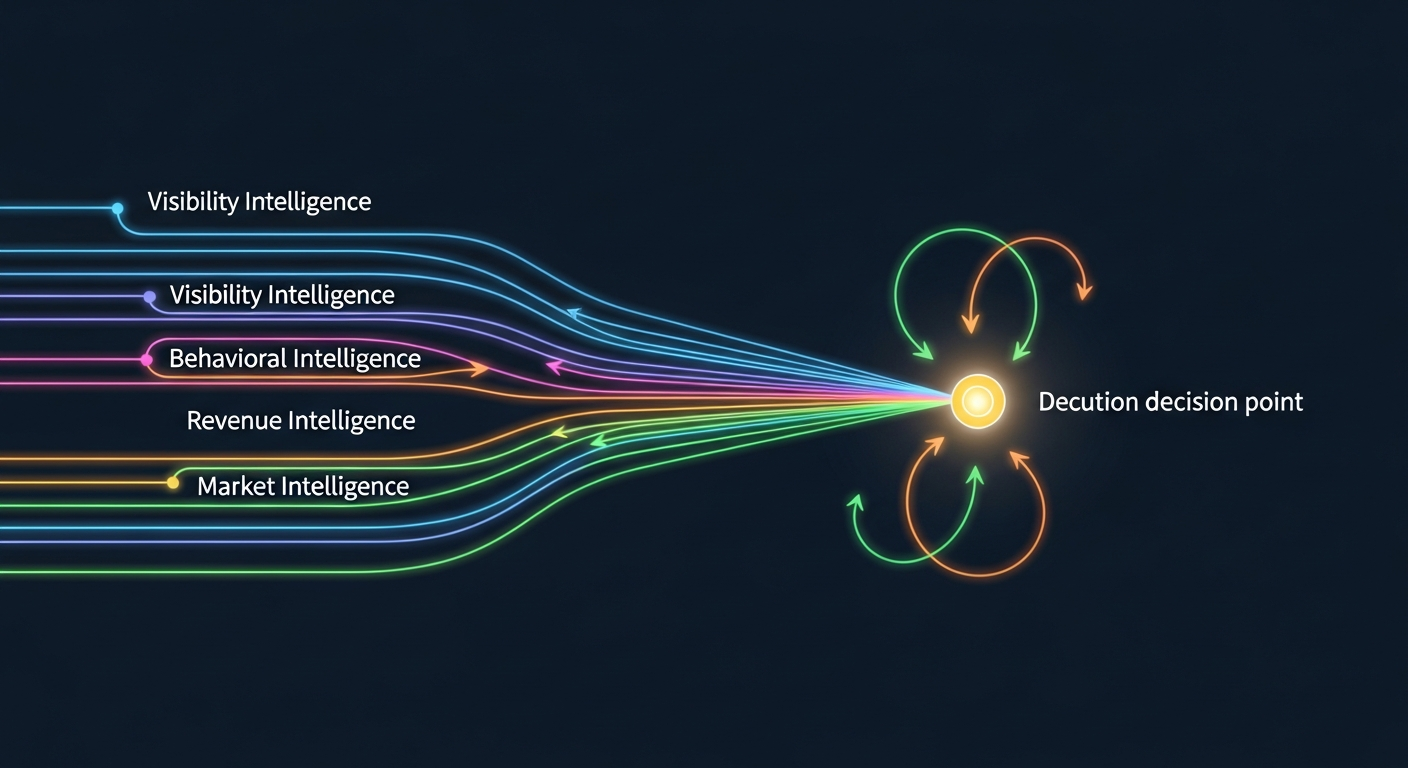
For decades, organizations have invested billions of dollars in analytics, reporting, attribution, CRM systems, business intelligence platforms, and revenue operations. The objective has always been the same: make better decisions.
Yet despite having more data than at any point in history, many organizations continue to struggle with forecast accuracy, budget allocation, strategic planning, revenue predictability, and competitive positioning. The problem is not a lack of information. The problem is structural.
What each system was designed to explain
Analytics
What occurred
Historical, not forward-looking
Attribution
What received credit
Credit assignment, not decision guidance
Revenue Reporting
What closed
Outcomes, not causes
Visibility Intelligence
Where discovery occurred
Discovery, not action
Decision Intelligence
What should we do next
Decision Intelligence combines all of those signals and transforms them into better decisions. It represents the next evolution of business measurement - because growth is not created by data. Growth is created by decisions.
What Is Decision Intelligence?
Decision Intelligence is a business framework that connects visibility, behavior, revenue, and market signals to improve organizational decision-making. Historically, organizations focused on collecting information. Decision Intelligence focuses on transforming information into action. This distinction is critical.
What should we do next?
The question Decision Intelligence is built to answer
What other systems answer
What Decision Intelligence answers
"What should we do next?"
Many organizations possess large amounts of data. Far fewer consistently make better decisions because of that data. Decision Intelligence exists to bridge that gap - not by creating more reports, but by creating better decisions.
Why Reporting Is No Longer Enough
Many organizations still operate primarily through reporting. Reporting remains important. However, reporting has a fundamental limitation: it tells organizations what happened. It does not tell them what to do next.
A common executive dashboard may show these metrics - and still leave executives without answers
Revenue increased
Why?
Pipeline declined
Why?
Opportunities accelerated
Why?
Forecast accuracy changed
Why?
Win rates shifted
Why?
Conversion rates moved
Why?
Reporting reveals outcomes. Decision-making requires understanding causes. The gap between what reporting tells executives and what executives need to know to make better decisions is exactly where Decision Intelligence operates.
The Difference Between Information and Intelligence
One of the biggest misconceptions in business is that information automatically creates intelligence. It does not. Information is raw input. Intelligence is actionable understanding. Organizations do not need more dashboards. They need better decisions.
Information
Raw input. Data points. Historical records. What happened.
Useful. But incomplete.
Intelligence
Actionable understanding. Context. What to do next.
Drives action.
Consider weather forecasting. Weather data alone is not useful. What matters is understanding what the data means and how to act on it. Business operates the same way. Decision Intelligence exists to transform information into action.
The Evolution of Business Measurement
To understand why Decision Intelligence is emerging now, it helps to understand how measurement has evolved. Each era solved a new problem - and revealed a new limitation.
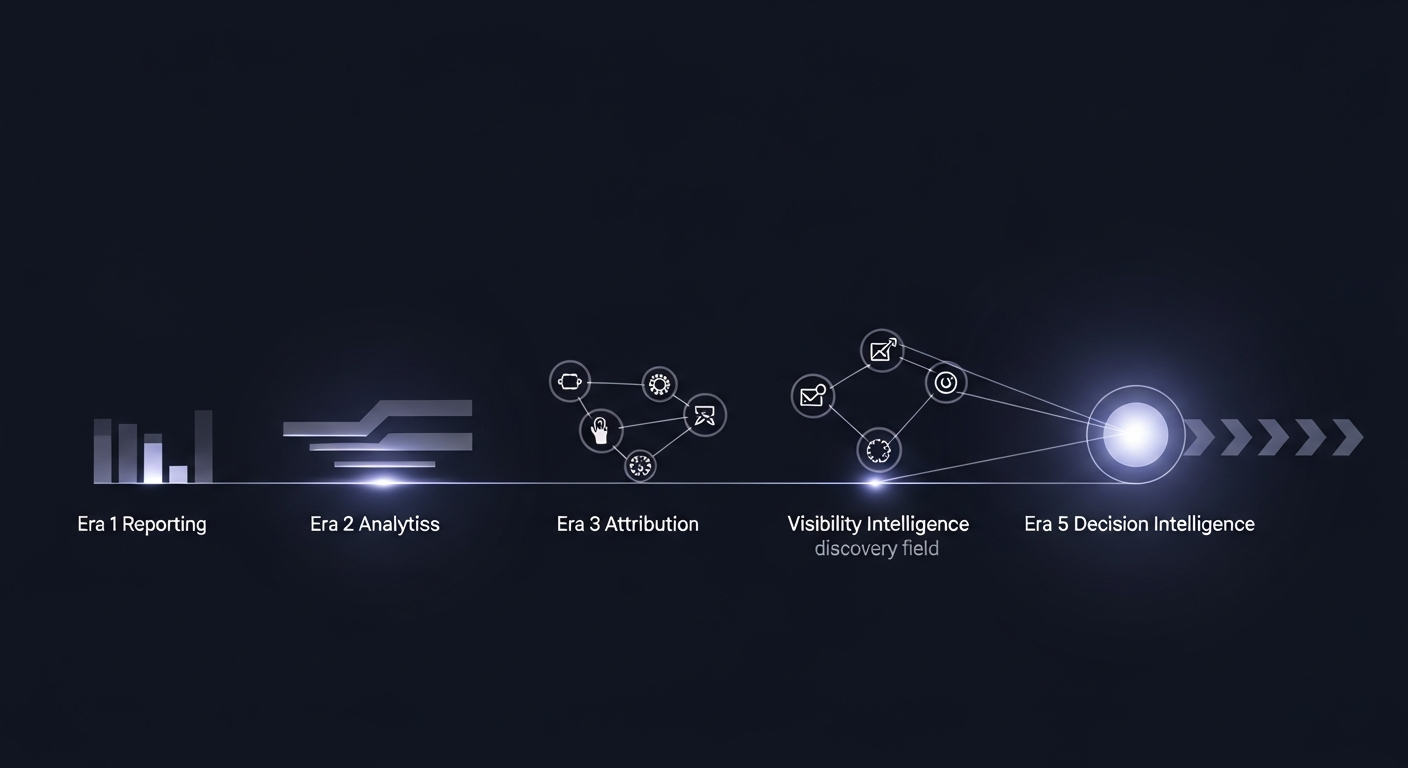
Each measurement era expanded organizational understanding - and exposed new limitations. Decision Intelligence is the convergence of all five perspectives.
Era 1: Reporting
Focus
Outcomes
Key questions
"How many leads? How much revenue?"
Limitation
Historical. Described outcomes but rarely explained causes.
Era 2: Analytics
Focus
Behavior
Key questions
"Which channels perform? Which campaigns drive engagement?"
Limitation
Deeper insight but still focused on historical events.
Era 3: Attribution
Focus
Credit
Key questions
"Which channel generated the lead? Which campaign influenced revenue?"
Limitation
Significant advancement but focused on interactions and credit assignment.
Era 4: Visibility Intelligence
Focus
Discovery
Key questions
"Where are buyers finding us? Are AI systems recommending us?"
Limitation
Expanded understanding of growth but did not directly drive decisions.
Era 5: Decision Intelligence
Focus
Action
Key questions
"Where should we invest? Which signals predict growth? What creates the greatest impact?"
Value
Transforms all previous layers into actionable growth decisions
Why Attribution Is No Longer Enough
Attribution remains one of the most important innovations in marketing measurement. However, attribution was never designed to be a decision-making system. It was designed to be a credit assignment system. That distinction matters significantly.
Attribution answers
"Which touchpoints contributed?"
Attribution explains
Decision Intelligence answers
"What should we do because of that?"
Attribution does not explain
As buying journeys become increasingly complex, attribution alone becomes less useful as a strategic framework. Decision Intelligence does not replace attribution - it gives attribution results more strategic context so executives can act on them. See: Attribution vs Visibility - full comparison.
The Five Layers of Decision Intelligence
Decision Intelligence is built upon five interconnected layers. Each layer provides a different perspective on growth. Together they create a complete understanding of business performance and future opportunity.
The first four layers provide input. Layer 5 transforms that input into decisions.
1Layer 1: Visibility Intelligence
Visibility Intelligence focuses on discoverability - the foundation of all growth. Without visibility, there is no discovery. Without discovery, there is no opportunity. It helps organizations understand where buyers encounter brands, products, and solutions across an increasingly fragmented discovery ecosystem.
Where buyers discover today
Key visibility metrics
Visibility is often the earliest signal of future growth. Increasing visibility frequently precedes increased engagement, increased pipeline, and increased revenue - making it one of the most valuable leading indicators available. See: Brand Visibility Intelligence framework.
2Layer 2: Behavioral Intelligence
Visibility explains discovery. Behavioral Intelligence explains engagement. This layer focuses on understanding how buyers interact with information, content, products, and brands. Two companies may have identical visibility - yet one consistently generates more opportunities. The difference often lies in behavior.
Content Depth
How deeply are buyers consuming content? Shallow engagement may indicate weak messaging.
Evaluation Activity
Are buyers comparing solutions? High comparison activity often indicates late-stage evaluation.
Stakeholder Engagement
Are buying committees becoming involved? Committee activity is a strong pipeline indicator.
Product Research
Are prospects exploring specific capabilities? Research depth often predicts opportunity quality.
Returning Visitors
Are buyers coming back repeatedly? Return frequency correlates with purchase intent.
Community Participation
Are buyers engaging in industry discussions? Community activity reveals consideration and intent.
Behavior reveals interest, intent, and evaluation signals that precede opportunity creation. These behaviors often indicate future revenue creation months before pipeline appears in reports.
3Layer 3: Revenue Intelligence
Revenue Intelligence connects visibility and engagement to business outcomes. It expands traditional revenue measurement from explaining what happened to understanding how growth is being created - and what is likely to happen next.
Revenue Reporting asks
"What happened?"
Historical. Outcome-focused. Limited strategic value.
Revenue Intelligence asks
"Why did it happen and what is coming next?"
Forward-looking. Driver-focused. High strategic value.
4Layer 4: Market Intelligence
Many organizations become overly focused on internal performance. This creates blind spots. Growth does not occur in isolation. Markets change. Competitors evolve. Buyer expectations shift. AI systems alter discovery behavior. Market Intelligence provides the external context that internal metrics alone cannot supply.
Strong internal performance can hide emerging risks
5Layer 5: Decision Intelligence
This is where the previous four layers converge. Decision Intelligence transforms information into action. The objective is not simply understanding - it is decision quality. Organizations frequently have enough information. What they lack is a framework for acting on that information.
What makes Decision Intelligence different
Signal
Visibility Intelligence reveals declining discoverability
Decision Intelligence asks
"What investment should we make in content and AI visibility?"
Signal
Revenue Intelligence reveals slowing pipeline velocity
Decision Intelligence asks
"How should resources be reallocated to accelerate opportunities?"
Signal
Market Intelligence reveals a competitor gaining share
Decision Intelligence asks
"How should strategy change to defend our position?"
Signal
Behavioral Intelligence reveals dropping content engagement
Decision Intelligence asks
"Which topics and formats need to be rethought?"
Most measurement systems stop at insight. Decision Intelligence continues to action. This is the critical difference between understanding what happened and shaping what happens next.
The Decision Intelligence Loop
Decision Intelligence is not a one-time exercise. It is an ongoing cycle. Organizations that continuously improve this loop create significant advantages over time - because each decision generates new signals that inform the next decision.
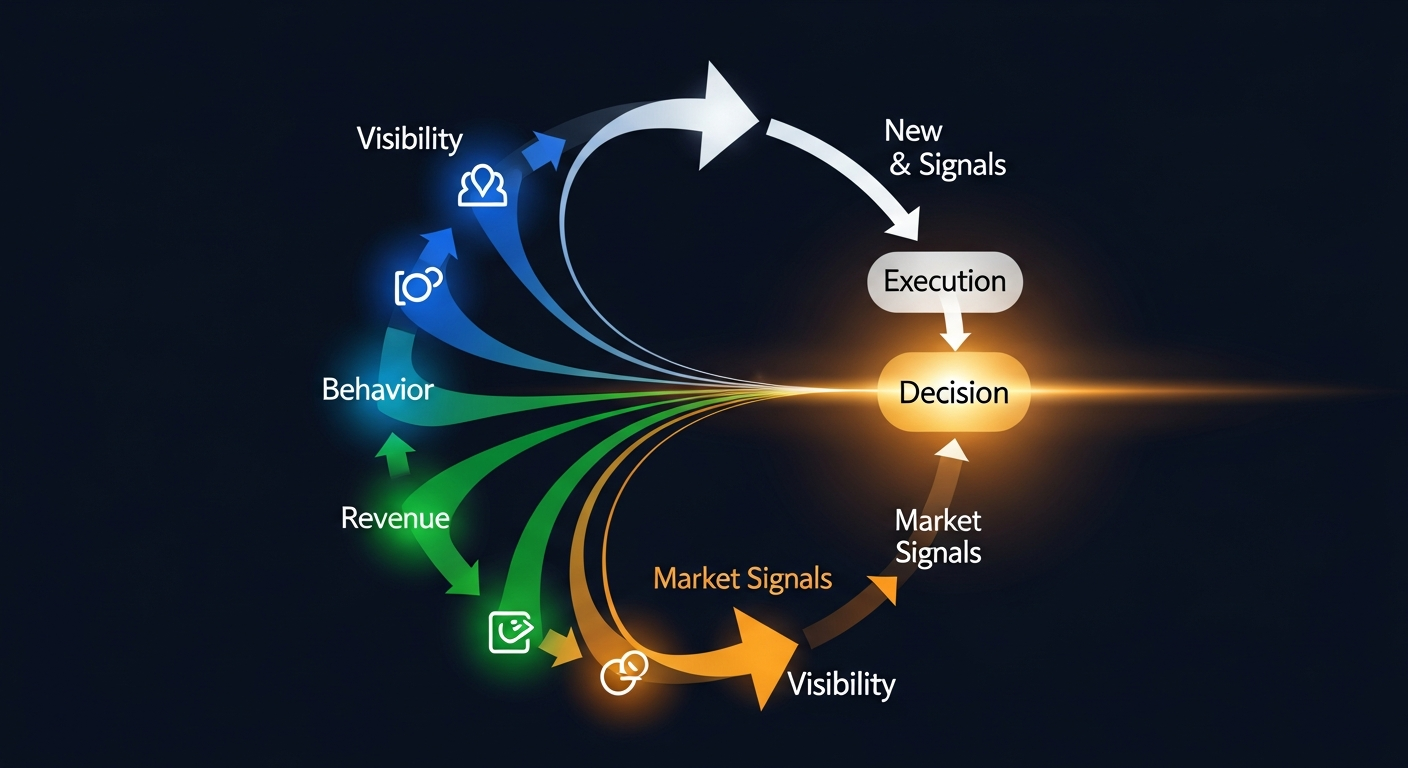
The Decision Intelligence loop is self-reinforcing. Better decisions generate better signals, which inform better decisions. Each cycle compounds the advantage.
The continuous improvement cycle
Why Traditional Dashboards Fail Executives
Many executive dashboards contain dozens of metrics. Traffic. Pipeline. Revenue. Conversion rates. Forecasts. Yet these dashboards frequently fail executives because they answer the wrong question. They tell executives what happened. They rarely tell executives what to do next.
What traditional dashboards answer
Useful. Incomplete for strategic decisions.
What executives increasingly need
Decision Intelligence answers these.
Organizations are no longer competing based on access to information. The competitive advantage increasingly comes from interpreting information more effectively and acting on it more quickly. Decision Intelligence exists to create that advantage.
Decision Intelligence for CEOs
Chief Executive Officers face a unique challenge: they are responsible for decisions that impact the entire organization, yet many executive teams still rely heavily on lagging indicators. Decision Intelligence helps CEOs identify signals earlier - so strategy can change before outcomes do.
Better Strategic Planning
Earlier Growth Signals
Stronger Competitive Positioning
Decision Intelligence for CMOs
Marketing leaders are increasingly expected to contribute directly to growth strategy - not just report on campaign performance. Decision Intelligence gives CMOs the broader context to do that confidently.
Better Budget Allocation
Attribution explains where credit was assigned historically. Decision Intelligence helps determine where future opportunity exists. A topic may generate limited attributed revenue today - but if visibility is increasing, buyer engagement is rising, AI recommendations are growing, and competitor visibility is declining, those signals may indicate strong future growth potential. Decision Intelligence helps CMOs identify opportunities before they become obvious.
Smarter Content Strategy
Content increasingly influences AI visibility, search visibility, category authority, and buyer education. Decision Intelligence helps CMOs understand which topics matter most, which content creates visibility, and which subjects influence decisions - creating more strategic content investments with clearer connections to growth outcomes.
Improved Executive Communication
Modern executive teams increasingly want answers to strategic questions: why are we growing, why are we losing opportunities, and what should we invest in next. Decision Intelligence gives CMOs the language and framework to contribute to those discussions with broader business context rather than campaign-level attribution.
Decision Intelligence for CROs
Revenue leaders are responsible for predictability. Predictability depends on visibility. The challenge is that many traditional revenue metrics are reactive. Pipeline reveals what exists today. Decision Intelligence helps explain what may exist tomorrow.
Better Forecasting
Opportunity Prioritization
Pipeline Risk Detection
Decision Intelligence for Boards
Boards increasingly require visibility beyond financial reporting. Revenue remains important. However, boards increasingly care about predictability, market position, competitive strength, and growth sustainability. Decision Intelligence helps answer those questions.
"Are we gaining market share?"
Competitive visibility and share of discovery metrics track market position changes before revenue shifts confirm them.
"Are competitors becoming stronger?"
Market Intelligence surfaces competitor visibility trends, AI recommendation changes, and category positioning shifts.
"Are buyers finding us?"
Visibility Intelligence tracks discoverability across search, AI systems, communities, and the full discovery ecosystem.
"Are growth drivers sustainable?"
Decision Intelligence connects visibility trends, behavioral signals, and pipeline quality to provide a forward-looking growth assessment.
See: Marketing Attribution and Board Reporting - how to present growth data to boards
The Decision Intelligence Maturity Model
Organizations typically evolve through five stages of intelligence maturity. Understanding these stages helps leaders evaluate current capabilities and identify the next stage of strategic development.
Level 1: Reporting
Primary Focus
"What happened?"
Typical Metrics
Revenue, Leads, Traffic
What Changes
Understand outcomes. Rarely understand causes.
Level 2: Attribution
Primary Focus
"What received credit?"
Typical Metrics
Channel performance, Campaign influence, Conversion paths
What Changes
Gain accountability. Visibility remains limited.
Level 3: Visibility Intelligence
Primary Focus
"Where are buyers discovering us?"
Typical Metrics
Search visibility, AI visibility, Competitive visibility, Topic authority
What Changes
Gain visibility into discovery and early buyer behavior.
Level 4: Revenue Visibility
Primary Focus
"How does discovery create growth?"
Typical Metrics
Pipeline velocity, Revenue influence, Visibility-to-pipeline correlation
What Changes
Connect visibility signals to business outcomes.
Level 5: Decision Intelligence
Primary Focus
"What should we do next?"
Typical Metrics
Growth signals, Opportunity prioritization, Decision quality indicators
What Changes
Move beyond measurement. Begin optimizing decisions.
Why Decision Intelligence Is Emerging Now
Several trends are accelerating demand for Decision Intelligence simultaneously. Each trend increases the complexity of decisions - and the cost of making poor ones.
AI Search
Discovery is becoming more complex. Buyers increasingly discover through AI recommendations before any attribution data exists. Traditional measurement misses a growing share of buyer influence.
Market Volatility
Forecasting is becoming more difficult. Economic uncertainty, competitive dynamics, and shifting buyer behavior create environments where lagging indicators provide insufficient warning.
Data Explosion
Organizations have more information than ever - but more information does not automatically produce better decisions. Decision Intelligence helps organizations interpret data, not just collect it.
Buyer Complexity
Customer journeys continue to fragment across AI systems, communities, buying committees, and private research channels. Attribution misses more of the story every year.
Competitive Pressure
Markets move faster than traditional planning cycles. Organizations that understand leading indicators consistently outmaneuver competitors relying on lagging ones.
AI Competition
AI systems increasingly recommend vendors. Organizations that do not understand their AI visibility risk being excluded from consideration sets before any measurable interaction occurs.
Together these forces make better decision-making increasingly valuable - and increasingly difficult to achieve without a structured framework. The future belongs not to organizations with the most data, but to organizations that make the best decisions from the data available.
How RankWorks Enables Decision Intelligence
Most organizations already possess large amounts of data. The challenge is connecting that data in a way that improves decision-making. RankWorks helps organizations understand visibility, buyer behavior, market dynamics, pipeline creation, and revenue outcomes together - creating the unified intelligence layer that drives better decisions.
Frequently Asked Questions About Decision Intelligence
Common questions from CEOs, CMOs, CROs, and revenue leaders about Decision Intelligence, how it differs from Business Intelligence and attribution, and why it represents the next evolution of growth management.
Still have questions?
Our SEO experts are here to help. Get personalized answers and a free consultation.
Key Takeaways
- 1
Data does not create growth - decisions do. The purpose of all measurement is ultimately to improve decisions. Organizations that collect more data without improving decision quality gain little advantage. Decision Intelligence exists to bridge the gap between information and action.
- 2
Reporting explains the past. Decision Intelligence shapes the future. Reporting, analytics, attribution, and even Visibility Intelligence are fundamentally retrospective. Decision Intelligence uses all of those signals to inform forward-looking decisions - shifting organizations from reactive to proactive.
- 3
The five layers work together. Visibility Intelligence reveals discovery. Behavioral Intelligence reveals engagement. Revenue Intelligence connects both to growth. Market Intelligence provides competitive context. Decision Intelligence transforms all four into action.
- 4
Attribution explains credit. Decision Intelligence explains opportunity. Attribution is a valuable input to Decision Intelligence - but it was designed to assign credit to observable interactions, not to guide strategic investment. Decision Intelligence gives attribution results strategic context.
- 5
AI search makes Decision Intelligence more important. As AI-assisted discovery expands, more buyer influence occurs before attribution begins. Organizations without AI visibility data are making strategic decisions from an increasingly incomplete picture of their market.
- 6
Every major executive role benefits from Decision Intelligence. CEOs gain earlier strategic signals. CMOs gain broader investment context. CROs gain improved forecasting and pipeline risk detection. Boards gain visibility into growth sustainability and competitive position beyond financial reporting.
- 7
The future belongs to organizations that make better decisions. Every major evolution in business measurement has followed the same pattern - organizations first sought visibility into outcomes, then behavior, then attribution, then discovery. The next evolution is visibility into decisions themselves.
Continue Reading
Brand Visibility Intelligence
The complete framework for measuring discoverability - Layer 1 of Decision Intelligence.
Revenue Visibility
How visibility and engagement signals connect to pipeline and revenue - Layer 3 of Decision Intelligence.
The Visibility Gap
Why traditional measurement misses how buyers actually make decisions - and what fills the gap.
Marketing Attribution and Board Reporting
How to present attribution, visibility, and growth intelligence to boards effectively.