Part of the Marketing Attribution Guide
Marketing Attribution: Models, Measurement & Revenue Impact →Why Last-Click Attribution Is Lying to You
Last-click attribution assigns 100% of conversion credit to the final touchpoint before a sale. Here is why that distorts every budget decision your team makes and what to do instead.
Last-click attribution has been the default measurement model for most marketing teams for over a decade. It is simple, easy to explain, and built into almost every analytics platform out of the box. It is also one of the most reliable ways to systematically underfund the channels that create demand and over-reward the ones that simply show up at the end.
This is not a fringe opinion. It is a structural problem baked into how last-click works. If your team makes budget decisions based on last-click data, you are almost certainly cutting channels that build pipeline and pouring money into channels that take credit for deals they did not originate.
What Last-Click Attribution Actually Does
Last-click attribution assigns 100% of the credit for a conversion to the final touchpoint before someone converted. If a prospect clicked a Google ad after reading three blog posts, attending a webinar, and seeing a retargeting banner, the Google ad gets full credit. Everything else gets zero.
The logic behind this was reasonable in a simpler era. When buyers had fewer touchpoints and conversion paths were short, the last click was a decent proxy for what caused the sale. That is no longer true. B2B buyers in 2026 average between 10 and 27 touchpoints before signing a contract. The last click is one data point in a long chain of influence. Treating it as the whole story distorts every budget decision that follows from it.
Four Ways Last-Click Distorts Your Data
1. It Systematically Punishes Top-of-Funnel Investment
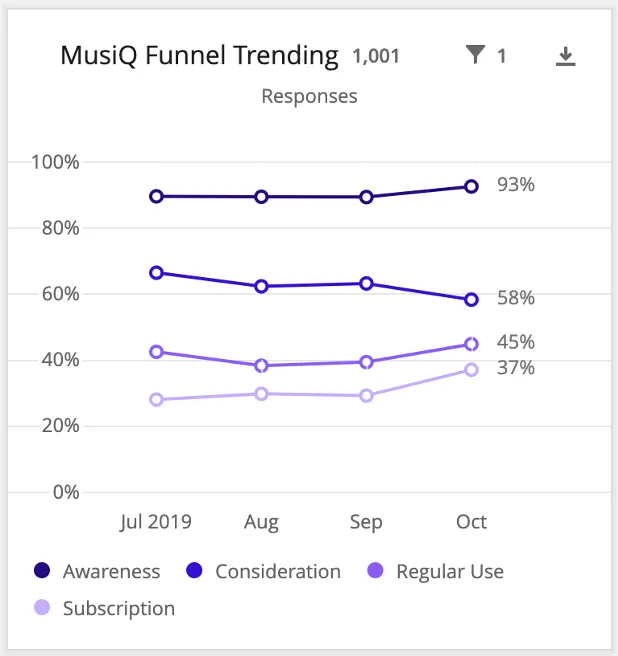
Content marketing, thought leadership, organic social, and brand advertising almost never show up as the last touch before a conversion. They work earlier in the process, when buyers are forming opinions and building awareness of potential solutions. Last-click models assign those channels a conversion value of zero, which makes them look like pure cost centers in any report based on last-click data.
The result is predictable: teams cut these channels because they cannot justify the spend, and then wonder why pipeline dries up 6 to 12 months later. The pipeline was being built by exactly the channels they defunded.
2. It Inflates the Apparent Value of Paid Search
Brand-keyword paid search is the most common beneficiary of last-click attribution. A buyer who has been educated by your content, nurtured by your email sequences, and retargeted across multiple platforms finally searches for your brand name by name and clicks a paid result. Last-click gives 100% of that deal to the paid keyword.
This inflates paid search ROI significantly. In most analyses that use multi-touch attribution instead, brand paid search drops from appearing to generate 3 to 4x returns to appearing much more modest, because the real work was done elsewhere and the paid search simply captured a buyer who was already sold.
3. It Makes Retargeting Look Like a Conversion Machine
Retargeting ads are designed to follow warm leads around the internet and stay visible until they are ready to buy. When they convert, retargeting often gets the last click. But retargeting does not create demand, it harvests demand that other channels created. Last-click attribution cannot tell the difference, so retargeting budgets grow while the channels that created the original demand get defunded.
4. It Cannot Handle Offline and Dark Social Touchpoints
A significant share of B2B buying behavior happens in places that attribution tools cannot track. A Slack community message recommending your product. A podcast episode that sparked a conversation between a buyer and their manager. A LinkedIn post that someone screenshotted and shared internally. A conference conversation. These touchpoints are real and they influence decisions, but last-click attribution treats them as if they never happened because they leave no trackable click.
The result is a model that measures only what is measurable and then pretends that is everything. If you want to understand how your dark social channels contribute to pipeline, last-click will always give you a false zero.
What B2B Buyers Actually Do Before Converting
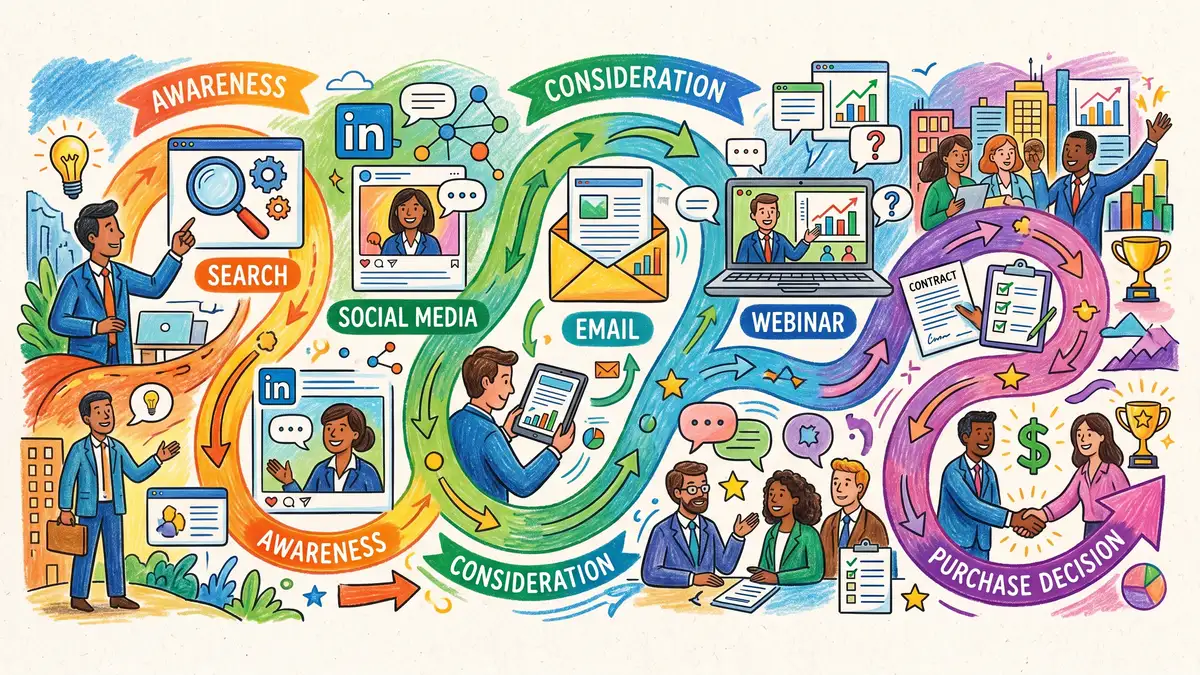
Research on B2B buying behavior consistently shows that purchase decisions involve multiple people, multiple channels, and extended timelines. A typical mid-market software deal might involve:
- An end user discovering the product through organic search or a peer recommendation
- That same user reading 4 to 6 pieces of content over several weeks
- A manager being looped in after an internal conversation
- The manager checking G2 or Capterra reviews
- Both attending a webinar or watching a recorded demo
- A finance contact looking at pricing pages directly
- A final brand keyword search before the form submission
In a last-click world
The Cost of Making Decisions on Bad Data
The practical consequences of last-click attribution compound over time. In the first year, you might overspend on paid search by 20% because the data makes it look like your highest-ROI channel. In the second year, you cut content marketing because it generates no attributable conversions. By the third year, organic traffic has declined, brand awareness is lower, and your paid search costs have risen because you are competing for buyers who are less pre-sold than they used to be.
This cycle is common enough that it has a name among performance marketers: the attribution death spiral. Teams optimize aggressively toward measurable last-click channels, reduce investment in hard-to-measure channels, watch pipeline quality decline, and then increase paid spend to compensate for the lower inbound volume, which further reduces the budget available for brand-building.
Breaking out of this cycle requires better data. You need to understand which channels actually contribute to conversions across the full path, not just which one happened to be last. That is what multi-touch attribution models and more sophisticated approaches are designed to provide.
The Real Question Attribution Should Answer
The goal of attribution is not to assign credit. Credit is a means to an end. The goal is to understand what marketing activity is actually moving buyers forward so you can do more of what works and less of what does not.
Last-click gives you a narrow slice of that picture. It tells you what happened immediately before conversion with reasonable accuracy. It tells you almost nothing about what influenced the buyer's decision to consider your product in the first place, what built their confidence over time, or what internal conversations and external research shaped their view before the final click.
To get answers to those questions, you need a model that looks at the full conversion path. Linear attribution distributes credit evenly across all touchpoints. Time-decay attribution gives more credit to touchpoints closer to conversion. Position-based models give extra credit to the first and last touchpoints. Data-driven models use machine learning to weight touchpoints based on their actual statistical contribution to conversion.
Each of these is a meaningful improvement over last-click for different use cases. None of them is perfect. The right model for your team depends on your sales cycle length, your data volume, and the questions you most need to answer.
What Better Attribution Looks Like in Practice
Moving beyond last-click does not require a complete overhaul of your measurement infrastructure. Most teams can make meaningful improvements with a few concrete steps.
Enable Multi-Touch Reporting in Your Existing Tools
Google Analytics 4 supports multiple attribution models and lets you compare them side by side. If you are currently looking only at last-click data, switching to a linear or data-driven model in GA4 costs nothing and takes about 10 minutes to set up. The comparison view alone is eye-opening for most teams that have never looked at their data this way.
Invest in Proper UTM Discipline
Attribution models are only as good as the data feeding them. Inconsistent UTM tagging, broken tracking links, and untagged campaigns create gaps in your conversion paths that attribution models cannot fill. Before upgrading your attribution model, audit your tracking setup to make sure every paid campaign, email, and owned channel is consistently tagged.
Layer in Self-Reported Attribution
The simplest way to capture dark social and offline touchpoints is to ask. Adding a single open-text field to your demo request or signup form asking how the buyer first heard about you gives you a qualitative layer that tracking data cannot provide. This self-reported attribution is imperfect but consistently surfaces channels and sources that click-based tracking misses entirely.
Consider Dedicated Attribution Software
For teams with complex conversion paths and significant marketing budgets, the limitations of in-platform attribution tools become meaningful. Dedicated marketing attribution software stitches together data from multiple sources, handles longer attribution windows, and provides more granular path analysis than GA4 or your CRM's built-in reports.
The investment is justified when the decisions you are making based on attribution data are large enough that getting them wrong costs more than the tool. For most teams spending more than $500,000 per year on marketing, that threshold is easy to cross.
Starting the Conversation with Your Team
The hardest part of moving beyond last-click attribution is not the technical setup. It is getting alignment on why the change is necessary. Marketing teams that have been reporting on last-click data for years have often built their entire reporting narrative around those numbers. Changing the model changes the story, and some channels that looked great under last-click will look worse under multi-touch.
The most effective way to handle this transition is to run both models in parallel for a quarter before making any budget changes. Show stakeholders the comparison, explain what each model measures and why multi-touch gives a more complete picture, and let the data make the argument. Teams that approach this change as a learning process rather than a verdict are much more likely to get genuine buy-in.
Last-click attribution served a purpose when marketing was simpler. The buyer journey is more complex now, and your measurement needs to keep up. The teams that make this shift stop optimizing for who crosses the finish line last and start understanding who actually ran the race.
If you want to see how full-path attribution changes your budget allocations, our attribution platform lets you run your historical data through multiple models and compare the results side by side. Most teams find the comparison alone is enough to change how they think about where their marketing budget should go.
Key Takeaways
- Last-click attribution misrepresents the value of marketing channels.
- It assigns all credit to the final touchpoint before conversion.
- B2B buyers now average 10 to 27 touchpoints before signing.
- Last-click attribution ignores offline and untrackable interactions.
Frequently Asked Questions
- What is last-click attribution?
- Last-click attribution assigns 100% of conversion credit to the last touchpoint before a sale. It simplifies measurement but distorts the true impact of various marketing channels.
- How does last-click attribution affect budget decisions?
- Budget decisions based on last-click data often lead to underfunding channels that create demand. This can result in a dried-up pipeline as teams cut essential top-of-funnel investments.
- Why is paid search's value inflated in last-click models?
- Last-click attribution gives full credit to paid search when a buyer searches for a brand name. This inflates its ROI, as the real influence often comes from earlier marketing efforts.
- What are dark social touchpoints?
- Dark social touchpoints include untrackable interactions like recommendations in Slack or conversations at conferences. Last-click attribution fails to account for these influences, leading to a misleading assessment of marketing effectiveness.
See Where Your Business Stands in Search
Get a free site audit. We identify what is holding you back and what to fix first.
Related Resources
Explore more insights to enhance your digital marketing strategy
Revenue Attribution Platform
Connect every marketing dollar to closed revenue. Multi-touch attribution, incrementality testing, and board-ready reporting in one place.
Revenue Attribution: Models, Measurement & Revenue
Every attribution model explained — from first-touch to data-driven — with a framework for choosing the right one for your pipeline.
See It Run on Your Pipeline
Book a demo and see the unified measurement framework applied to your own revenue data. No slide decks — just your numbers.