B2B Lead Nurturing: Moving Prospects Through the Funnel

Learn how to build effective B2B lead nurturing programs that move prospects from awareness to decision. Includes email sequences, behavioral triggers, and content mapping by funnel stage.
Why Most B2B Nurture Programs Fail to Move the Needle
The majority of B2B lead nurturing programs share a common design flaw: they are built around sending content on a schedule rather than around moving prospects toward a decision. A program that sends a blog post on Monday, a case study on Wednesday, and a product video on Friday — regardless of what the prospect has engaged with, what they have not read, or where they are in their own buying process — is a broadcast program with an email delivery mechanism, not a nurturing program. Nurturing implies movement: a systematic process of identifying where a prospect is in their journey, providing the right content or conversation to address the barriers to progress at that stage, and advancing them toward the next stage. When nurture programs are designed as scheduled content delivery rather than as stage-advancement engines, they generate email engagement metrics — open rates, click rates — that show activity without producing the MQL volume, sales-qualified opportunities, and pipeline contribution that the program was supposed to generate.
The research on B2B buying behavior makes the stakes of this design flaw concrete. Forrester Research has found that companies that excel at lead nurturing generate 50% more sales-ready leads at 33% lower cost per lead compared to companies that don't nurture. Annuitas Group research found that nurtured leads make purchases 47% larger than non-nurtured leads — a finding that reflects the value of educating prospects on the full scope of a solution's value before they engage with sales, rather than having sales discover an undereducated prospect who has a narrow initial frame of the problem and solution. These outcomes — more sales-ready leads, lower cost per lead, larger deal sizes — are only achievable from nurture programs designed to produce stage advancement, not from content broadcasting that generates opens without producing qualified intent.
Mapping Content to Funnel Stage
The foundation of effective B2B lead nurturing is content that is explicitly matched to the prospect's stage in the buying journey. Three stages define the content mapping framework: awareness stage (the prospect is experiencing a problem but may not have a precise definition of it or know that a category of solutions exists), consideration stage (the prospect has defined their problem, is researching solution categories, and is evaluating options), and decision stage (the prospect has a shortlist of vendors and is gathering the specific information needed to make a purchase decision). Content that is appropriate for consideration-stage prospects — detailed vendor comparison guides, ROI calculators, technical architecture documentation — is likely to feel overwhelming or premature for awareness-stage prospects who are still forming their understanding of the problem. Content appropriate for awareness-stage prospects — broad problem education, trend reports, industry statistics — is likely to feel generic and irrelevant to decision-stage prospects who have already done their research and need vendor-specific proof of capability.

Awareness-stage content is designed to help prospects articulate and understand their problem in the vendor's preferred framing. This includes educational blog posts (the post you are reading is an example), trend and benchmark reports, industry research, podcast episodes, and short-form video content that addresses common pain points at a broad level. The goal of awareness content in a nurture sequence is not to make a product case — it is to establish that the vendor understands the prospect's world and has relevant perspective on the challenges the prospect is facing. Prospects who engage substantively with awareness content — reading multiple articles, watching educational videos, returning to the site multiple times — are signals of active learning that indicate readiness to advance to consideration-stage content.
Consideration-stage content helps prospects understand the solution category, evaluate their options, and develop the internal business case for investment. This includes solution overview content, case studies and customer stories, competitive comparison resources, ROI calculators and value frameworks, and webinars that demonstrate the vendor's approach to the prospect's problem. The goal is to help the prospect develop confidence that the vendor's solution category is the right approach and that this vendor is among the credible options worth evaluating seriously. Behavioral engagement with consideration content — downloading a case study, completing an ROI calculator, attending a product webinar — is a strong signal of active evaluation that should trigger sales-awareness alerts or direct outreach from the SDR team for ICP-matched prospects.
Decision-stage content addresses the specific objections, proof requirements, and vendor selection criteria that a prospect in active evaluation needs to resolve before committing. This includes detailed product documentation, implementation guides, customer references and reviews, free trials or limited proof-of-concept offers, and procurement-focused content (security documentation, compliance certifications, legal templates). The goal is to remove the barriers to decision for a prospect who is already positively disposed toward the vendor. Decision-stage content that a prospect engages with is among the strongest behavioral signals of purchase intent available to marketing — a prospect reading implementation guides and checking compliance documentation is likely in active vendor selection, and should trigger priority sales engagement.
Behavioral Triggers vs. Time-Based Sequences
The two architectural approaches to lead nurturing sequences differ fundamentally in their logic for deciding what content to send next. Time-based sequences send content on a defined schedule regardless of prospect behavior: email one on day 1, email two on day 7, email three on day 14. Behavioral trigger sequences send content based on what the prospect has done: a prospect who downloads the ROI calculator receives the decision-stage case study within 24 hours; a prospect who visits the pricing page receives an offer for a personalized demo; a prospect who has not opened the last three emails is moved to a re-engagement sequence or suppressed from the primary sequence to protect deliverability.
Time-based sequences have the advantage of simplicity: they are easy to build and do not require the behavioral tracking infrastructure and conditional logic that behavioral trigger sequences depend on. But their simplicity produces a fundamental misalignment between the sequence cadence and the prospect's actual buying timeline. A prospect who is ready for decision-stage content on day 3 is receiving day-3 awareness-stage content from a time-based sequence; a prospect who is still in the research phase on day 21 is receiving day-21 decision-stage content they are not ready for. The sequence is correct on schedule but wrong for the individual prospect at every point in the journey.
Behavioral trigger sequences require more sophisticated MAP configuration — conditional logic that routes prospects into different content tracks based on specific engagement behaviors — but produce materially better nurturing outcomes because the content delivered is matched to the prospect's actual engagement state rather than their calendar position in a fixed sequence. The most effective nurture programs use behavioral triggers as the primary sequencing mechanism for active engagers (prospects who are demonstrating consistent engagement) and time-based fallback sequences for passive prospects (prospects who are not engaging with behavioral trigger content), using the engagement behavior as the signal that determines which architecture governs the sequence for each prospect.
Building the Re-Engagement Program
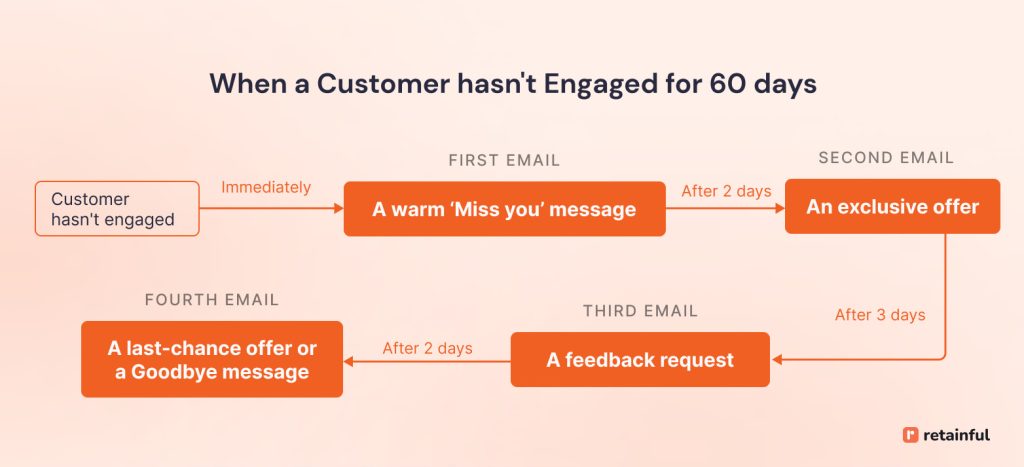
Every nurture database contains a significant segment of prospects who were active at some point — they submitted a form, downloaded content, attended a webinar — but have gone dark. They are not unsubscribed; they have simply stopped engaging. For most B2B marketing teams, this "cold" segment represents 30-50% of the total nurture database, and it represents a significant pipeline opportunity if even a fraction of those prospects can be re-engaged at the right moment with the right message.
Re-engagement programs for cold prospects require a different approach than primary nurture sequences. The instinct is to send more content — if they weren't engaging with the educational content, maybe they'll engage with a case study. But the more productive frame is to address the disengagement directly: acknowledge that it has been a while, ask if the prospect's situation or priorities have changed, and make a clear offer of value that is easy to accept (a personalized audit, a no-obligation strategy call, access to a research report) with minimal friction. A re-engagement email that says "We noticed you haven't been in touch for a while — has your priority around [problem] shifted? If so, we'd love to help when the timing is right. In the meantime, here's our new research report on [topic] that might be useful" is more likely to generate a genuine re-engagement response than email 47 in a content series that the prospect has been silently ignoring since email 12.
The re-engagement program should have a defined endpoint: if a prospect does not engage with any re-engagement attempt after a defined number of touches over a defined period (typically 3-4 emails over 6-8 weeks), they should be moved to a suppressed or archived segment rather than continuing to receive nurture emails. Continuing to send to unresponsive prospects degrades deliverability rates for the domain, which reduces inbox placement rates for all nurture emails including those going to actively engaged prospects. Maintaining a clean, engaged nurture database — by regularly sunsetting cold prospects who do not respond to re-engagement — is one of the highest-leverage deliverability optimizations available to B2B marketing teams operating at volume.
Lead Scoring as the Nurture Feedback Loop
Lead scoring — assigning numeric values to prospect attributes and behaviors that, when combined, indicate sales readiness — is the mechanism that converts nurture program engagement data into an actionable signal for the sales team. A prospect who has accumulated enough engagement across enough high-intent behavioral signals (pricing page visit, case study download, webinar attendance, ROI calculator completion) reaches the lead score threshold that defines MQL status and triggers sales outreach, converting from a nurture program participant to a sales-engaged lead.
The design of the lead scoring model directly affects the quality of MQLs that nurture programs produce. Lead scoring models that are overweighted toward engagement quantity (opening emails, visiting pages) rather than engagement quality (high-intent page visits, decision-stage content downloads) generate MQLs from engaged-but-not-ready prospects who accumulate score through light touch activity rather than through meaningful intent signals. These "false positive" MQLs degrade sales acceptance rates and create friction in the marketing-sales relationship, as reps receive a stream of prospects who are not ready for sales conversations despite having reached the MQL threshold.
Calibrating the lead scoring model to produce MQLs that the sales team consistently accepts as genuinely sales-ready requires a feedback loop between sales and marketing. Sales reps reviewing MQLs and marking them as accepted or rejected — with rejection reasons — provide the signal that marketing operations needs to identify which engagement patterns are producing MQLs that convert to pipeline versus which patterns are producing MQLs that are rejected as not ready. A data analysis of accepted versus rejected MQLs by engagement pattern, conducted quarterly, enables the lead scoring model to be refined toward the behavioral patterns that actually predict sales readiness rather than the behaviors that simply indicate digital activity.
Nurture Program Metrics: What to Measure and What to Ignore
The most commonly reported nurture program metrics — email open rates and click-through rates — are the least useful for evaluating nurture program effectiveness. Open rates and click-through rates measure email engagement, not funnel advancement. A nurture program with a 35% open rate that produces no MQL progression is performing worse than a nurture program with a 20% open rate that consistently advances 15% of engaged prospects to MQL status — but the first program would appear to be outperforming the second based on the metrics most commonly reported for email programs.

The metrics that reflect nurture program effectiveness against its actual objective — advancing prospects toward sales readiness — are: MQL conversion rate from nurture (the percentage of prospects in the nurture database who advance to MQL status within a defined period), pipeline contribution from nurtured leads (the dollar value of opportunities sourced from prospects who were in the nurture program before converting to pipeline), nurture-to-close rate compared to non-nurtured leads (do nurtured leads close at a higher rate than leads who were not in a structured nurture program), and deal size comparison (are nurtured leads producing larger deals than non-nurtured leads). These metrics directly measure whether the nurture program is achieving its pipeline objectives, and they are the metrics that should anchor nurture program review discussions and investment decisions.
Frequently Asked Questions
How long should a B2B lead nurture sequence be?
The length of a B2B lead nurture sequence should match the typical length of the buying process for the segment being nurtured. For mid-market B2B deals with 60-90 day sales cycles, a nurture sequence of 8-12 touches over 6-10 weeks — combining email, retargeting, and content offers — covers the buying process adequately. For enterprise deals with 6-12 month sales cycles, nurture sequences may extend over several months, with a shift from active sequence content to periodic relationship-maintenance touches after the initial education phase. The sequence should not end before the prospect either converts to MQL, disengages (triggering re-engagement or suppression), or explicitly opts out — it should be designed to be "always on" for ICP-matched prospects who are showing no signal of being ready to disengage.
What is the ideal email cadence for B2B nurture programs?
For active nurture sequences, a cadence of one email per week is appropriate for the first 4-6 weeks. After the initial active phase, reducing cadence to bi-weekly or monthly for prospects who are engaged but not converting to MQL prevents list fatigue while maintaining brand presence. For re-engagement sequences targeting cold prospects, a compressed cadence — three emails over two weeks — followed by suppression for non-responders is more effective than continuing to send monthly emails to a prospect who has shown no engagement for 90+ days. Cadence should also be adjusted for prospect-reported preference: offering nurture recipients a "send less often" option in the email footer reduces unsubscribes from prospects who are engaged but overwhelmed by frequency.
How should nurture content differ for different buyer personas?
Nurture content should address the specific concerns, objectives, and evaluation criteria of each persona targeted. A marketing operations director evaluating a MAP platform cares about integration capabilities, workflow automation depth, and reporting flexibility — the nurture sequence for this persona should lead with content that addresses these concerns specifically. A CFO evaluating the same platform cares about total cost of ownership, payback period, and vendor stability. The nurture sequence for the CFO persona should lead with ROI models, customer ROI case studies, and financial justification frameworks. Persona-specific nurture requires persona segmentation in the MAP — routing prospects into persona-specific tracks based on their job title or seniority level at the form submission point — and a content library that includes assets addressing each persona's specific concerns at each funnel stage.
What triggers should automatically move a lead from nurture to sales outreach?
High-intent behavioral triggers that should automatically notify sales or trigger SDR outreach include: pricing page visits (a prospect reviewing pricing is demonstrating active budget evaluation), demo or trial request page visits without form completion, repeat visits to the same decision-stage content within a short window (returning to a case study or implementation guide multiple times), engagement with the nurture email inviting a sales conversation (clicking through to a meeting booking link), and lead score reaching the MQL threshold. For account-based programs, trigger criteria should also include account-level engagement — multiple contacts at the same account engaging with content simultaneously is a strong signal of committee-level evaluation that warrants immediate account team engagement regardless of individual contact lead scores.
How do we prevent nurture emails from going to spam?
Deliverability best practices for B2B nurture programs include: sending from a consistent, warmed sending domain (not a new domain or a domain with poor reputation), maintaining list hygiene by promptly removing hard bounces and suppressing long-term non-engagers, using a double opt-in or confirmed opt-in process for new subscribers to ensure the list contains genuinely interested recipients, avoiding spam trigger words and deceptive subject lines that cause spam filter flags, and maintaining a healthy sending ratio of opted-in engaged recipients versus cold contacts. Most importantly, the single most effective deliverability protection for nurture programs is sending content that the recipients actually want to receive — high-quality, relevant, appropriately targeted content generates higher engagement rates, which Google and Microsoft's filtering systems use as positive signals that the domain is a trusted sender.
Should we use one nurture track or multiple tracks for different segments?
Multiple nurture tracks — with content and cadence tailored to the specific characteristics of each segment — consistently outperform single-track nurture programs for B2B organizations with meaningful differences across their ICP segments. The minimum useful segmentation for most B2B nurture programs is by funnel stage (separate tracks for awareness-stage prospects versus consideration-stage prospects who have demonstrated stronger engagement) and by persona or job function (separate content tracks for the technical buyer versus the business buyer versus the economic buyer). Building and maintaining multiple tracks requires more content production investment and more MAP configuration sophistication, but the improvement in MQL conversion rate from content relevance consistently justifies the investment for organizations with sufficient lead volume to populate multiple tracks meaningfully.
Key Takeaways
- B2B lead nurturing should focus on moving prospects toward decisions.
- Scheduled content delivery does not effectively nurture leads.
- Content must match the prospect's stage in the buying journey.
- Nurtured leads result in larger purchases and lower costs per lead.
Frequently Asked Questions
- What is the main flaw in many B2B nurture programs?
- Many B2B nurture programs focus on scheduled content delivery rather than advancing prospects toward decisions.
- How does content mapping relate to lead nurturing?
- Content mapping aligns content with the prospect's buying stage, ensuring relevance and effectiveness in nurturing.
- What types of content are suitable for awareness-stage prospects?
- Awareness-stage content includes educational blog posts, trend reports, and industry research to help prospects understand their problems.
- What benefits do companies gain from effective lead nurturing?
- Companies that excel at lead nurturing generate more sales-ready leads and achieve larger deal sizes at lower costs.
See Where Your Business Stands in Search
Get a free site audit. We identify what is holding you back and what to fix first.
Related Resources
Explore more insights to enhance your digital marketing strategy