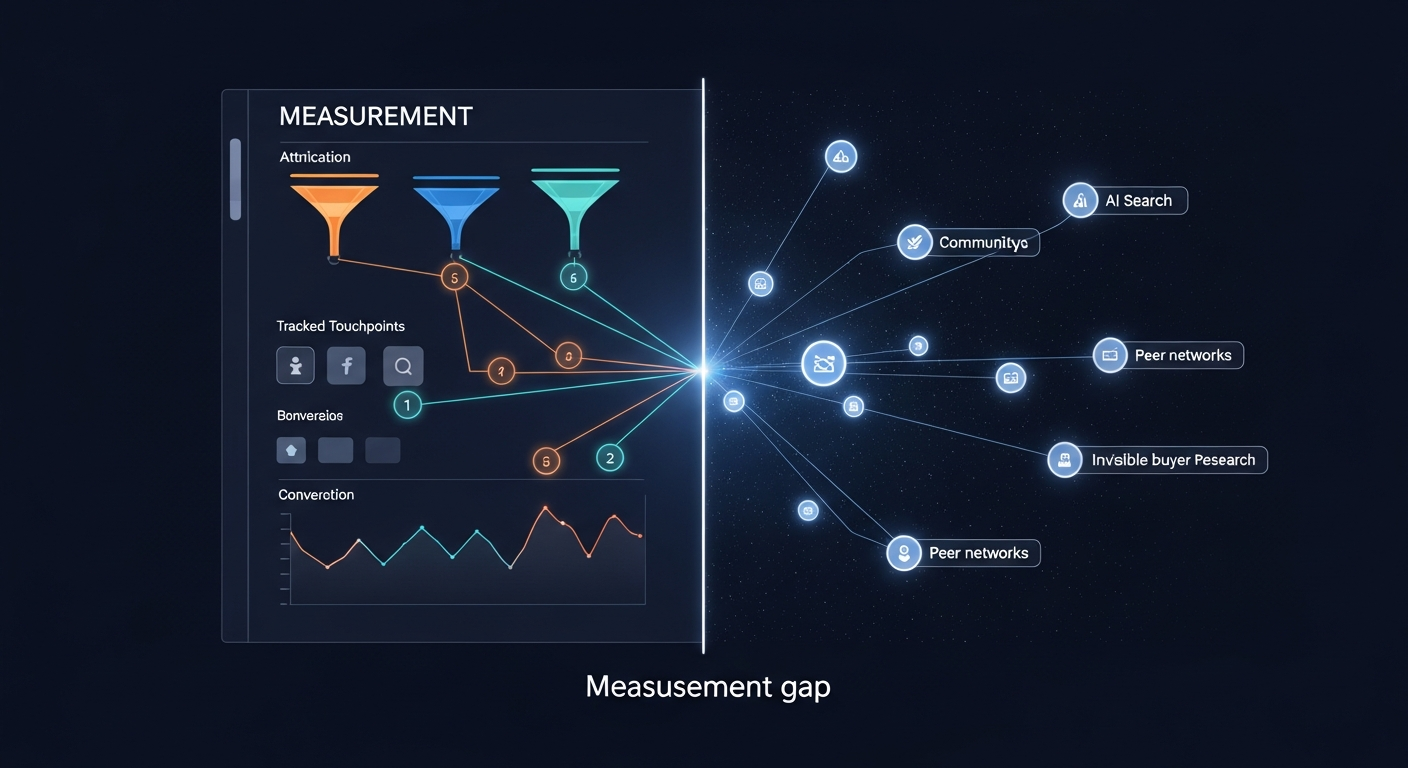
For more than a decade, marketing attribution has been the dominant framework for measuring performance. Organizations built entire analytics stacks around one fundamental question:
Which marketing activities deserve credit for revenue?
Attribution remains valuable. However, modern buying behavior has changed dramatically. Today's buyers research anonymously, consult buying committees, participate in private communities, ask AI systems for recommendations, and share information internally before engaging with any vendor. Many of the most influential moments occur before attribution systems record any interaction.
This creates a growing gap between what influenced the buyer and what attribution reports can measure. That gap is driving the emergence of a new measurement discipline: Visibility Intelligence.
What Is Attribution?
Attribution is the process of assigning credit to marketing activities that contribute to leads, opportunities, pipeline, and revenue. It is fundamentally a credit assignment system that seeks to identify which interactions contributed to a measurable outcome.
What attribution measures
- Organic search attribution
- Paid search attribution
- Email campaign attribution
- Social media attribution
- Multi-touch attribution
- Revenue attribution
Questions attribution answers
- "Which channels generate leads?"
- "Which campaigns influence opportunities?"
- "Which touchpoints contribute to conversions?"
- "How should marketing budgets be allocated?"
- "What is the ROI of each channel?"
Attribution remains one of the most useful tools available for understanding measurable marketing performance. The challenge is that attribution only measures interactions it can observe - and an increasing portion of buyer influence occurs outside any tracking system. For a deep dive into attribution models, see Marketing Attribution Models Explained.
What Is Visibility?
Visibility refers to the degree to which buyers can discover, encounter, evaluate, and remember a company throughout the buying process. Unlike attribution, visibility focuses on discoverability rather than credit.
What visibility helps organizations understand
Where buyers discover them
AI systems, search, communities, events
How frequently they appear
Recommendation frequency, citation share
Whether competitors are more visible
Share of voice, competitive positioning
Which topics drive awareness
Topic authority, prompt coverage
Critical insight: Visibility exists before attribution. Visibility creates the conditions that make attribution possible. A buyer cannot click a result they never see. They cannot evaluate a company they never encounter. They cannot recommend a brand they have never heard of.
Visibility Exists Before Attribution
This is one of the most important concepts in modern marketing measurement. Consider a common scenario:
What actually happened
Prospect asks ChatGPT: "What are the best marketing measurement platforms for B2B companies?"
invisibleAI recommends several vendors - including yours
invisibleOne vendor is discussed and evaluated internally
invisiblePeer validation occurs in a team meeting
invisibleProspect visits website directly, one week later
attributedAttribution records
Direct Traffic
Visibility explains
AI recommendation created the discovery
Attribution vs Visibility
Attribution and visibility answer different questions. Understanding that difference is essential for building a measurement framework that reflects how buyers actually behave.
Attribution helps explain outcomes. Visibility helps explain opportunities. Organizations need both perspectives.
Why Attribution Leaves Gaps
Attribution systems only measure observable interactions. Unfortunately, many important buying influences are not observable. Four major categories create attribution blind spots in almost every organization.
Dark Social
Dark social refers to private sharing and communication environments - Slack, Microsoft Teams, WhatsApp, email forwarding, direct messages. A recommendation shared privately may influence a purchase decision without generating measurable attribution data. The attribution report shows direct traffic. The influence happened in a message thread.
See: Dark Social Attribution guide →Buying Committees
B2B purchases increasingly involve executives, procurement teams, technical evaluators, finance teams, and department leaders. Each stakeholder experiences a different journey. Traditional attribution often struggles to connect these journeys into a unified account-level narrative.
Anonymous Research
Modern buyers conduct extensive research before identifying themselves - reading content, watching videos, exploring competitors, asking AI systems questions. Most of this activity occurs before attribution systems can associate behavior with a lead or account.
Offline Influence
Industry conferences, executive introductions, analyst recommendations, and customer referrals frequently influence purchases while generating little attribution data. These can be among the most influential interactions in the entire buying process.
AI Search Is Expanding the Visibility Gap
AI search is accelerating attribution challenges more than any other single development in modern buyer behavior. Attribution systems were designed around a traditional discovery process. AI search changes that process fundamentally.
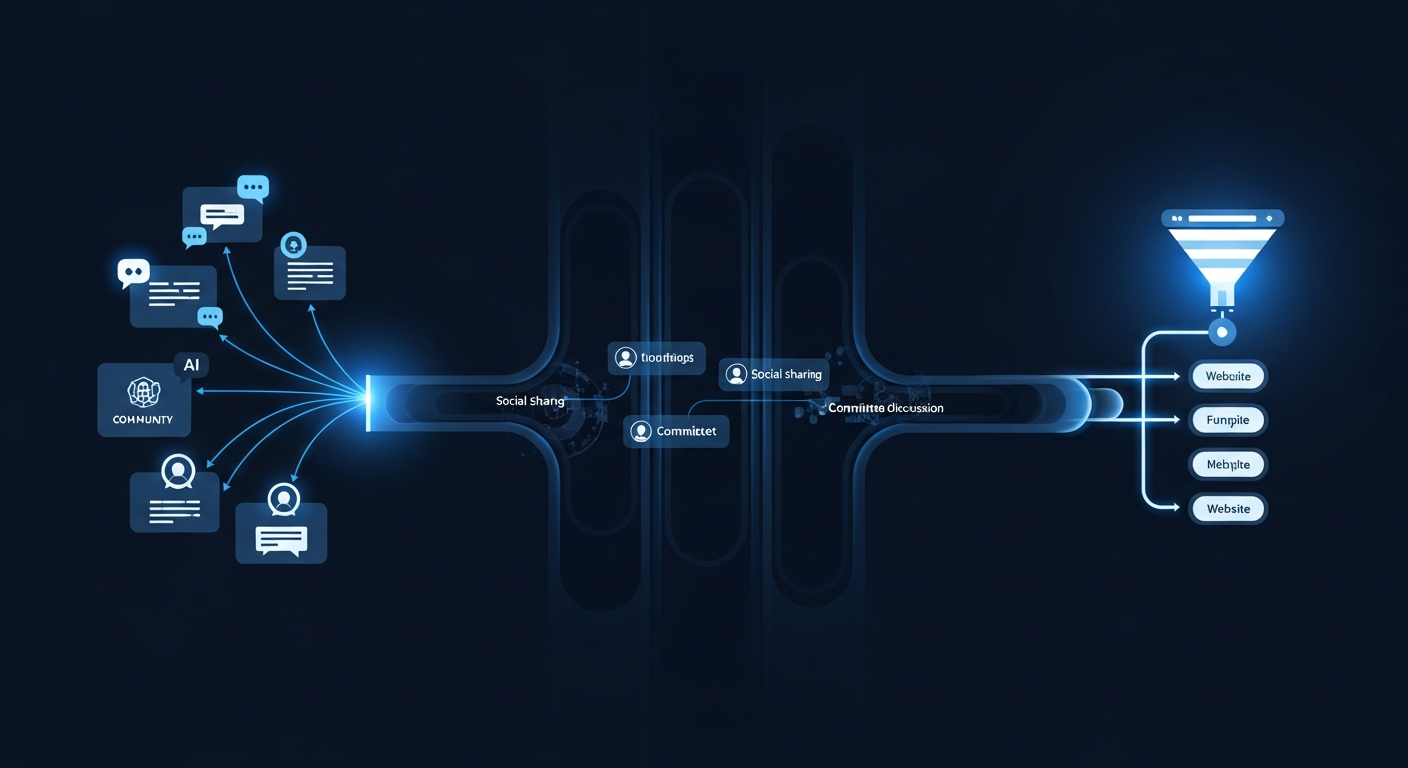
Modern buyer discovery flows through AI systems, private communities, and dark social channels before any attribution system can observe it.
Traditional Journey - Attribution Works
AI-Driven Journey - Attribution Gap
Notice where attribution begins - at the website visit. The recommendation and evaluation occurred earlier. This creates the visibility gap. For a full analysis, see Marketing Attribution in the Age of AI Search.
What Is the Visibility Gap?
The Visibility Gap
The difference between actual buyer influence and measured attribution. It represents the portion of the buying journey that contributes to decisions but remains difficult or impossible to measure through traditional attribution systems.
As buying behavior evolves toward AI-assisted research, private communities, and buying committee dynamics, the Visibility Gap continues to grow. Organizations focused exclusively on attribution are increasingly making decisions based on a shrinking fraction of the actual buyer journey.
Visibility Across the Modern Buying Journey
Visibility influences every stage of the customer journey - but it influences earlier stages more than attribution does. Attribution typically becomes strongest during later stages.
Discovery
Can buyers find the company?
Visibility role
Primary - AI recommendations, search visibility, community presence
Attribution role
Weak - most discovery is pre-click
Consideration
Does the company appear during evaluation?
Visibility role
Strong - AI comparisons, competitive visibility, content authority
Attribution role
Moderate - some trackable interactions
Validation
Do peers and communities reinforce trust?
Visibility role
Primary - dark social, peer networks, analyst coverage
Attribution role
Weak - validation rarely generates trackable clicks
Selection
Is the company in the final consideration set?
Visibility role
Moderate - brand recognition and familiarity
Attribution role
Strong - demo requests, direct visits, form fills
Why Marketing Leaders and CEOs Need Visibility
Why CMOs Need Visibility
Attribution alone cannot explain:
- Declining awareness trends
- Competitive positioning changes
- AI discoverability gaps
- Market presence vs competitors
- Leading indicators of future pipeline
Visibility provides leading indicators of future growth - signals that emerge before revenue metrics change. See: CMO Attribution Guide
Why CEOs Need Visibility
Questions visibility helps executives answer:
- "How visible are we compared to competitors?"
- "Are buyers discovering us before competitors?"
- "How are AI systems presenting our brand?"
- "Are we becoming more or less visible over time?"
- "What is our share of buyer attention?"
These insights help leadership make better strategic decisions with confidence.
Why Visibility Creates Better Business Decisions
The biggest misconception in marketing measurement is that its purpose is reporting. It is not. The purpose of measurement is decision-making. Attribution tells organizations what happened. Visibility tells them what is happening - and what may happen next.
Executives do not allocate budgets based solely on historical performance. They allocate budgets based on expected future outcomes. Attribution is inherently backward-looking. Visibility provides forward-looking signals. That distinction matters enormously for budget decisions.
Better Budget Allocation
Attribution may tell you that branded search is driving conversions. Visibility reveals why - increased AI recommendations, improved category awareness, stronger community presence. Attribution explains the conversion. Visibility explains the cause. That difference is what makes budget decisions reliable versus reactive.
Better Forecasting
Increasing AI visibility often indicates growing buyer awareness before pipeline growth appears. Improving competitive visibility can signal market expansion. Declining visibility may indicate future demand challenges before they appear in revenue reports. These signals emerge earlier than revenue metrics - giving teams time to respond.
Better Competitive Strategy
Attribution rarely explains competitive position. Visibility does. Are competitors more visible? Which topics do competitors own in AI systems? Which conversations exclude your brand? Understanding visibility identifies strategic opportunities that attribution reports would never surface.
Better Board Reporting
Boards increasingly care about discoverability. The question is no longer simply "how much revenue did marketing influence?" It becomes "how are buyers discovering the company?" Visibility provides context that attribution cannot. See: Attribution and Board Reporting.
The New Revenue Measurement Framework
Modern revenue teams are moving from single-source attribution to layered measurement frameworks. Rather than treating any one metric as the sole source of truth, they combine multiple perspectives to build a complete picture.
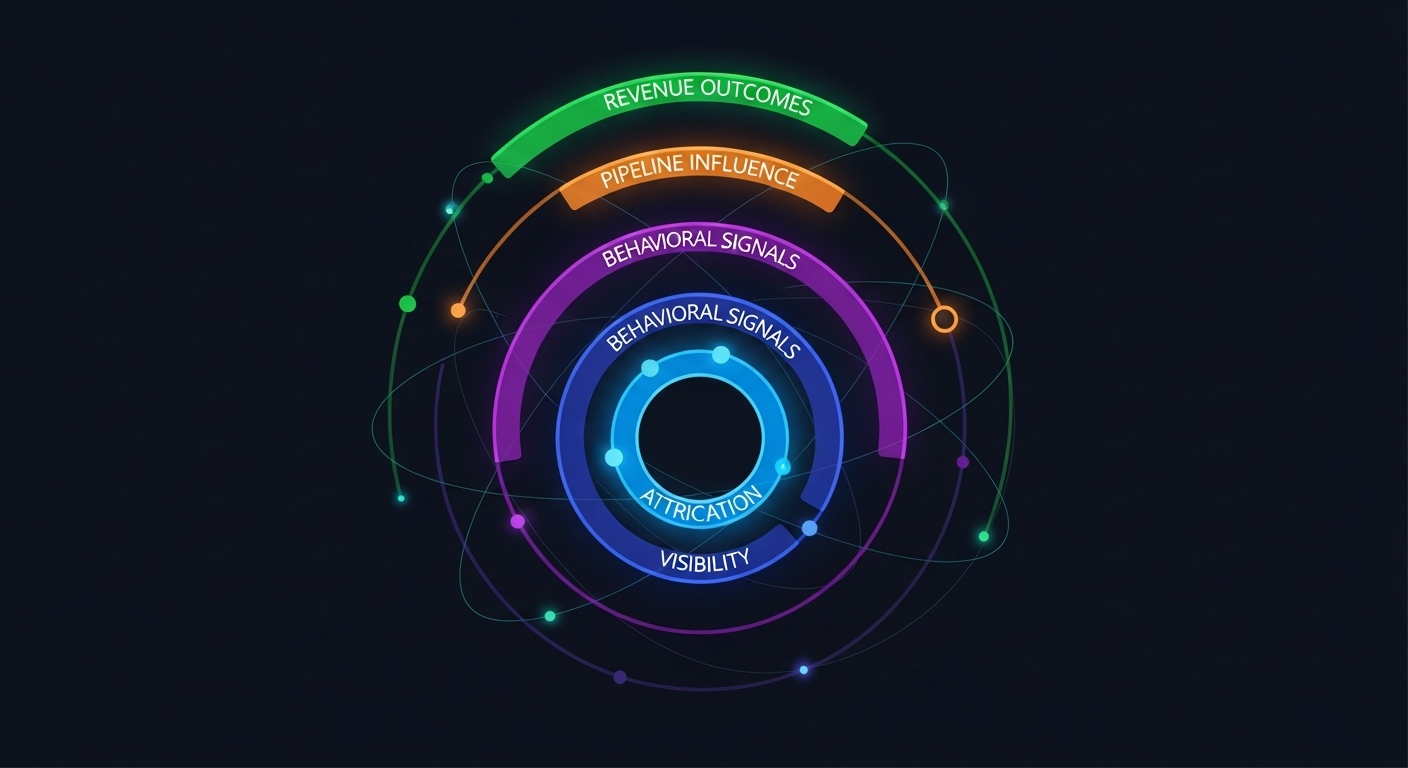
The five-layer framework builds from attribution outward - each layer measuring a different dimension of buyer behavior and growth influence.
What Is Visibility Intelligence?
Visibility Intelligence is the discipline of measuring and understanding discoverability across modern buying environments. It creates a critical bridge between buyer discovery and attribution - measuring what happens before any trackable interaction occurs.
Search Visibility
Organic rankings, share of search, topic ownership in traditional search environments
AI Visibility
How often the brand appears in ChatGPT, Claude, Gemini, Perplexity, and AI Overviews
Brand Visibility
Market recognition, direct search volume, brand mentions and thought leadership presence
Competitive Visibility
How frequently competitors appear during buyer research compared to your brand
Topic Visibility
Which subjects and questions generate brand discovery and recommendation
Recommendation Visibility
How frequently buyers encounter recommendations involving the company across channels
The Five Layers of Visibility Intelligence
Visibility Intelligence is not a single metric. It is a framework consisting of five interconnected layers that together explain how buyers discover and evaluate companies before any measurable attribution interaction occurs.
Layer 1: Search Visibility
Measures
How discoverable the brand is within traditional search environments.
Examples include
Organic rankings, share of search, topic ownership, search presence
Why it matters
Search remains important because search continues to influence discovery - but it is no longer the only discovery channel.
Layer 2: AI Visibility
Measures
How frequently the company appears within AI-generated responses and recommendations.
Examples include
ChatGPT mentions, Gemini recommendations, Claude citations, Perplexity presence, AI Overview visibility
Why it matters
Rapidly becoming one of the most important visibility categories as buyers shift to AI-assisted research.
Layer 3: Brand Visibility
Measures
Overall market awareness and recognition.
Examples include
Brand mentions, direct search volume, market awareness, thought leadership presence
Why it matters
Strong brand visibility often influences buying behavior long before any attribution interaction appears.
Layer 4: Competitive Visibility
Measures
How frequently competitors appear during buyer research relative to the brand.
Examples include
Competitive AI recommendations, topic ownership comparison, evaluation discussion presence
Why it matters
Understanding competitive visibility identifies market opportunities that attribution reports would never surface.
Layer 5: Revenue Visibility
Measures
Connects visibility to business outcomes.
Examples include
Visibility-to-pipeline correlation, discovery signals preceding revenue growth, influence patterns
Why it matters
Revenue visibility bridges the gap between marketing measurement and business performance.
Visibility Is Bigger Than SEO
Many organizations mistakenly assume visibility is simply another term for SEO. Visibility includes SEO - but extends far beyond it. SEO focuses primarily on rankings and traffic. Visibility focuses on discoverability across every environment where buyers form opinions and make decisions.
Traditional SEO environment
Modern visibility environment
What Is Revenue Visibility?
Revenue visibility is the ability to connect discovery and influence signals to business outcomes. It expands the traditional marketing attribution framework to include the full chain from awareness to revenue.
Traditional marketing framework
Revenue visibility framework
Revenue visibility is particularly valuable because it connects leading indicators with lagging indicators. Visibility often appears before revenue. Understanding that relationship creates stronger forecasting capabilities - and earlier warnings when demand is at risk.
Visibility Intelligence Maturity Model
Organizations typically progress through several stages of measurement maturity as they evolve from basic attribution toward full Visibility Intelligence.
Attribution Only
Focus
Lead sources and conversion tracking
Key questions
- "Which channels generated leads?"
- "Which campaigns converted?"
Note
Misses everything before the first tracked click
Multi-Touch Attribution
Focus
Customer journey analysis
Key questions
- "Which touchpoints contributed?"
- "How do channels interact?"
Note
Better coverage but still dependent on observable data
Attribution + Visibility
Focus
Organizations begin recognizing attribution limitations
Key questions
- "Where are buyers discovering us?"
- "How visible are competitors?"
Note
Measurement expands - but not yet unified
Visibility Intelligence
Focus
Active measurement of AI visibility, search visibility, brand, and competitive data
Key questions
- "Which AI systems recommend us?"
- "How does our visibility compare?"
Note
Comprehensive visibility - but discovery and revenue still separate
Decision Intelligence
Focus
Attribution + visibility + behavioral signals + pipeline + revenue outcomes unified
Key questions
- "What actually drives our growth?"
- "Where should we invest next?"
Note
This is the future state
Visibility in Action: Real-World Examples
AI Search Discovery
Attribution report shows
What actually happened
Attribution captures the search. Visibility explains why the search happened in the first place.
Enterprise Software Evaluation
Attribution report shows
What actually happened
Attribution records the demo request. Visibility explains the five invisible stages that led to it.
Competitive Visibility Loss - Early Warning
Attribution report shows
What actually happened
Attribution shows nothing wrong. Visibility provides the early warning signal that would otherwise appear months later as pipeline decline.
Attribution Is Not Dead
An important clarification
Some organizations interpret attribution limitations as evidence that attribution no longer matters. This is not the right conclusion. Attribution remains valuable. The challenge is not attribution itself - the challenge is expecting attribution to answer every measurement question.
Attribution still answers
- Channel performance analysis
- Campaign effectiveness evaluation
- Conversion behavior patterns
- Revenue contribution by channel
- Budget allocation optimization
Attribution cannot answer
- Where buyers discover before clicking
- AI search recommendation presence
- Competitive visibility gaps
- Dark social influence
- Brand familiarity at purchase time
Visibility complements attribution. It does not replace it. Together they create a more complete understanding of modern buyer behavior than either can provide alone.
How RankWorks Measures Visibility Intelligence
RankWorks AI was built for organizations that need both attribution and visibility. The platform unifies search visibility, AI visibility, brand presence, competitive intelligence, and revenue signals into a single decision framework - so you understand not only where buyers convert, but where they discover, evaluate, and decide.
Frequently Asked Questions About Attribution vs Visibility
Common questions from marketing leaders about the difference between attribution and visibility, and how to use both frameworks together.
Still have questions?
Our SEO experts are here to help. Get personalized answers and a free consultation.
Key Takeaways
- 1
Attribution explains credit. It measures which observable interactions contributed to conversions, pipeline, and revenue. It remains valuable for channel evaluation, campaign measurement, and revenue reporting.
- 2
Visibility explains discovery. It measures where buyers encounter, evaluate, and consider brands before any measurable interaction occurs - including AI search, search rankings, brand recognition, and competitive presence.
- 3
Influence happens before attribution. Many buying decisions are shaped by AI recommendations, dark social sharing, peer conversations, and community influence that occur before attribution systems record any interaction.
- 4
AI search is expanding measurement gaps. When buyers research vendors through AI systems before visiting websites, the resulting direct traffic records mask the actual discovery mechanism - creating a growing gap between what happened and what attribution reports.
- 5
Modern organizations need both frameworks. Attribution and visibility serve different purposes and answer different questions. Neither alone is sufficient for understanding how modern buyers discover, evaluate, and choose vendors.
- 6
Visibility provides leading indicators of growth. Visibility signals - AI recommendation frequency, competitive share of voice, brand awareness trends - often emerge before revenue metrics change, giving organizations time to respond.
- 7
Visibility Intelligence is the next evolution. As buying journeys become more complex, the strongest revenue teams combine attribution, visibility, behavioral signals, pipeline influence, and revenue outcomes into a complete decision intelligence framework. The companies that understand visibility earliest will understand demand before their competitors do.
Continue Reading
Marketing Attribution in Modern B2B
The full pillar guide covering what attribution is, where it falls short, and the complete measurement framework.
Attribution in the Age of AI Search
How AI search creates attribution blind spots and what organizations are doing to adapt their measurement approach.
Dark Social Attribution
Why private buyer conversations are invisible to every attribution model and how to account for them.
How CMOs Should Use Attribution Data
A practical leadership framework for using attribution within a broader measurement strategy.