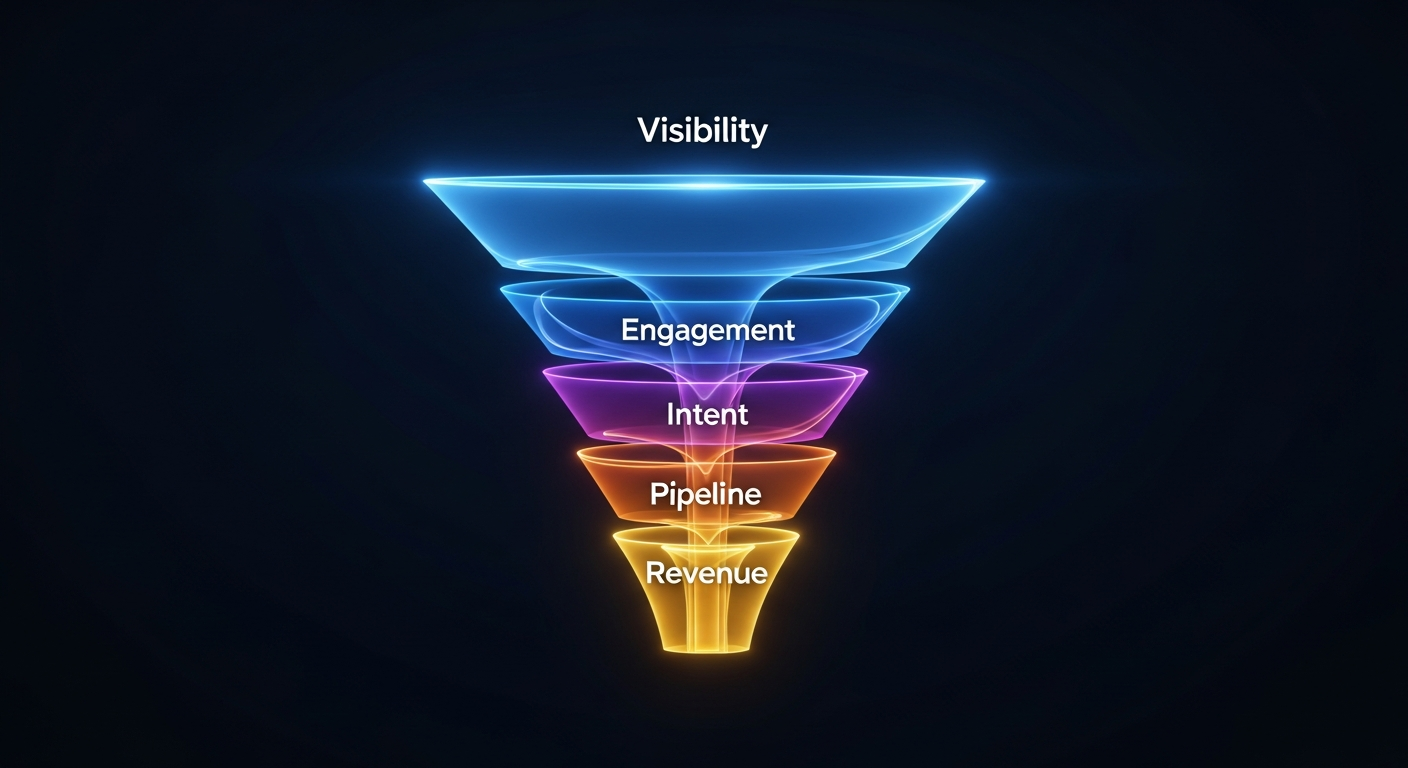
For decades, organizations have measured revenue the same way. Revenue was reported. Pipeline was tracked. Attribution attempted to explain performance. These systems remain important - but they share a fundamental limitation.
They primarily explain what has already happened.
They are retrospective. They are historical. They are lagging indicators.
Modern executives increasingly need something different. They need visibility into what is happening before revenue appears. They need visibility into discovery before leads exist. They need visibility into buyer behavior before opportunities are created. They need visibility into market influence before attribution becomes available.
Revenue Visibility is the ability to understand how discoverability, buyer behavior, engagement, pipeline progression, market influence, and competitive positioning contribute to future revenue outcomes. Organizations that understand revenue before it happens can influence performance - not just report it.
What Is Revenue Visibility?
Revenue Visibility is the ability to understand how visibility, discovery, engagement, buyer intent, pipeline progression, and market influence contribute to future revenue outcomes. At its core, Revenue Visibility answers a question that traditional reporting often cannot:
Why is revenue happening?
Most organizations can tell you
Far fewer can explain
Revenue Visibility helps answer the second set of questions. It expands measurement beyond outcomes and into causes. Revenue is an outcome. Visibility helps explain the conditions that produce that outcome. This distinction is critical for organizations that want to grow with intention rather than surprise.
Why Revenue Visibility Matters
Revenue is one of the most important metrics in business. However, revenue alone is a poor management tool. Revenue tells organizations what happened. It rarely explains why it happened.
When a company reports a 25% revenue increase, executives still need to understand:
"What created the increase?"
Revenue Visibility shows visibility signals that preceded the growth
"Which markets contributed?"
Revenue Visibility maps discovery sources to opportunity creation by market
"Which buyer behaviors changed?"
Revenue Visibility tracks engagement and intent patterns over time
"Which factors may affect future performance?"
Revenue Visibility surfaces leading indicators of future pipeline risk or opportunity
Better decisions
Understanding why growth happened leads to repeatable strategies rather than guessing
Better forecasting
Leading indicators improve forecast accuracy by revealing future pipeline signals
Better resource allocation
Investment goes to activities proven to create discovery, not just credited with conversions
Revenue Visibility vs Revenue Reporting
Reporting and visibility are related concepts - but they are not the same thing. Most organizations already have revenue reporting. Far fewer have revenue visibility. This gap creates a significant opportunity for organizations willing to measure earlier in the growth chain.
Organizations that understand growth drivers earlier can make better decisions earlier. Revenue reporting will always be necessary. Revenue Visibility makes it strategically actionable.
The Problem With Traditional Revenue Measurement
Most revenue systems were designed for a world that no longer exists. Historically buyer journeys were relatively straightforward. Today the reality is far more complex.
Historical buyer journey (measurable)
Modern buyer journey (largely invisible)
Many of the most influential moments happen before traditional measurement systems can observe them. Organizations often see revenue outcomes without understanding what actually created them. This is the visibility problem Revenue Visibility is designed to solve.
Why Revenue Is a Lagging Indicator
One of the most important concepts executives must understand is that revenue is a lagging indicator. Revenue is evidence that something happened - not evidence of why it happened. By the time revenue appears, every upstream stage has already completed.
By the time revenue appears, all of this has already occurred
Revenue tells you what happened
- How much we sold
- Which markets performed
- Which customers purchased
Important. But incomplete.
Revenue does not explain why it happened
- Why buyers discovered us
- Why buyers entered the pipeline
- Why opportunities accelerated
- Why certain messages resonated
These questions require Revenue Visibility.
Visibility Appears Before Revenue
This is one of the most important concepts in the Revenue Visibility framework. Revenue does not appear first. Visibility does. Organizations that understand this sequence gain a significant timing advantage over those that only measure at the bottom of the chain.
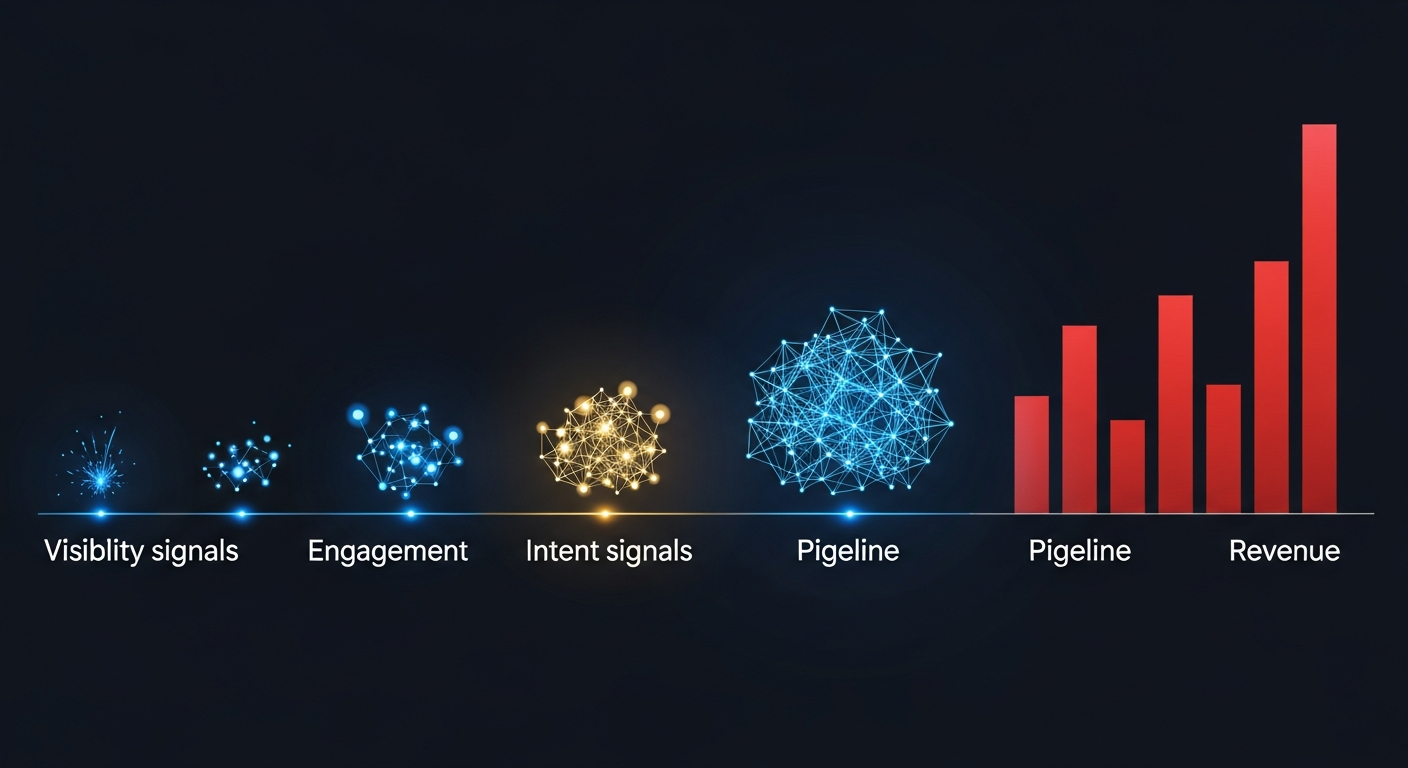
Visibility signals appear months before pipeline and revenue change - giving organizations that measure them earlier warning than any lagging indicator can provide.
The modern growth sequence
months earlier
measured last
Historically organizations focused measurement on the lower half of this sequence: pipeline and revenue. Revenue Visibility expands measurement upward to capture the earliest signals - giving organizations months of additional lead time to respond to growth opportunities and threats.
The Revenue Visibility Gap
Every organization faces a Revenue Visibility Gap. It is the difference between what drives revenue and what traditional reporting can explain.

The Revenue Visibility Gap represents everything that influences buyer decisions but remains invisible to traditional reporting systems.
The Revenue Visibility Gap
The difference between what drives revenue and what traditional reporting can explain. This gap continues to grow because buyer behavior is becoming increasingly difficult to observe.
Factors that influence revenue decisions but often remain invisible to traditional systems:
The Evolution of Revenue Measurement
Revenue measurement has evolved dramatically over the past two decades. Understanding this evolution helps explain why Revenue Visibility is emerging now as an executive priority.
Era 1: Lead Generation
Focus
Lead volume and website traffic
Limitation
Ignored revenue outcomes entirely
Era 2: Attribution
Focus
Connecting marketing activity to revenue outcomes
Limitation
Depended on observable interactions only
Era 3: Multi-Touch Attribution
Focus
Credit distribution across multiple buyer touchpoints
Limitation
Still missed anonymous research, dark social, AI-assisted discovery
Era 4: Visibility Intelligence
Focus
Measuring discoverability across search, AI, communities
Limitation
A major shift - but visibility still disconnected from revenue
Era 5: Revenue Visibility
Focus
Connecting discovery, influence, engagement, and pipeline creation to future revenue
Why it matters now
The current frontier - where visibility becomes strategically valuable
The Five Layers of Revenue Visibility
Revenue Visibility is best understood as a layered framework. Revenue does not appear suddenly - it is the result of a sequence of events that occur over time. Each layer builds on the previous one. Organizations that understand only the final layer are operating with incomplete information.
Every organization measures Layer 5. Few organizations measure all five. The strongest growth organizations understand each layer and how they interact.
1Layer 1: Visibility
Before buyers engage, they must discover. Before opportunities are created, companies must become visible. Visibility answers a fundamental question: Can buyers find us? This includes visibility across search engines, AI systems, industry communities, review sites, social platforms, analyst reports, and industry publications.
Why visibility is a leading indicator
Organizations often underestimate how much future growth depends on discoverability today. Companies not visible are excluded from consideration. Companies not considered rarely create pipeline. See: Brand Visibility Intelligence - full framework.
2Layer 2: Engagement
Visibility alone is not enough. Buyers must engage. Engagement measures how buyers interact after discovery occurs - and answers a critical question: Are buyers responding to discovery?
Engagement signals
Why engagement matters
Not all visibility produces action. A company may experience increasing AI visibility but still see flat pipeline if engagement is weak. Understanding this distinction helps organizations:
- Identify gaps between discovery and interest
- Improve content and messaging strategy
- Invest in engagement conversion rather than just more visibility
Engagement creates momentum. The more buyers engage, the more likely they are to continue researching, join evaluation processes, engage stakeholders, and enter active buying cycles.
3Layer 3: Intent
Intent is where interest begins to transform into opportunity. Visibility measures discovery. Engagement measures interaction. Intent measures seriousness. It answers: Which buyers are actively moving toward a decision?
Classic intent signals
Modern intent signals (often missed)
A prospect demonstrating strong buying intent is significantly more valuable than one demonstrating casual interest. Organizations that understand modern intent signals gain earlier insight into future opportunities and can prioritize resources more effectively.
4Layer 4: Pipeline
Pipeline is where visibility begins to become measurable business value. It answers: Are opportunities being created? Pipeline does not emerge independently - it is the outcome of effective visibility, engagement, and intent.
Pipeline Visibility helps answer
Pipeline occupies a unique position in Revenue Visibility: it is simultaneously a leading indicator (predicting future revenue) and a lagging indicator (evidence that earlier layers are functioning effectively). This dual role makes pipeline visibility one of the most important transition metrics available.
5Layer 5: Revenue
Revenue remains the ultimate business outcome. The difference is that Revenue Visibility views revenue as the result of a system rather than an isolated metric - creating a more complete understanding of growth.
Revenue answers
"What happened?"
Revenue Visibility answers
"Why did it happen?"
Revenue Visibility Metrics That Matter
Traditional dashboards contain dozens of metrics. Few explain growth. Revenue Visibility focuses on metrics that help explain how discovery becomes revenue.
Visibility Share
The percentage of discoverability owned relative to competitors in a market or topic area.
Provides context raw visibility numbers cannot - you can grow absolutely while losing share.
AI Visibility
Discoverability within ChatGPT, Claude, Gemini, Perplexity, and AI Overview environments.
As AI-assisted discovery grows, this metric becomes increasingly important.
Recommendation Rate
How frequently a company appears when buyers ask category-related questions.
Organizations increasingly compete for recommendations rather than rankings.
Topic Authority
How strongly a company is associated with strategic topics in search and AI systems.
Organizations that own important topics often own visibility.
Pipeline Visibility
Measures opportunity sources, pipeline quality, velocity, and health by discovery origin.
Creates stronger forecasting by connecting discoverability to pipeline creation.
Revenue Influence
How visibility, engagement, and intent contribute to revenue outcomes beyond attribution.
A more complete view of business performance than attribution alone.
Revenue Visibility and AI Search
AI search is accelerating the importance of Revenue Visibility more than any other single factor. Historically discovery often occurred through measurable search behavior. Today discovery increasingly occurs through AI recommendations - before any attribution system records any interaction.
Two views of the same revenue outcome
Attribution view
Accurate but incomplete
Revenue visibility view
Complete picture of how revenue occurred
Both views describe the same outcome. Only Revenue Visibility explains how the outcome occurred.
Organizations that understand AI-driven discovery gain earlier visibility into future revenue creation. See: Marketing Attribution in the Age of AI Search and Attribution vs Visibility.
Revenue Visibility vs Attribution
Revenue Visibility and attribution are not competing concepts - they are complementary. Attribution focuses on credit. Revenue Visibility focuses on growth. Both are necessary. The challenge is that many organizations rely almost exclusively on attribution while leaving significant portions of the buyer journey unexplained.
Attribution was designed for observable interactions. Modern buying behavior increasingly includes influence that occurs before observable interactions exist. Revenue Visibility provides that additional context. Together they create a complete picture of growth.
Revenue Visibility for CMOs
Marketing leaders are under increasing pressure to demonstrate business impact. Revenue Visibility helps CMOs move beyond reporting and toward strategic decision-making.
Better Budget Allocation
Attribution explains historical performance. Revenue Visibility helps identify future opportunities. A topic may generate limited attributed revenue today - but if visibility is increasing, AI recommendations are growing, and competitive visibility is declining, those signals may indicate strong future growth potential. Revenue Visibility helps organizations invest earlier.
Stronger Forecasting
Forecasting becomes significantly more effective when organizations understand leading indicators. Revenue Visibility helps CMOs identify emerging demand, visibility trends, buyer engagement shifts, and market expansion opportunities before they appear in pipeline reports.
Improved Executive Reporting
Executives increasingly want to understand why growth is occurring, which signals predict future growth, and which risks threaten it. Revenue Visibility helps marketing leaders answer these questions more effectively than attribution alone.
Revenue Visibility for CROs
Chief Revenue Officers are responsible for predictable growth. Predictability requires visibility. Traditional pipeline reporting provides a snapshot of current opportunities. Revenue Visibility explains how future opportunities are being created.
Pipeline Health
Opportunity Creation
Revenue Efficiency
Revenue Visibility for CEOs
CEOs are increasingly expected to make decisions in environments characterized by uncertainty. Traditional reporting explains historical performance. Revenue Visibility helps explain future potential.
Strategic Planning
"Where are our growth opportunities?"
Revenue Visibility surfaces market discoverability trends, emerging growth signals, competitive threats, and visibility gaps before they appear in revenue metrics.
Competitive Positioning
"How are we positioned vs competitors?"
Visibility share, AI recommendation presence, competitive discovery frequency - all reveal whether the organization is gaining or losing market position before revenue reflects it.
Investor Confidence
"Can we predict growth reliably?"
Revenue Visibility provides earlier signals of future performance, improving confidence in growth projections and helping leadership teams present stronger forward-looking narratives.
AI and Buyer Behavior
"How is AI changing how buyers find us?"
Revenue Visibility includes AI recommendation tracking and AI citation share - giving leadership visibility into how the new discovery layer is affecting consideration and pipeline.
The Revenue Visibility Maturity Model
Organizations typically evolve through six stages of measurement maturity. Understanding these stages helps leaders identify where they are today and where they should be headed.
Revenue Reporting
Focus
Revenue outcomes
Key questions
"How much revenue was generated?"
"What happened last quarter?"
Note
Provides outcome visibility but not causes
Attribution
Focus
Revenue credit assignment
Key questions
"Which channels generated revenue?"
"Which campaigns influenced opportunities?"
Note
Improves accountability but discovery remains largely invisible
Multi-Touch Attribution
Focus
Customer journey analysis
Key questions
"Which touchpoints contributed?"
"How do interactions influence outcomes?"
Note
Greater journey visibility but many pre-click influences still hidden
Visibility Intelligence
Focus
Discoverability measurement
Key questions
"Where are buyers finding us?"
"Are AI systems recommending us?"
"How visible are competitors?"
Note
Organizations begin measuring visibility directly
Revenue Visibility
Focus
Growth creation understanding
Key questions
"How does visibility influence revenue?"
"Which signals predict future growth?"
Note
Organizations connect discoverability to business outcomes
Decision Intelligence
Focus
Strategic decision-making
Key questions
"What drives growth?"
"How should resources be allocated?"
Note
Unifies visibility, attribution, behavioral signals, pipeline, and revenue outcomes
Why Revenue Visibility Is Becoming a Competitive Advantage
Historically organizations competed primarily on product, price, and distribution. Today they increasingly compete on information. Organizations that understand growth drivers earlier gain significant advantages.
Allocate resources more effectively
Investment goes where visibility signals show future opportunity, not just where last quarter converted
Identify opportunities earlier
Visibility trends often emerge months before pipeline changes become visible to the market
Respond to threats faster
Competitive visibility shifts and declining AI presence provide early warnings before revenue impact
Improve forecasting accuracy
Leading indicator signals make growth projections more reliable and defensible to investors and boards
The organizations that win over the next decade will not simply understand where revenue came from. They will understand where revenue begins. Because the ability to understand growth before it happens is ultimately more valuable than the ability to explain it after it occurs.
How RankWorks Enables Revenue Visibility
Revenue Visibility requires a broader framework than traditional attribution. RankWorks connects search visibility, AI visibility, brand visibility, competitive intelligence, pipeline signals, and revenue outcomes into a single view - so organizations can understand where growth begins, not just where it ends.
Frequently Asked Questions About Revenue Visibility
Common questions from executives, CROs, and CMOs about Revenue Visibility, how it differs from attribution, and how it helps predict future growth.
Still have questions?
Our SEO experts are here to help. Get personalized answers and a free consultation.
Key Takeaways
- 1
Revenue is an outcome, not a driver. By the time revenue appears, discovery, research, evaluation, consideration, and pipeline creation have all already occurred. Managing only the outcome means responding to growth after the opportunity to influence it has passed.
- 2
Visibility creates opportunity. Discovery occurs before engagement. Engagement occurs before pipeline. Pipeline occurs before revenue. Understanding the full chain gives organizations months of additional lead time compared to organizations that only measure at the bottom.
- 3
Attribution explains what happened. Revenue Visibility explains why growth happens. Attribution assigns credit to observable interactions. Revenue Visibility explains how discovery, influence, engagement, and pipeline creation contribute to future outcomes - including the stages that attribution cannot observe.
- 4
AI search is changing revenue creation. Buyers increasingly discover and evaluate companies before attribution begins. Organizations that track AI recommendation frequency and AI citation share gain visibility into demand creation before any click is recorded.
- 5
Visibility signals are leading indicators. Increasing AI visibility, improving search presence, growing topic authority, and rising competitive share typically appear months before pipeline and revenue changes become visible in traditional reports.
- 6
Decision Intelligence is the next evolution. The strongest organizations will combine visibility, attribution, behavioral signals, pipeline data, and revenue outcomes into a unified strategic framework. The goal is not better reporting - it is better decisions.
- 7
Understanding growth before it happens is a competitive advantage. Organizations that can explain why pipeline is growing - and why it may slow - can allocate resources earlier, respond to threats faster, and forecast with greater confidence than those relying exclusively on lagging indicators.
Continue Reading
Brand Visibility Intelligence
The complete framework for measuring discoverability across search, AI, communities, and competitive ecosystems.
Attribution vs Visibility
Why attribution alone cannot explain modern buyer behavior and how the two frameworks work together.
Attribution in the Age of AI Search
How AI search creates revenue before attribution begins - and what organizations are doing about it.
Marketing Attribution and Board Reporting
How to present attribution and visibility data to boards in a way that connects to strategic decisions.