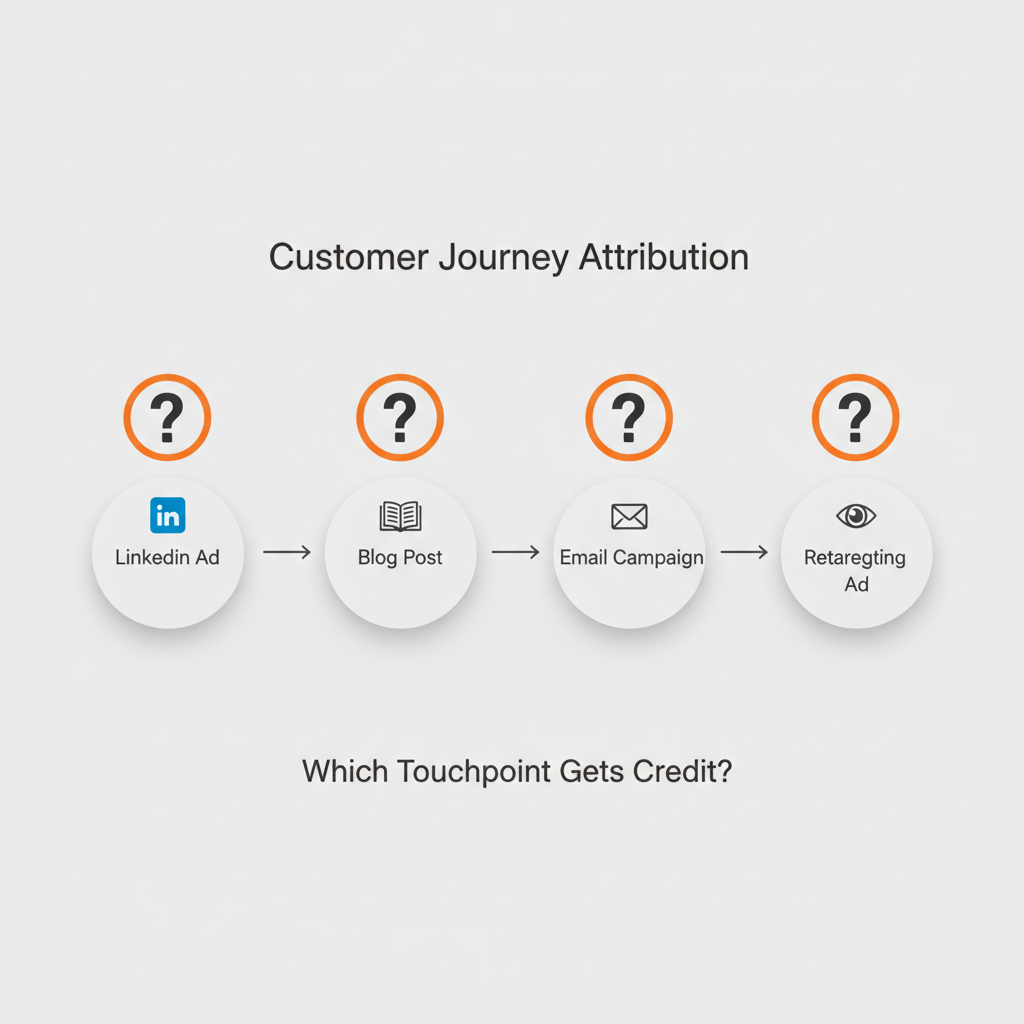
For years, marketers struggled with a common attribution problem.
A prospect might discover a company through Google Search, engage with LinkedIn content, attend a webinar, receive multiple emails, speak with sales, and eventually become a customer. Yet traditional attribution models often assigned all the credit to a single interaction.
The first touch received all the recognition. Or the last touch received all the recognition. Neither reflected reality.
This challenge led to the rise of multi-touch attribution. Multi-touch attribution, often referred to as MTA, attempts to distribute credit across multiple interactions within the buyer journey. Rather than focusing on a single touchpoint, it acknowledges that marketing influence is often cumulative.
The question modern revenue teams are asking
Not "Should we use multi-touch attribution?" but rather: "How much of the buyer journey can multi-touch attribution actually see?"
Buyers research anonymously. They ask AI systems for recommendations. They participate in private communities. They engage with multiple stakeholders and switch devices. Many consume content without ever filling out a form. As a result, even the best multi-touch model only sees part of the picture.
What Is Multi-Touch Attribution?
Multi-touch attribution is a marketing attribution approach that distributes credit across multiple interactions before a conversion or revenue event. Instead of assigning 100% of credit to one touchpoint, multi-touch attribution recognizes that buyers often engage with multiple channels, campaigns, and content assets throughout their decision-making process.
Example: A prospect's journey before becoming a customer
A multi-touch model assigns credit across steps 1 through 6. A first-touch model only credits step 1. A last-touch model only credits step 6.
Single-touch models ask:
"What was the most important interaction?"
Multi-touch models ask:
"How did multiple interactions contribute to the outcome?"
Why Multi-Touch Attribution Became Popular
Multi-touch attribution emerged because marketers recognized the limitations of single-touch models. First-touch attribution focuses entirely on discovery. Last-touch attribution focuses entirely on conversion. Neither provides visibility into everything that happened between those two events.
As marketing channels expanded and customer journeys became more complex, organizations needed better ways to understand influence. Multi-touch attribution offered several clear advantages over the models it replaced:
How Multi-Touch Attribution Works
Multi-touch attribution distributes credit across multiple touchpoints using predefined rules or algorithmic models. The specific distribution depends on which model is used. The credit bars below show how each model assigns value across five touchpoints (T1 through T5).
Linear
Every touchpoint receives equal credit.
Five interactions = 20% each.
Credit distribution across 5 touchpoints:
Time Decay
Touchpoints closer to conversion receive more credit. Recent interactions are weighted higher.
Earlier touches: 5-15%. Final touches: 30-45%.
Credit distribution across 5 touchpoints:
Position-Based (U-Shaped)
Greater credit goes to first and conversion interactions. Middle touchpoints share the remaining credit.
40% first, 40% conversion, 20% middle.
Credit distribution across 5 touchpoints:
Data-Driven
Machine learning and statistical analysis determine credit distribution based on historical conversion patterns.
Algorithm-based weighting from observed data.
Credit distribution across 5 touchpoints:
Benefits of Multi-Touch Attribution
There are several reasons why multi-touch attribution remains popular among marketing and revenue teams.
Better Journey Visibility
Multi-touch attribution recognizes that buyers rarely convert after a single interaction. This produces a more realistic view of modern buying behavior across the full funnel.
Improved Budget Decisions
Organizations gain greater insight into how different channels contribute throughout the funnel. This helps marketing leaders make more informed investment decisions.
Reduced Channel Bias
Single-touch models often overvalue specific channels. Multi-touch attribution distributes recognition more broadly, reducing reporting distortions.
Better Marketing and Sales Alignment
When multiple interactions are acknowledged, marketing and sales teams often gain a more balanced view of influence - reducing internal disagreements around channel contribution.
More Complete Revenue Analysis
Multi-touch attribution helps organizations understand how awareness, engagement, consideration, and conversion activities work together - creating richer reporting than single-touch approaches.
Why Multi-Touch Attribution Still Has Challenges
Despite its advantages, multi-touch attribution is not a complete solution. The reason is straightforward: multi-touch attribution can only analyze interactions it can see. When important buyer activity happens outside measurable systems, the model cannot assign credit.
The core limitation: Attribution measures visibility within systems, not total buyer influence. These are often very different things.
The Missing Data Problem
Every attribution model relies on available data. When touchpoints are missing, attribution becomes incomplete. Common sources of missing data in B2B attribution include:
Dark Social and Private Conversations
Dark social refers to interactions that occur in environments where referral information is unavailable. These interactions frequently influence buying decisions while remaining invisible to attribution platforms.

Dark social channels like Slack, Teams, and private communities frequently influence B2B buying decisions but never generate trackable attribution data.
A common scenario: A buyer receives a recommendation in a Slack community, searches for the company later by name, and arrives via direct traffic. The attribution platform credits direct traffic. The real influence originated in a private channel that no model can see.
AI Search and AI-Assisted Discovery
AI search is creating a new attribution challenge. Buyers increasingly ask AI systems which vendors to evaluate, what solutions are available, and how products compare. These interactions may influence purchasing decisions before a prospect ever visits a website.
Traditional attribution systems typically cannot observe AI recommendation pathways. As AI search adoption increases, attribution visibility gaps may continue to grow - making brand visibility inside AI systems increasingly important for revenue teams to track.
Buying Committees Create Attribution Complexity
Modern B2B purchases often involve multiple stakeholders. Each individual experiences a different journey, interacts with different content, and encounters your brand through different channels. Attribution systems often struggle to connect these separate journeys into a complete account-level view.

B2B buying committees typically include multiple stakeholders, each interacting with different channels. Attribution systems often fail to connect these separate journeys into one account-level story.
Executive sponsor
Webinar or event
Budget owner
Analyst report
End user
Product content
Technical evaluator
Docs and integrations
Procurement
Pricing and contracts
Security team
Compliance content
Multi-Device Research
Buyers frequently switch between mobile phones, work laptops, home computers, and tablets throughout their research process. Identity resolution across devices remains difficult. Attribution systems may treat connected interactions as separate journeys, reducing accuracy.
The Attribution vs Influence Gap
One of the most useful concepts for modern marketers is understanding the difference between attribution and influence.
Attribution measures
- +Trackable interactions
- +Observable events
- +Recorded touchpoints
- +Click-based pathways
- +Form fills and conversions
Influence also includes
- +Brand awareness and familiarity
- +Peer recommendations
- +Market perception
- +Executive thought leadership
- +AI-generated recommendations
- +Community discussions
This distinction explains why attribution reports sometimes feel incomplete despite having accurate data. The data is accurate - but influence extends beyond what the data can capture. See Attribution vs Visibility for a deeper look at this distinction.
Common Multi-Touch Attribution Mistakes
Treating attribution as absolute truth
Attribution should inform decisions, not replace judgment. Every attribution model contains assumptions. The model is a useful signal, not a definitive record of buyer behavior.
Ignoring data quality
Incomplete CRM data creates incomplete attribution. Strong data governance is essential before drawing conclusions from attribution reports.
Overvaluing precision
Attribution can create an illusion of precision. A report showing a channel contributed exactly 17.4% of revenue should be interpreted carefully. The underlying assumptions matter as much as the number.
Measuring credit instead of understanding buyers
The purpose of attribution is not to win internal credit discussions. The purpose is to better understand customer behavior. Organizations focused exclusively on credit often miss larger growth opportunities.
Which Organizations Benefit Most from Multi-Touch Attribution?
B2B SaaS companies
Long buying cycles typically involve numerous touchpoints across many channels and content types.
Enterprise organizations
Complex journeys with multiple stakeholders benefit from broader visibility than single-touch models provide.
Multi-channel marketing teams
Organizations investing across search, social, events, email, and content gain more accurate insight into channel contribution.
Revenue operations teams
MTA supports more sophisticated reporting frameworks and ties marketing activity to pipeline more clearly.
What Revenue Teams Should Measure Alongside Multi-Touch Attribution
As buying journeys become more fragmented, organizations increasingly supplement attribution with additional signals. These signals help fill the gaps that attribution cannot cover.
Brand Visibility
Where buyers discover your company across channels
Share of Search
How often your brand appears during category research
AI Search Visibility
How often AI systems recommend your company
Pipeline Influence
How marketing contributes throughout opportunity progression
Behavioral Signals
How target accounts engage before becoming customers
Competitive Visibility
Where competitors are gaining attention you are not
The Future of Multi-Touch Attribution
Multi-touch attribution will remain an important component of marketing measurement. However, its role is changing. The future is unlikely to be about finding a perfect attribution model. Instead, leading organizations are building broader measurement systems.
Old question
"Which channel gets credit?"
Better question
"What influenced the buyer?"
Leading organizations are combining attribution data with visibility metrics, behavioral analytics, revenue intelligence, AI search signals, and market influence data. This creates a more complete understanding of buyer behavior than any single attribution model can provide.
How RankWorks Helps Revenue Teams See Beyond Attribution
RankWorks AI unifies fragmented marketing, revenue, behavioral, and visibility data across channels and AI systems - helping teams understand not just which channel got credit, but how buyers discover and choose your company.
Frequently Asked Questions About Multi-Touch Attribution
Common questions from B2B revenue teams about implementing and using multi-touch attribution.
Still have questions?
Our SEO experts are here to help. Get personalized answers and a free consultation.
Key Takeaways
- 1
Multi-touch attribution is a significant improvement over single-touch models because it recognizes that buyers engage with multiple channels before converting.
- 2
It provides broader visibility into customer journeys and helps organizations understand how multiple interactions contribute to revenue outcomes.
- 3
Multi-touch attribution is still limited by the interactions it can observe. Dark social, AI search, buying committees, and anonymous research create visibility gaps that no MTA model can close.
- 4
The four main MTA approaches - linear, time decay, position-based, and data-driven - each answer a different question about the same buyer journey.
- 5
The most effective revenue teams use multi-touch attribution as one component within a broader measurement strategy that also includes visibility, behavioral signals, and influence tracking.
- 6
The goal of measurement is not simply assigning credit. It is understanding influence - which includes much that attribution cannot see.
Continue Reading
Marketing Attribution in Modern B2B
The full pillar guide - what attribution is, why it falls short, and the modern measurement framework.
Attribution Models Explained
First-touch, last-touch, linear, time decay, position-based, and data-driven compared side by side.
Channel Attribution Explained
How modern B2B teams measure marketing influence across channels - and where channel reporting breaks down.
Attribution vs Visibility
Why attribution and influence are not the same thing, and how to measure what attribution cannot see.