For more than two decades, marketing measurement has been built around a simple assumption:
If something influences a purchase decision, it can be measured.
That assumption is becoming increasingly inaccurate. Modern buyers make decisions in ways that traditional measurement systems struggle to observe. They ask AI systems for recommendations. They participate in private communities. They consult peers. They conduct anonymous research. They collaborate with buying committees. They evaluate vendors long before they ever visit a website.
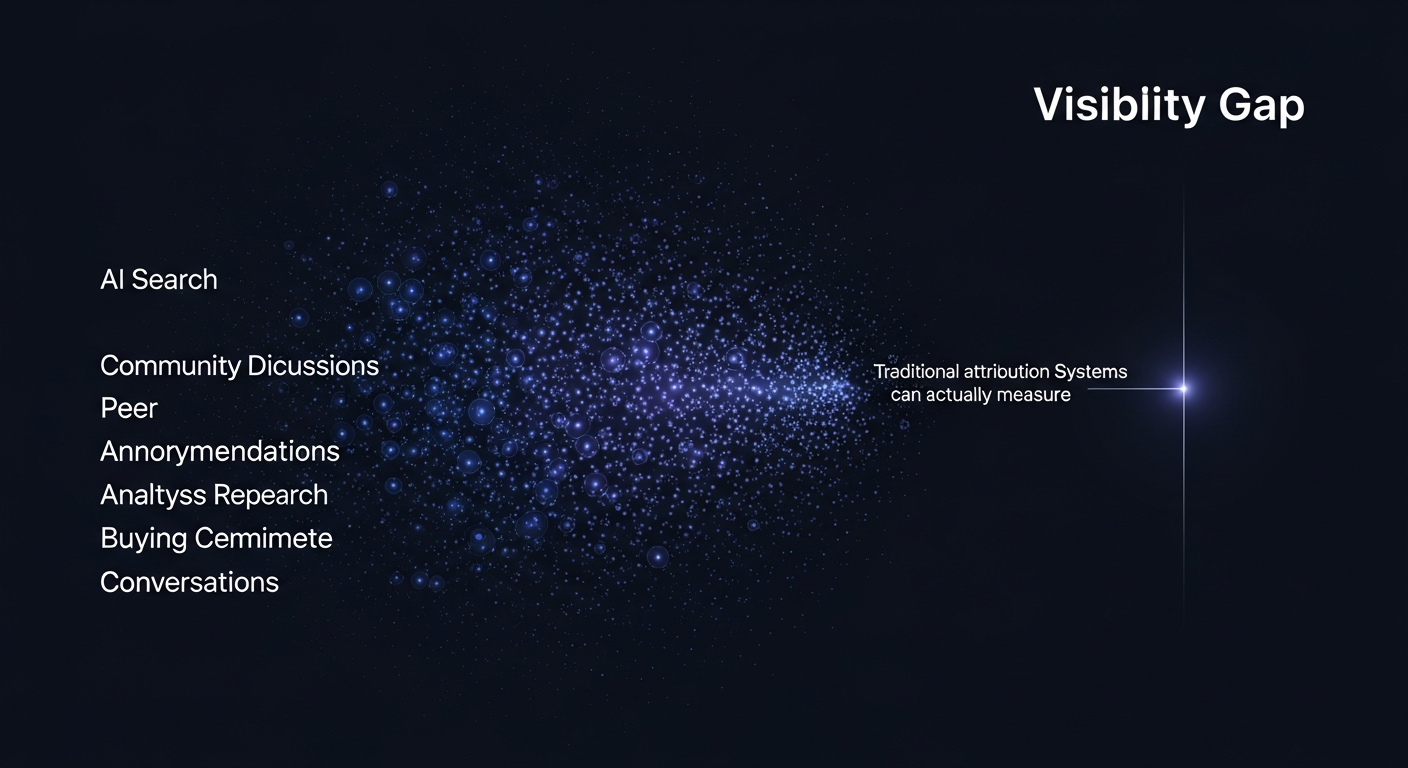
As a result, many of the most influential moments in the customer journey occur before attribution systems, analytics platforms, CRM records, and revenue reports begin collecting data. This creates what we call the Visibility Gap.
What Is the Visibility Gap?
The Visibility Gap is the difference between actual buyer influence and measurable buyer activity. It represents everything that contributes to decision-making but remains difficult to observe through traditional marketing and revenue systems.
What traditional systems measure
Important, but incomplete
What lives in the Visibility Gap
Influences decisions but often invisible
Most organizations have sophisticated tools for measuring interactions. These interactions are important. However, they represent only a portion of the buying journey. Many influential moments occur before these measurable events take place. The result is a growing gap between what drives decisions and what organizations can measure.
Why the Visibility Gap Matters
At first glance, the Visibility Gap may seem like a marketing problem. In reality, it is a business problem. Growth depends on understanding why customers buy. If organizations only understand measurable interactions, they risk overlooking many of the factors that actually influence decisions.
Visibility influences discovery
Buyers increasingly discover solutions through AI, communities, and peer networks before any measurable interaction occurs.
Visibility influences consideration
Reputation, recommendations, and brand familiarity shape whether a company enters a shortlist - often before any website visit.
Visibility influences revenue
Every revenue outcome begins with a series of influences. Traditional reporting often captures the end of that process while missing the beginning.
The Visibility Gap creates challenges across
How Buyers Actually Make Decisions Today
One of the biggest reasons organizations struggle with the Visibility Gap is that many measurement frameworks still assume buyers behave the way they did ten years ago. Modern buyers have fundamentally changed how they discover, evaluate, and select solutions.
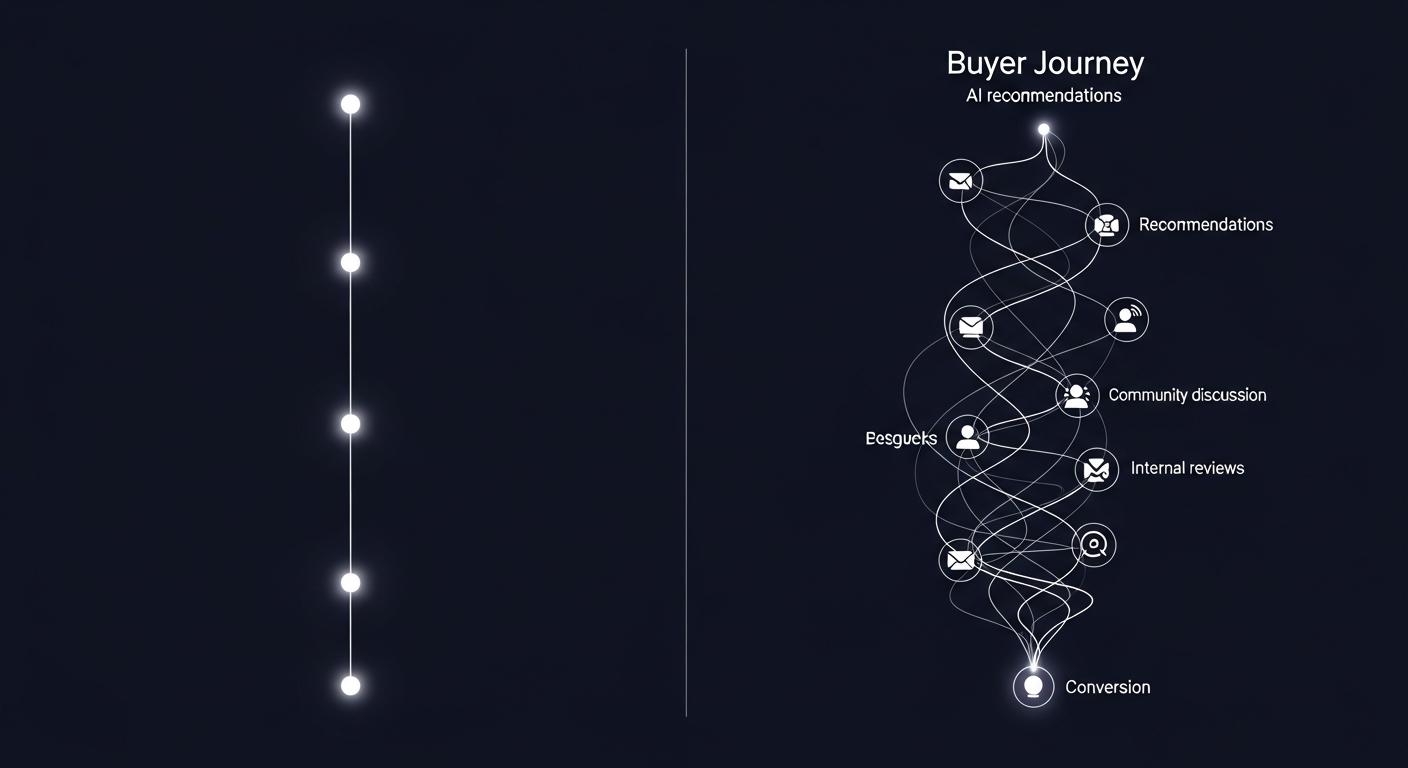
The traditional buyer journey was simple and linear. The modern buyer journey is complex and largely invisible - winding through environments that attribution systems were never designed to observe.
A typical modern buyer may:
Notice where traditional measurement begins: at the vendor website. Everything before that often exists inside the Visibility Gap. By the time a prospect submits a form or requests a demo, significant decision-making may have already happened.
Why Traditional Measurement Creates Blind Spots
The Visibility Gap is not caused by bad technology. It is caused by limitations in what technology can observe. Most measurement systems depend on interactions. No interaction means no measurement. This creates unavoidable blind spots across every layer of the measurement stack.
Attribution Blind Spots
Sees
+ Search clicks
+ Paid media clicks
+ Email engagement
+ Website visits
Misses
- AI recommendations
- Dark social sharing
- Peer referrals
- Community discussions
Buyer asks ChatGPT for recommendations, discusses internally, visits website. Attribution records: Direct Traffic.
Analytics Blind Spots
Sees
+ Page views
+ Sessions
+ Conversions
+ Events on site
Misses
- Pre-site research behavior
- Why engagement occurred
- Off-site evaluation
Analytics begins after engagement. It rarely explains why engagement occurred in the first place.
CRM Blind Spots
Sees
+ Leads
+ Opportunities
+ Contacts
+ Activities after contact
Misses
- Pre-contact research
- Buying committee behavior
- Peer influences
By the time a lead enters the CRM, discovery and initial evaluation have already occurred invisibly.
Revenue Reporting Blind Spots
Sees
+ Revenue generated
+ Pipeline created
+ Deals won and lost
Misses
- Why outcomes occurred
- What created demand
- Which influences drove decisions
Revenue reporting explains outcomes. It rarely explains causes. Organizations see the result without understanding the process.
The Difference Between Observable and Invisible Influence
One of the most important concepts in understanding the Visibility Gap is the distinction between observable influence and invisible influence. Both types of influence affect decisions. Only one is easily measured.
Invisible influence is not inherently untraceable - it is simply outside the scope of systems designed to measure clicks and conversions. Understanding this distinction is the first step toward building measurement that reflects how buying decisions actually happen.
Invisible Influence Is Growing - and the Gap Is Expanding
The Visibility Gap is not a temporary challenge. It is a structural shift in how buying decisions are made. Every year buyers gain access to more information, more communities, more AI systems, and more opportunities to evaluate solutions before engaging directly with vendors.
AI-assisted research is accelerating
As AI search adoption grows, recommendation-driven discovery expands and attribution visibility declines.
Private communities are growing
Buyers increasingly trust peers over advertising. Many of these interactions occur in Slack, Discord, and other untracked environments.
Buying committee complexity is increasing
Enterprise purchases involve more stakeholders than ever before. Each stakeholder contributes separate invisible influence.
Buyers prefer self-service research
Buyers increasingly want to educate themselves before speaking with vendors. More decision-making occurs outside observable environments.
Organizations that continue relying exclusively on attribution and analytics will understand a shrinking percentage of the buyer journey. The gap between what drives decisions and what gets measured is not closing - it is widening.
The Five Sources of Invisible Influence
While invisible influence can take many forms, five sources are driving the majority of today's Visibility Gap. Understanding each source helps organizations identify where measurement currently falls short.
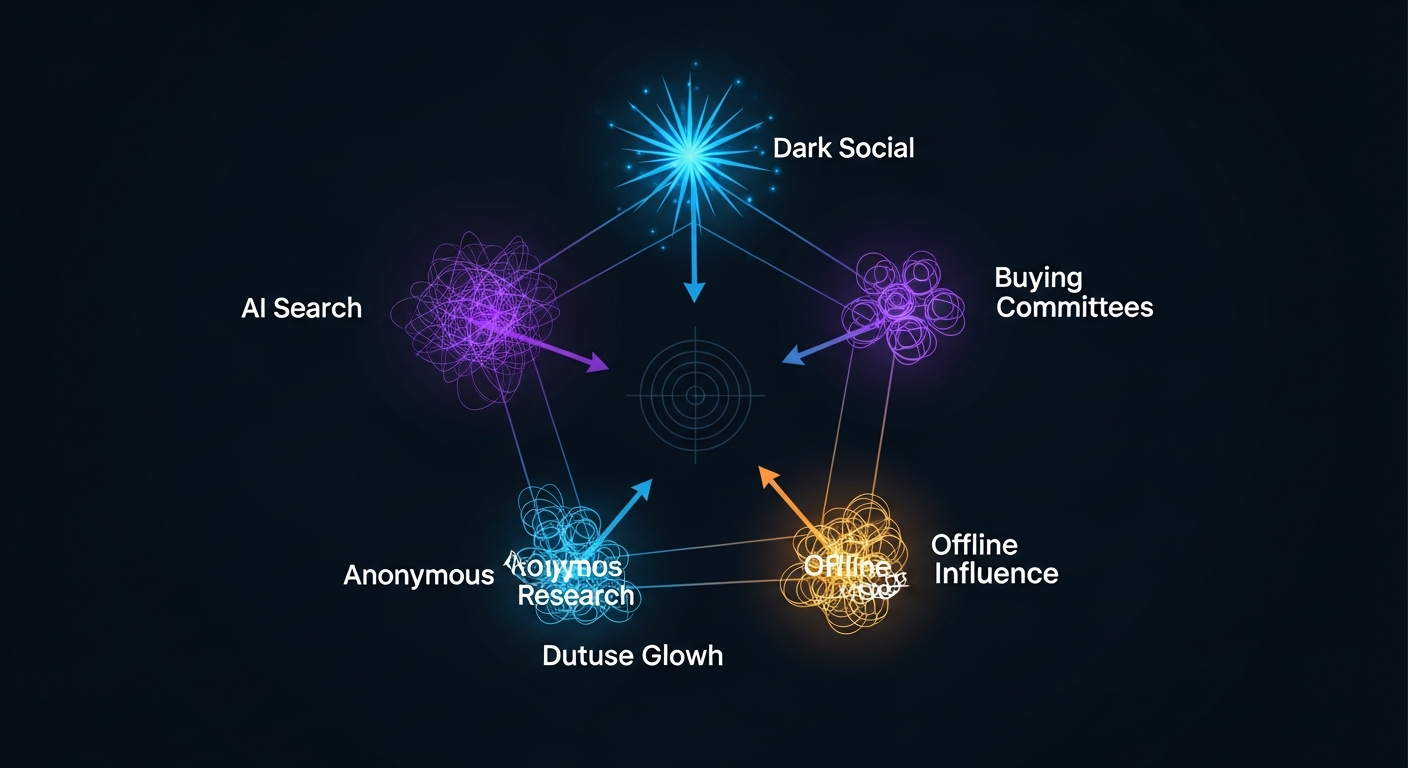
The five sources of invisible influence each contribute to the Visibility Gap in different ways. Individually they create blind spots. Collectively they reshape how organizations should understand growth.
1AI Search and Recommendation Engines
The fastest-growing source of invisible influence is AI-assisted discovery. For decades, search engines served as the primary gateway. Buyers searched, clicked links, and analytics captured the activity. AI search changes the process entirely - and with it, the entire measurement landscape.
Traditional search journey
Every step measurable
AI search journey
Recommendation invisible to attribution
AI recommendations influence
- Vendor consideration and shortlist creation
- Category understanding
- Competitive comparisons
- Purchase evaluation
Attribution struggles because
- First-touch misses discovery
- Last-touch misses influence
- Multi-touch misses recommendations
- Revenue reporting misses the cause
3Buying Committees
One of the largest sources of invisible influence in B2B is the buying committee. Traditional attribution often assumes a single buyer journey. Modern B2B purchases rarely involve a single buyer. They involve groups of stakeholders with different priorities and different research behaviors - each adding invisible influence.
A single software purchase may involve
Executives
AI search and peer recommendations
Procurement
Vendor compliance research
Security Teams
Technical documentation review
Technical Evaluators
Community forums and reviews
Finance Stakeholders
Analyst reports and pricing
End Users
Product comparison sites
Each stakeholder experiences a unique journey. Each stakeholder consumes different information. Each stakeholder influences the final decision. Attribution systems often struggle to connect these fragmented journeys into a coherent picture. The larger the deal, the more stakeholders, the larger the Visibility Gap.
4Anonymous Research
One of the most important realities of modern buying behavior is that buyers prefer to remain anonymous for as long as possible. Modern buyers have access to search engines, AI systems, communities, review platforms, analyst content, and educational resources. They often educate themselves independently for weeks or months before making any vendor contact.
What anonymous research looks like
All invisible to attribution systems
The false attribution signal
Anonymous research often creates inflated attribution credit for branded search. Example: a prospect spends months researching solutions, eventually performs a branded search, and attribution credits branded search - while the actual decision process was far broader.
Anonymous research creates the appearance of simple buyer journeys when the reality is far more complex.
5Offline Influence
Despite the growth of digital marketing, many buying decisions remain heavily influenced by offline interactions. These interactions often shape purchasing decisions in ways that digital measurement struggles to capture - and they frequently accelerate deals significantly.
Industry conferences
Direct vendor exposure and peer discussions
Executive introductions
High-trust relationships that accelerate deals
Customer referrals
Often records as direct traffic in attribution
Analyst meetings
Shape category understanding and vendor selection
Advisory relationships
Trusted recommendations outside digital channels
Industry events
Brand exposure before measurable engagement begins
The most common scenario
A customer recommends a vendor. The prospect visits the website. The prospect converts. Attribution records: Direct Traffic. The referral that created the opportunity never appears in any report.
The Business Cost of the Visibility Gap
The Visibility Gap is not simply a measurement challenge. It creates real business consequences. Organizations that fail to understand invisible influence often make decisions based on incomplete information.
Misallocated Marketing Investment
Attribution assigns credit to measurable interactions - creating the illusion that measurable channels are responsible for all growth. A prospect may discover a company through AI search, research for weeks, then perform a branded search. Attribution credits branded search. Marketing investment follows attribution. Organizations overinvest in measurable interactions while underinvesting in discovery that creates demand.
Underestimating Brand Influence
Brand familiarity frequently exists within the Visibility Gap. Buyers often choose familiar brands - yet brand familiarity rarely appears inside attribution reports. Organizations sometimes reduce brand investments because attribution cannot easily measure their impact. Over time this can reduce discoverability and future demand creation.
Forecasting Challenges
Forecasting depends on understanding future growth drivers. Revenue reporting explains historical performance. Visibility helps explain future performance. Organizations that ignore visibility often struggle to identify emerging opportunities, competitive threats, and market shifts before they appear in revenue metrics.
Competitive Blind Spots
Visibility is relative. If competitors become more visible in AI systems, communities, or analyst ecosystems, future opportunities may decline. Organizations focused exclusively on internal metrics often fail to recognize these changes early enough. Competitive visibility provides context that attribution cannot.
The Visibility Gap in Practice
The Visibility Gap affects every industry. The underlying challenge remains consistent: influence occurs before measurement. Here are three common scenarios that illustrate how the gap appears in practice.
SaaS Example
A VP of Marketing asks ChatGPT: "What are the best marketing measurement platforms?" ChatGPT provides recommendations. The VP shares the results internally. A shortlist is created. Several vendors are evaluated. Weeks later one vendor receives a demo request.
Attribution records
Demo Request > Opportunity > Revenue
Visibility Gap contains
The AI recommendation that created the entire process.
Enterprise Software Example
An enterprise buying committee researches security vendors. One stakeholder reads analyst reports. Another asks peers. Another consults community forums. Another uses AI search. Eventually the committee visits several vendor websites.
Attribution records
Website visits and form submissions.
Visibility Gap contains
The majority of evaluation - analyst research, peer consultations, AI queries, and committee discussions.
B2B Services Example
A consulting firm receives a referral from a satisfied customer. The prospect already trusts the recommendation. They visit the website simply to validate the decision that has largely already been made.
Attribution records
Direct Traffic > Conversion.
Visibility Gap contains
The customer referral that created the entire opportunity.
How Visibility Intelligence Closes the Gap
The Visibility Gap cannot be eliminated completely. Not every influence can be measured. Not every decision can be reconstructed. However, organizations can dramatically improve their understanding of buyer behavior. This is where Visibility Intelligence becomes essential.
Visibility Intelligence expands measurement beyond interactions. It focuses on discoverability, presence, influence, and consideration. Rather than asking "which click converted?", it asks "where are buyers finding us?"
Questions Visibility Intelligence helps answer
"Are buyers finding us?"
Search Visibility
"Are AI systems recommending us?"
AI Visibility
"How recognizable is our brand?"
Brand Visibility
"Are competitors more visible than us?"
Competitive Visibility
"Which topics create discovery?"
Topic Authority
"How does discoverability influence revenue?"
Revenue Visibility
Visibility Intelligence does not replace attribution. It extends it - adding a layer of measurement focused on where buyers discover, evaluate, and consider before attribution begins. See: Brand Visibility Intelligence - full framework and Revenue Visibility - the executive framework.
The Visibility Gap Maturity Model
Organizations typically evolve through six stages of measurement maturity. Understanding where an organization sits helps leaders evaluate current capabilities and plan what comes next.
Traffic Reporting
Focus
Traffic
Primary question
"How many visitors do we have?"
Note
Visibility is completely invisible at this level
Attribution
Focus
Credit
Primary question
"Which channels generated conversions?"
Note
Measurable interactions tracked but discovery still largely invisible
Multi-Touch Attribution
Focus
Journeys
Primary question
"Which touchpoints contributed?"
Note
More complete journey view but pre-click influence still hidden
Visibility Intelligence
Focus
Discovery
Primary question
"Where are buyers finding us?"
Note
Organizations begin measuring discoverability directly
Revenue Visibility
Focus
Growth
Primary question
"How does discoverability create revenue?"
Note
Connects visibility signals to pipeline and revenue outcomes
Decision Intelligence
Focus
Business decisions
Primary question
"What drives future growth?"
Note
Unifies visibility, attribution, behavioral signals, and revenue outcomes
The Future of Measurement
The future of measurement is not more attribution. The future is broader visibility. Organizations increasingly need to understand discovery, influence, consideration, engagement, pipeline, and revenue together - as a connected system rather than isolated metrics.
The complete measurement system
This shift is being driven by buyer behavior - not technology, not marketing trends, but buyer behavior. As buyers continue to adopt AI search, private communities, and independent research, organizations that understand visibility will gain a significant advantage over organizations that only measure what they can already see.
Start Measuring What Attribution Misses
RankWorks helps organizations measure discoverability across search, AI systems, communities, and competitive ecosystems - the environments where the Visibility Gap lives. By combining Visibility Intelligence with traditional attribution, you get a more complete picture of how buyers discover, evaluate, and choose you.
Frequently Asked Questions About the Visibility Gap
Common questions from marketing leaders, revenue teams, and executives about the Visibility Gap, invisible influence, and how Visibility Intelligence helps organizations understand what attribution misses.
Still have questions?
Our SEO experts are here to help. Get personalized answers and a free consultation.
Key Takeaways
- 1
Buyers make decisions before attribution begins. Much of the modern buyer journey occurs before measurable interactions exist. AI search, community discussions, peer recommendations, buying committee research, and anonymous self-education all happen before any click is recorded.
- 2
The Visibility Gap is the distance between what drives decisions and what gets measured. It is not caused by bad technology. It is caused by buyers who have changed how they discover and evaluate solutions - and measurement systems that have not kept pace.
- 3
Five sources drive the majority of invisible influence: AI search and recommendation engines, dark social, buying committees, anonymous research, and offline influence. Each source contributes to the gap in different ways.
- 4
Invisible influence is growing, not shrinking. AI adoption is accelerating, private communities are expanding, buying committees are growing in size and complexity, and buyers are increasingly self-educating before any vendor contact. The gap is structural.
- 5
The business cost is real. Organizations that ignore the Visibility Gap risk misallocating budgets, underestimating brand influence, struggling with forecasting, and missing competitive threats that do not appear in attribution reports until it is too late.
- 6
Visibility Intelligence helps close the gap. By measuring discoverability across search, AI systems, communities, and competitive ecosystems, organizations gain insight into the buyer behavior that creates demand before attribution begins.
- 7
The future belongs to organizations that understand visibility. Attribution explains some of what happened. Visibility explains why it happened and where future growth is coming from. Companies that understand both gain a significant advantage over those that only understand one.
Continue Reading
Brand Visibility Intelligence
The complete framework for measuring discoverability across the five dimensions of brand visibility.
Dark Social Attribution
How private sharing channels create attribution blind spots and what organizations can do about it.
Revenue Visibility
How discoverability and buyer influence connect to pipeline and revenue outcomes.
Attribution in the Age of AI Search
How AI recommendations create revenue before attribution records any interaction.