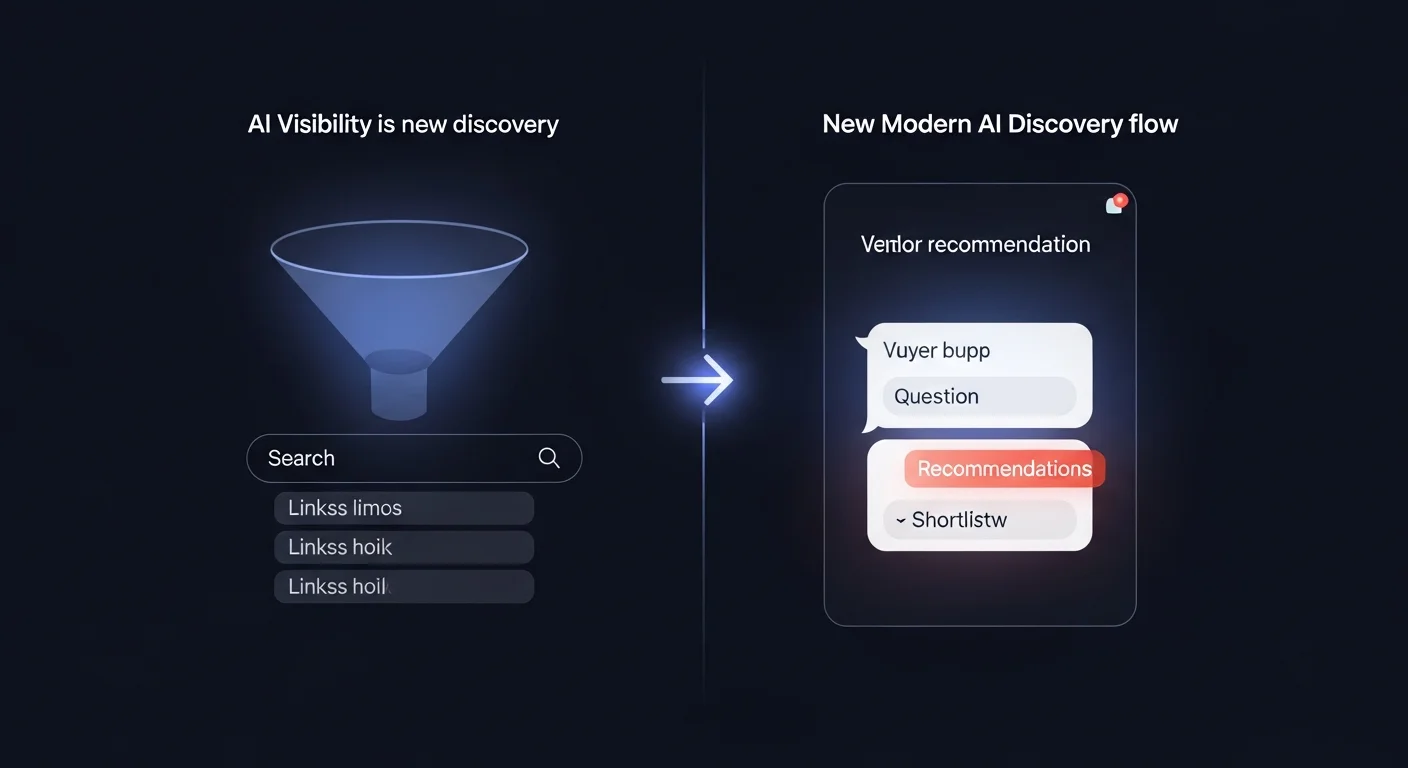
For more than two decades, digital discovery was largely governed by search engines. Organizations invested heavily in SEO, content marketing, paid search, and website optimization. The objective was straightforward: rank higher, generate traffic, capture demand.
That model shaped an entire generation of marketing strategies. Today, discovery is changing. Increasingly, buyers are not searching for information. They are asking AI systems for answers. Instead of reviewing ten links, buyers receive a recommendation. Instead of comparing dozens of websites, buyers receive a curated shortlist.
AI Visibility
The ability to be discovered, understood, referenced, recommended, and cited by AI systems during buyer research, evaluation, and decision-making.
As AI becomes a primary interface for information discovery, AI Visibility is emerging as one of the most important leading indicators of future growth. Organizations that understand AI Visibility gain a competitive advantage. Organizations that ignore it risk becoming invisible during some of the most influential moments in the buying process.
What Is AI Visibility?
AI Visibility is the ability of a brand, company, product, or organization to appear within AI-generated responses, recommendations, citations, evaluations, and summaries. Historically, organizations measured visibility through rankings. Today, visibility increasingly depends on whether AI systems recognize, understand, and recommend a brand.
Search Visibility answers
"Can buyers find us?"
Through rankings, traffic, and click-through rates in search engines.
AI Visibility answers
"Will AI systems recommend us?"
Through citations, recommendations, and influence within AI-generated responses.
Those are fundamentally different questions - and they require different strategies.
True AI Visibility includes all five elements
Discovery
Can AI systems surface your brand?
Understanding
Can AI systems accurately interpret your expertise?
Citation
Can AI systems reference your content?
Recommendation
Can AI include you in viable options?
Influence
Do recommendations impact buyer decisions?
Organizations need all five components to achieve meaningful AI Visibility. Being mentioned is not enough. Being understood, cited, recommended, and influential in buyer decisions is what drives business value.
Why AI Visibility Matters
The way buyers discover information is changing fundamentally. AI systems increasingly sit between buyers and information - and this changes how visibility works.
AI systems influence shortlists
Buyers increasingly ask AI which vendors to evaluate. The companies included gain visibility. The companies excluded often disappear from the buying process entirely before any measurable interaction occurs.
Recommendations precede websites
AI recommendations now occur before website visits. The website is no longer the beginning of evaluation - it is the continuation. Visibility must be earned earlier, in AI systems, before buyers arrive.
Recommendations beat rankings
A company can rank at position one yet be absent from AI recommendations. Conversely, a company may receive frequent AI recommendations without holding dominant search positions. These are separate competitive battles.
How Discovery Is Changing
To understand AI Visibility, it is important to understand how AI search differs from traditional search. The two systems operate differently, influence buyers differently, and create visibility differently.
Traditional search journey
Website = beginning of evaluation
AI search journey
Website = continuation of evaluation. AI = beginning.
The recommendation now occurs before the website visit. This means visibility must be earned at the AI layer - before buyers ever arrive at a company's website. For years, marketers optimized for visibility within search engines. Today they must also optimize for visibility within recommendation engines.
Search Visibility vs AI Visibility
Many organizations assume AI Visibility is simply another name for SEO. This is inaccurate. SEO remains important. However, AI Visibility is broader - and operates on different principles.
SEO is an input
Strong SEO often contributes to AI Visibility. However, SEO alone does not guarantee recommendations. AI systems evaluate additional signals including authority, brand recognition, topic expertise, citation frequency, and entity understanding.
AI Visibility is an outcome
SEO is a tactic. AI Visibility is an outcome. Organizations should not measure success solely through rankings. They should measure success through discoverability and recommendation frequency across AI systems.
Why Recommendations Matter More Than Rankings
Historically, rankings were the primary currency of digital discovery. Organizations competed intensely for top positions. The assumption was simple: higher rankings create more visibility. That assumption becomes less reliable in AI environments.
Traditional SEO world
Buyer searches a query. Search engine returns ten ranked options. Buyer selects which links to explore. Rankings determine visibility.
AI recommendation world
Buyer asks AI a question. AI synthesizes information and recommends specific brands. Buyers never see a ranked list. Inclusion determines visibility.
No ranking. No gradation. Included or excluded.
The new competitive reality: Recommendation-driven discovery is becoming one of the defining characteristics of modern buying behavior. Organizations that continue optimizing exclusively for rankings may find themselves increasingly absent from critical buying conversations.
The AI Visibility Framework
Most discussions about AI search focus on tactics. Organizations ask how to get cited by ChatGPT or appear in AI Overviews. While those questions matter, they skip a more fundamental one: how does AI Visibility actually work?
AI Visibility is not a single event. It is a progression. Before a company can be recommended, it must first be understood. Before it can be understood, it must first be discovered. The AI Visibility Framework consists of five interconnected layers.
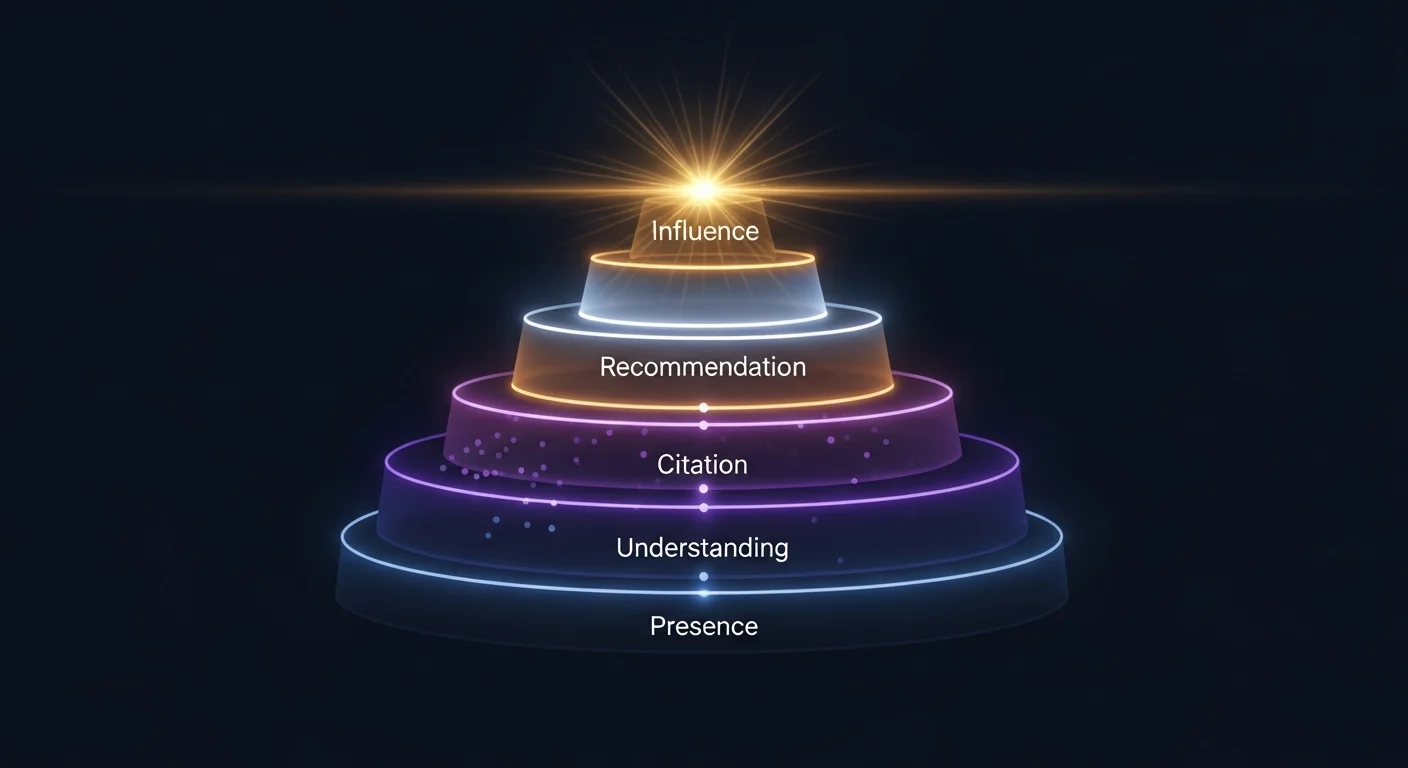
The five layers of AI Visibility build on each other. Each layer must be established before the next becomes possible. Influence - the highest layer - is where AI Visibility creates measurable business value.
1Layer 1: Presence
Presence is the foundation of AI Visibility. Before an AI system can recommend a company, reference a framework, or cite a resource, it must first know the entity exists. Presence is not visibility - it is existence. It answers a simple question: does the AI system know we exist?
Organizations often assume the answer is yes. However, AI systems may recognize a company name while having very little context about what it does, who it serves, which category it belongs to, or which topics it owns. Presence is the starting point - not the destination.
Website Content
Clear descriptions of products, services, and expertise that AI systems can discover and interpret.
Third-Party References
Mentions across publications, communities, and partner ecosystems that signal existence.
Industry Citations
Evidence that others discuss the company within its category.
Structured Information
Clear organizational and entity signals that help AI understand context.
Category Participation
Evidence that the company belongs within a specific market or topic area.
Consistent Messaging
Coherent information across all digital touchpoints that reinforces entity understanding.
2Layer 2: Understanding
Presence alone does not create visibility. An AI system may recognize a company name but still have a weak understanding of its expertise. If AI systems do not understand what an organization does, they cannot confidently recommend it. Understanding creates relevance.
When a user asks: "What are the best platforms for measuring AI visibility?"
The AI system evaluates
Entity association matters
AI systems increasingly operate through entities rather than keywords. Building clear entity relationships creates stronger recommendation potential.
RankWorks
→ Visibility Intelligence
→ Revenue Visibility
→ Decision Intelligence
Topic ownership matters
Organizations that consistently publish authoritative content around a specific subject create stronger topic associations - improving recognition, citation potential, and recommendation frequency. Topic ownership becomes a compounding competitive advantage.
3Layer 3: Citation
Once an AI system understands an organization, the next stage is citation. Citation is one of the strongest indicators that an organization has established authority. When AI systems repeatedly reference a company or its content, they signal that the information is useful, relevant, and trustworthy.
What AI systems tend to cite
Why category creation builds citations
Organizations that define categories often earn more citations than organizations that merely compete inside them. When you create the framework, you become the reference.
This is one reason why original frameworks - like Visibility Intelligence, Revenue Visibility, and Decision Intelligence - generate strong citation signals.
Citation Share
Citation Share measures how frequently a company is cited relative to competitors. As AI adoption increases, Citation Share is becoming an increasingly important visibility metric - and a leading indicator that often precedes higher Recommendation Rate.
4Layer 4: Recommendation
Recommendation is where AI Visibility begins creating real business value. A citation demonstrates authority. A recommendation influences decisions. Buyers increasingly ask AI systems questions like "which vendors should we evaluate?" or "what are the leading solutions for this use case?" The organizations included in those answers gain visibility. The organizations excluded often disappear from consideration.
Traditional SEO objective
Position
Be number one in search rankings. Visibility determined by rank.
AI Visibility objective
Inclusion
Be present in the recommendation. Visibility determined by inclusion.
The recommendation creates the shortlist
Most buying journeys begin with a shortlist. AI recommendation determines who appears on that shortlist. The sequence: Recommendation → Discovery → Evaluation → Consideration → Pipeline → Revenue. Organizations that consistently appear during recommendation events gain a significant compounding advantage.
5Layer 5: Influence
Influence represents the highest level of AI Visibility maturity. This is where visibility becomes measurable business value. Presence creates awareness. Understanding creates relevance. Citation creates authority. Recommendation creates consideration. Influence creates outcomes.
The AI Influence Pathway
Traditional attribution often begins at Website Visit. AI Visibility explains everything before that.
Organizations do not invest in visibility simply to be mentioned. They invest because visibility influences decisions. AI Visibility ultimately matters because it impacts discovery, evaluation, shortlist inclusion, pipeline creation, and revenue growth. Influence connects AI Visibility directly to business performance.
How AI Systems Evaluate Organizations
One of the most common misconceptions about AI Visibility is that AI systems behave like search engines. They do not. Search engines primarily evaluate pages. AI systems increasingly evaluate entities, relationships, authority, and context. This creates a fundamentally different visibility model.
Search engines primarily evaluate
AI systems increasingly evaluate
Organizations that understand these evaluation signals gain a significant advantage. The strongest AI Visibility strategies focus on becoming a recognized, authoritative entity within a topic - not just optimizing individual pages for keywords.
From Search Optimization to Knowledge Optimization
Historically, organizations optimized pages. The future belongs to organizations that optimize knowledge. This shift from page optimization to knowledge optimization represents one of the biggest changes in digital discoverability.
Organizations that adapt to knowledge optimization early will be significantly better positioned as AI becomes a primary interface for information discovery. The competitive advantage goes to companies that AI systems understand, trust, cite, and recommend - not simply to companies with the most technically optimized pages.
AI Visibility Metrics
One of the biggest challenges organizations face with AI Visibility is measurement. Most executives understand the importance of visibility. However, many still struggle to answer a simple question: how do we measure AI Visibility? Traditional metrics like rankings, traffic, and impressions were designed for search engines. AI systems create different forms of visibility that require different measurement frameworks.
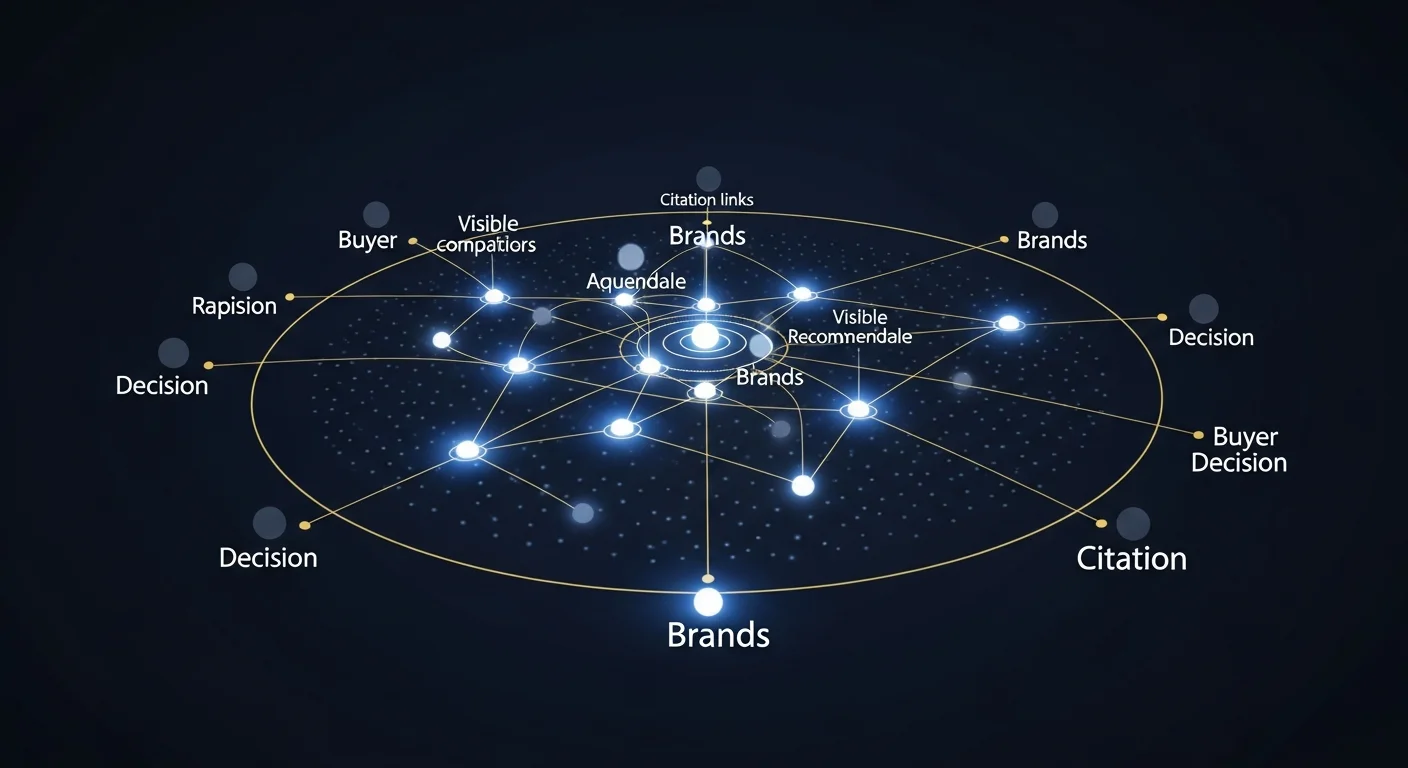
AI Visibility is a competitive metric. Some organizations dominate citations and recommendations while others remain largely invisible. Understanding relative position is as important as understanding absolute performance.
Recommendation Rate
While citations demonstrate authority, recommendations influence decisions. Recommendation Rate measures how often a company appears when users ask category-related questions - the ones buyers ask when building evaluation shortlists.
Example recommendation queries
"What are the best marketing measurement platforms?"
"Which revenue intelligence solutions should we evaluate?"
"What are the leading AI visibility tools?"
"What alternatives should we consider?"
Why Recommendation Rate matters
Many buyers never review traditional search results. They simply evaluate the recommendations generated by AI systems. As a result, Recommendation Rate may become one of the most important visibility metrics of the next decade - directly predicting future pipeline and revenue.
Competitive AI Visibility
Visibility is relative. A company may increase its AI visibility while still losing market position - because competitors may be increasing visibility faster. Competitive AI Visibility provides the context that absolute metrics alone cannot supply.
AI Visibility is a market share problem
Many organizations focus exclusively on their own performance. The strongest organizations focus on relative performance. Without competitive context, visibility metrics lose strategic value.
AI Visibility Maturity Model
Organizations typically evolve through five stages of AI Visibility maturity. Understanding where an organization sits helps leaders identify the next stage of strategic development.
Search Visibility
Focus
Rankings
Primary question
"Can buyers find us through search?"
Note
Visibility determined by search position. AI Visibility not yet considered.
Content Visibility
Focus
Topic coverage
Primary question
"Do we own important topics in search?"
Note
Topic-level content investment. Still primarily search-oriented.
AI Visibility
Focus
Recommendations
Primary question
"Are AI systems recommending us?"
Note
Active measurement of Citation Share, Recommendation Rate, and Topic Authority.
Revenue Visibility
Focus
Business impact
Primary question
"How does AI Visibility influence pipeline and revenue?"
Note
Connecting AI visibility signals to business outcomes.
Decision Intelligence
Focus
Strategic action
Primary question
"What should we do next?"
Note
AI Visibility data feeds into the broader Decision Intelligence framework.
AI Visibility for CMOs
AI Visibility is rapidly becoming a strategic marketing responsibility. As AI-assisted discovery changes how demand is created, CMOs need to understand and measure AI visibility alongside traditional marketing performance.
Better Demand Creation
Demand begins with discovery. AI systems increasingly influence discovery before any measurable interaction occurs. Understanding AI Visibility gives CMOs earlier insight into emerging demand, topic opportunities, recommendation trends, and competitive shifts.
Better Content Prioritization
AI Visibility helps marketers determine which topics matter most for citation potential, which content creates authority signals, and which frameworks generate recommendation frequency. This produces stronger, more strategic content investments.
Better Executive Reporting
Marketing leaders increasingly need to answer whether AI systems are recommending their brand, whether competitors are gaining AI visibility, and which topics are driving discoverability. AI Visibility provides a measurable framework for those answers.
AI Visibility for CEOs
AI search is becoming a strategic business issue - not solely a marketing concern. AI systems increasingly influence brand discovery, vendor evaluation, competitive positioning, and market perception. As a result, executive teams need visibility into AI-driven discoverability as a core strategic signal.
"Are competitors being recommended more frequently?"
Competitive AI Visibility tracks relative recommendation rates and citation share across competitors, surfacing market position shifts before they appear in revenue metrics.
"Are we visible in emerging AI ecosystems?"
AI Visibility measurement covers ChatGPT, Claude, Gemini, Perplexity, AI Overviews, and Copilot - the platforms increasingly shaping initial discovery.
"Which topics are driving market influence?"
Topic Authority measurement identifies which subject areas create the strongest AI recommendation signals - informing content and thought leadership strategy.
"Is our AI Visibility improving or declining?"
Trend tracking across Citation Share, Recommendation Rate, and AI Mention Share provides early indicators of competitive position changes.
AI Visibility as a Leading Indicator of Growth
One of the most important characteristics of AI Visibility is timing. AI Visibility often appears before measurable business outcomes. Because recommendations occur early in the buyer journey, they frequently act as leading indicators - giving organizations earlier insight into future growth opportunities than traditional attribution metrics.
The leading indicator sequence
This sequence mirrors the broader Visibility Intelligence framework. AI Visibility often appears months before the pipeline and revenue it predicts.
Organizations that monitor AI Visibility gain earlier insight into future growth opportunities. In the next generation of digital discovery, visibility will not be determined solely by rankings. It will be determined by recommendations. And the organizations that understand how to earn, measure, and improve those recommendations will gain a significant and compounding competitive advantage.
AI Visibility connects to the full Visibility Intelligence framework
Brand Visibility Intelligence
The complete five-dimension visibility framework
Revenue Visibility
How AI Visibility connects to pipeline and revenue
Decision Intelligence
How visibility signals feed strategic decisions
The Visibility Gap
Why attribution misses AI-driven discovery
Attribution in AI Search
Attribution challenges when AI drives discovery
Dark Social Attribution
Other invisible influence sources
Measure Your AI Visibility
RankWorks approaches AI Visibility through the broader framework of Visibility Intelligence - connecting AI citation share, recommendation rates, topic authority, and competitive position to revenue outcomes. The objective is not simply understanding where a brand appears. The objective is understanding how visibility influences business decisions.
Frequently Asked Questions About AI Visibility
Common questions from marketing leaders, CEOs, and digital strategists about AI Visibility, how it differs from SEO, how it is measured, and why it is becoming one of the most important indicators of future growth.
Still have questions?
Our SEO experts are here to help. Get personalized answers and a free consultation.
Key Takeaways
- 1
AI search is shifting discovery from rankings to recommendations. Buyers increasingly ask AI systems for answers rather than reviewing search results. The brands AI systems recommend gain consideration before any measurable attribution interaction begins.
- 2
AI Visibility is not SEO. Both matter, but they are different disciplines. SEO optimizes for rankings in search engines. AI Visibility optimizes for inclusion in AI-generated recommendations. A company can rank at position one and still be absent from AI recommendations.
- 3
AI Visibility is a five-layer progression. Presence, Understanding, Citation, Recommendation, and Influence build on each other. Each layer must be established before the next becomes possible. True AI Visibility requires all five.
- 4
AI systems evaluate entities, not just pages. AI systems increasingly assess authority, topic ownership, entity relationships, and citation frequency - not just technical page optimization. Organizations must shift from page optimization to knowledge optimization.
- 5
AI Visibility is measurable. Citation Share, Recommendation Rate, AI Mention Share, Topic Authority, and Competitive AI Visibility provide measurable signals of discoverability and authority. These metrics are becoming core to marketing measurement.
- 6
AI Visibility is a leading indicator of growth. Because AI recommendations occur before website visits, they precede engagement, pipeline, and revenue. Organizations that monitor AI Visibility gain earlier insight into future growth opportunities than organizations relying exclusively on attribution.
- 7
The future of discovery is recommendation-driven. The next decade will be defined by recommendations, not rankings. The companies that win in AI-driven markets will not simply be those with the best content. They will be the companies that AI systems understand, trust, cite, and recommend to buyers.
Continue Reading
Brand Visibility Intelligence
The complete five-dimension visibility framework that incorporates AI Visibility as a core component.
Attribution in the Age of AI Search
How AI recommendations create revenue before attribution records any interaction.
The Visibility Gap
Why AI search is the fastest-growing source of invisible influence in the modern buyer journey.
Decision Intelligence
How AI Visibility data feeds into the broader Decision Intelligence framework for better growth decisions.