Decision Intelligence: From Dashboards to Recommendations

Learn how decision intelligence moves B2B marketing and revenue teams beyond dashboards to automated, AI-driven recommendations that drive faster, better outcomes.
Most marketing and revenue teams have more dashboards than they know what to do with. Data is not the bottleneck. The bottleneck is converting that data into clear, confident decisions — and doing it fast enough to matter. Decision intelligence is the discipline that closes that gap.
Decision intelligence (DI) is the application of AI, machine learning, and structured decision frameworks to help teams move from observation to action. Instead of presenting a chart and expecting someone to figure out the right next step, DI systems synthesize data, identify the most relevant options, model the likely outcomes, and surface a recommended course of action. The human still decides — but with far better inputs and far less time spent processing raw data.
For B2B marketing and revenue operations teams managing complex pipelines, account-based motions, and multi-channel campaigns, decision intelligence is not a nice-to-have. It is fast becoming the operational layer that separates high-performing teams from teams perpetually stuck in report review meetings.
Why Dashboards Alone Are Not Enough
Dashboards were a significant step forward when they replaced static weekly reports. Seeing live data on pipeline coverage, campaign performance, and channel attribution in a single view was genuinely useful. But dashboards have a structural limitation: they show what happened, not what to do next.
A revenue leader looking at a dashboard showing pipeline at 78% of target with two weeks left in the quarter sees a problem clearly. What they do not see is which accounts are most likely to close with the right intervention, which channel has the most uncontacted at-risk deals, or whether pulling budget from a paid campaign to fund accelerated outreach would move the needle. Those answers require analysis, modeling, and judgment — all of which take time the team does not always have.
Research from Gartner consistently shows that executives spend a significant portion of their time not making decisions, but searching for the information needed to make them. Decision intelligence addresses this directly by embedding analytical logic into the workflow, so the system does the synthesis and the human applies judgment to a pre-structured recommendation rather than raw data.
The Core Components of a Decision Intelligence System
A functional decision intelligence system for marketing and revenue operations typically combines four layers:
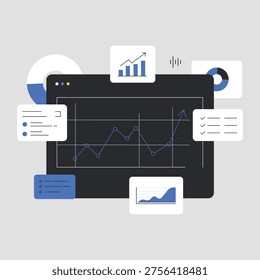
Data integration: Decision intelligence requires clean, connected data. This means CRM, marketing automation, product data (if applicable), and channel analytics feeding into a unified layer — not isolated tools reporting independently. Without a connected data foundation, the system cannot identify patterns across the buyer journey.
Signal detection: The system monitors incoming data for meaningful changes — a spike in intent data for a target account, a sharp drop in email reply rates for a specific sequence, a cluster of at-risk deals with shared characteristics. Not all signals matter equally; the system learns which signals have historically predicted the outcomes you care about.
Scenario modeling: Given a signal or a decision point, the system models multiple response options and their expected outcomes. This is where AI adds its clearest value: processing historical data at a scale humans cannot match to build probabilistic models of what typically follows each type of intervention.
Recommendation output: The system surfaces a ranked set of recommended actions with supporting rationale. The revenue leader does not get a dashboard — they get a recommendation ("Prioritize these six accounts for executive outreach this week — three have opened 4+ emails and visited the pricing page") alongside the evidence that supports it.
Real-World Applications in B2B Revenue Teams
Decision intelligence is already in use at scale across B2B companies, often under different labels. Salesforce Einstein, for example, applies machine learning to opportunity scoring and next-best-action recommendations directly inside the CRM. Instead of reviewing every open deal manually, sales reps see a ranked list of which opportunities to focus on and why — based on engagement signals, deal age, stakeholder activity, and historical win patterns.
Drift (now part of Salesloft) built decision intelligence into its conversational marketing product: instead of routing all chatbot conversations to the same workflow, the system identifies high-fit accounts in real time and routes them directly to available sales reps for immediate engagement — a decision that previously required manual review of firmographic data is made in milliseconds.
On the marketing side, companies like Metadata use decision intelligence to automate paid media optimization. Rather than relying on marketers to manually adjust bids, targeting, and creative rotation, the system tests combinations, identifies what drives pipeline (not just clicks), and reallocates budget automatically — shifting from activity-based optimization to revenue-based optimization without requiring constant human oversight.
Where Most Teams Get Stuck
Building toward decision intelligence is harder than buying a new tool. The common failure points are predictable:

Data quality upstream: Decision intelligence systems are only as reliable as the data feeding them. Teams with inconsistent UTM conventions, incomplete CRM data, or unreliable attribution models will get recommendations built on corrupted inputs. The AI will confidently recommend the wrong action. Before deploying decision intelligence tools, auditing and cleaning the data layer is non-negotiable.
Misaligned success metrics: If the system optimizes for MQL volume and the business actually cares about closed revenue, the recommendations will be technically precise but strategically wrong. Defining the outcome the system should optimize for — pipeline influenced, revenue sourced, account engagement by tier — requires cross-functional alignment before the system goes live.
Over-automation: Teams that remove human judgment entirely often discover that their decision intelligence system has learned to optimize for the wrong proxy metric at scale. The goal is augmentation — reducing the cognitive load of decision-making, not eliminating human judgment from consequential choices.
Change management: Marketing and revenue operations teams trained to trust their own analysis often resist AI-generated recommendations, especially when those recommendations conflict with their intuition. Adoption requires demonstrated accuracy over time, transparency in how recommendations are generated, and a clear process for overriding recommendations and feeding that feedback back into the system.
Building the Path From Dashboards to Recommendations
Most B2B teams cannot flip a switch and deploy a full decision intelligence system overnight. A phased approach is more realistic:
Phase 1 — Clean the data layer. Audit your CRM for completeness and accuracy. Standardize UTM conventions. Validate your attribution model. Resolve MAP-to-CRM sync errors. This phase is unglamorous but foundational — every subsequent layer depends on it.
Phase 2 — Build leading indicators. Identify the metrics that predict the outcomes you care about — which early engagement signals correlate with closed-won, which campaign interactions precede pipeline creation. These leading indicators become the signal layer your decision intelligence system monitors.
Phase 3 — Introduce AI-assisted scoring. Implement account scoring, lead scoring, or opportunity scoring using machine learning rather than manual rule-based models. This is often the first concrete experience teams have with AI-generated recommendations, and it builds organizational trust in the technology before more complex applications are deployed.
Phase 4 — Automate low-stakes decisions. Start with decisions that are frequent, low-risk, and well-understood — email send-time optimization, bid adjustments, content recommendations. Automate these fully and track the outcomes against human-made equivalents. Build the evidence base that justifies expanding the system's scope.
Phase 5 — Surface recommendations at key decision points. Integrate the system's outputs into the workflow moments where decisions actually happen: the weekly pipeline review, the quarterly budget allocation, the channel performance debrief. The recommendation should appear where the human is already working, not in a separate tool they have to open.
Measuring the Impact of Decision Intelligence
One of the practical challenges of implementing decision intelligence is establishing clear before-and-after measurements. Teams that invest in DI infrastructure need to demonstrate business impact — not just operational improvements — to justify continued investment and organizational change.

The metrics most directly influenced by decision intelligence implementation fall into three categories:
Decision velocity: How long does it take the team to move from observing a signal to acting on it? In pipeline management, this might be measured as time from an intent spike to first sales contact. In campaign optimization, it might be measured as time from performance data availability to budget reallocation. Decision intelligence should reduce these timelines — if it does not, the implementation is not actually changing how decisions get made, only adding analytical complexity.
Decision accuracy: Are the decisions the team makes producing better outcomes over time? This requires tracking the results of AI-recommended actions versus manually made decisions across a meaningful sample. Most teams find that tracking decision accuracy requires a deliberate experimental design — a split between leads handled through the DI recommendation workflow and a control group handled through the standard process — run long enough to accumulate statistically meaningful outcome data.
Analyst time recaptured: Decision intelligence should reduce the time revenue operations and marketing analytics teams spend on manual data aggregation and interpretation. This time can be measured and monetized: if your DI system recaptures 10 hours per week per analyst that would otherwise be spent building reports and synthesizing data, that is a real productivity gain that can be reinvested into higher-value work.
Openview Partners, which has published extensively on go-to-market benchmarks for product-led growth companies, notes that the operational teams with the highest revenue output per headcount are consistently those that have invested in decision support infrastructure — not necessarily the largest teams, but the ones with the best-designed systems for converting data into action. Decision intelligence is the current frontier of that investment for most B2B organizations.
Building toward DI does not require a full-scale transformation program. Teams that start with the components they already have — improving the quality of their scoring models, adding leading indicator tracking to their pipeline reviews, automating a handful of low-stakes decisions — build the organizational capability and the data foundation that more sophisticated decision intelligence systems require. The goal is not to deploy AI for its own sake, but to make the team's collective judgment faster, better-informed, and less dependent on who happens to be in the room.
Connecting Decision Intelligence to Revenue Outcomes
Decision intelligence only justifies its implementation cost when it demonstrably improves revenue outcomes — not operational metrics, but pipeline, conversion rates, and closed revenue. Making this connection requires intentional instrumentation from the start: tracking which decisions were AI-recommended, which were human-overridden, and what the downstream outcomes were for both groups over time.
Teams that build this feedback loop early develop a compound advantage. Each cycle of AI recommendations, human decisions, and outcome tracking produces training data that improves the next round of recommendations. The system learns which signals in your specific market predict which outcomes for your specific ICP — and those learned patterns become proprietary competitive infrastructure that a competitor cannot replicate simply by purchasing the same tool.
Benchmark data from Forrester's B2B marketing research consistently shows that companies with mature AI-assisted decision workflows outperform peers on pipeline velocity — the speed at which opportunities move through the funnel — by a meaningful margin. This is not primarily because AI finds better leads; it is because AI-assisted systems reduce the lag between a signal appearing and a human acting on it. In B2B markets where buying windows are real and competitive, that lag reduction compounds into material pipeline and revenue difference over a fiscal year.
The practical entry point for most B2B teams in 2026 is not building custom decision intelligence infrastructure — it is activating the AI features already embedded in the platforms they use, instrumenting the outcomes, and building organizational habits around reviewing and acting on AI-generated recommendations with the same discipline they currently apply to dashboard review. The shift from "reading the numbers" to "reviewing and acting on the recommendations" is the cultural change that makes the technology investment worthwhile.
In practical terms, this means treating decision intelligence not as a technology project but as an operational capability — one that is built incrementally, measured rigorously, and refined continuously as the business and its data evolve. Teams that approach it this way consistently reach the point where the system's recommendations are trusted enough to act on by default, with human override reserved for the edge cases where context and judgment matter most. That inflection point is where the productivity and competitive gains become most tangible.
Frequently Asked Questions
Is decision intelligence the same as business intelligence?
No. Business intelligence (BI) focuses on reporting and visualization — showing what the data says. Decision intelligence goes further by applying AI and structured frameworks to translate data into recommended actions. BI answers "what happened?" — decision intelligence answers "what should we do about it?"
Do we need a data science team to implement decision intelligence?
Not necessarily. Many modern revenue and marketing platforms (CRMs, MAPs, ad platforms) have embedded decision intelligence features — predictive scoring, next-best-action recommendations, automated optimization — that do not require a dedicated data science team to operate. However, data science resources become important when you want to build custom models or integrate signals from multiple systems that don't natively connect.
How long does it take to see results from decision intelligence?
For teams adopting embedded features within existing tools (like Salesforce Einstein or HubSpot AI), value is often visible within 60-90 days as scoring models build accuracy on historical data. For teams building custom decision intelligence layers, the timeline is longer — typically 6-12 months to clean data, build models, and validate recommendations before deploying them in production workflows.
What is the biggest risk of decision intelligence?
The biggest risk is optimizing confidently for the wrong outcome. If your decision intelligence system is trained on biased or incomplete data, it will generate recommendations that are precisely wrong at scale. Regular model audits, outcome tracking, and human override mechanisms are essential safeguards. The system should make you faster and more precise, not replace the judgment required to define what success actually looks like.
How does decision intelligence relate to predictive analytics?
Predictive analytics is a component of decision intelligence. Predictive models forecast what is likely to happen — account X has a 78% probability of closing this quarter. Decision intelligence takes that prediction and pairs it with scenario modeling and a recommended action — "contact account X's economic buyer this week with a ROI case study based on their industry." Prediction without recommended action is insight; prediction with structured recommendations is decision intelligence.
Can small marketing teams benefit from decision intelligence?
Yes, often more proportionally than large teams. A small team that replaces time-consuming manual analysis with AI-generated recommendations gets a larger efficiency gain relative to their total capacity. The key is starting with the right tools — platforms with embedded AI features — rather than attempting to build custom infrastructure that requires resources a small team does not have.
Key Takeaways
- Decision intelligence helps teams make faster, more confident decisions.
- Dashboards show past data but do not provide actionable next steps.
- A decision intelligence system combines data integration, signal detection, scenario modeling, and recommendations.
- B2B companies are using decision intelligence for improved opportunity scoring and action recommendations.
Frequently Asked Questions
- What is decision intelligence?
- Decision intelligence is the application of AI and structured frameworks to convert data into actionable decisions.
- Why are dashboards insufficient for decision-making?
- Dashboards only display historical data and do not indicate what actions to take next.
- What are the core components of a decision intelligence system?
- The system includes data integration, signal detection, scenario modeling, and recommendation output.
- How is decision intelligence applied in B2B companies?
- B2B companies use decision intelligence for opportunity scoring and to prioritize actions based on data signals.
See Where Your Business Stands in Search
Get a free site audit. We identify what is holding you back and what to fix first.
Related Resources
Explore more insights to enhance your digital marketing strategy
Revenue Operations: Connecting Marketing, Sales, and CS Data
How high-performing RevOps teams unify data across the full customer lifecycle to eliminate reporting gaps and drive faster decisions.
Decision Intelligence Platform
Unify attribution, MMM, and incrementality into a single operating view. Route every measurement question to the right instrument automatically.
See It Run on Your Stack
Book a demo to see how RankWorks connects to your CRM, MAP, and ad platforms without adding more complexity to your martech stack.