
For decades, organizations have measured success using a familiar set of metrics. Traffic. Leads. Pipeline. Revenue. Market share. These metrics remain important. However, they all share a common characteristic: they are outcome metrics. They tell organizations what happened after buyers made decisions.
What they do not explain is why those decisions happened in the first place. Before revenue exists, buyers must discover. Before pipeline exists, buyers must evaluate. Before market share exists, buyers must become aware. In every market, growth begins with discoverability.
Historically, discoverability was dominated by search engines. Organizations competed for rankings. Visibility was largely determined by search position. Today, discoverability occurs across a much broader ecosystem. Buyers discover information through Google, ChatGPT, Gemini, Claude, Perplexity, Reddit, LinkedIn, industry communities, analyst reports, and peer recommendations.
Visibility Share
The percentage of total discoverability an organization owns relative to competitors across search engines, AI systems, content ecosystems, communities, publications, and buyer research environments.
Just as market share became one of the defining business metrics of the twentieth century, Visibility Share is emerging as one of the defining growth metrics of the AI era. Before companies compete for customers, they compete for discovery. The companies that own discovery often own the future.
The RankWorks Definition of Visibility Share
Visibility Share is the percentage of total discoverability an organization owns relative to competitors across search engines, AI systems, content ecosystems, communities, publications, and buyer research environments. Several elements of this definition are critical.
Not limited to search
Visibility Share encompasses all environments where buyers discover solutions - including AI systems, publications, and communities that traditional search metrics ignore.
Not limited to traffic
Traffic measures visits. Visibility Share measures discoverability. An organization can have strong Visibility Share without high traffic - and vice versa.
Not limited to impressions
Impressions capture one moment. Visibility Share captures the complete competitive discoverability picture across the entire buyer research ecosystem.
What Visibility Share measures
The Economics of Visibility
Visibility behaves like an economic asset. It can be accumulated. It can be lost. It can compound. It creates competitive advantages. And like other strategic assets, visibility is limited. There are only so many search results, AI recommendation slots, industry citations, category leaders, and buyer consideration sets. Every market contains a finite amount of discoverability - and organizations compete to control larger portions of it.
Visibility Is Scarce
Buyer attention is not infinite. AI recommendation slots are not infinite. Search rankings are not infinite. Category leadership positions are not infinite. Visibility is scarce - which means it has value. Organizations that accumulate Visibility Share are accumulating a strategic asset.
Visibility Compounds
Higher visibility creates more discovery, more engagement, more citations, and more recommendations - which in turn creates more visibility. This compounding effect explains why category leaders frequently strengthen over time. Visibility becomes self-reinforcing.
Visibility Creates Advantages
Organizations with strong Visibility Share often experience lower acquisition costs, greater brand recognition, stronger recommendation rates, more inbound demand, and greater category authority. These advantages compound over time.
Buyers have more information access today than at any previous point in history. Every category contains more vendors, more content, more opinions, more research, and more recommendations. This abundance creates scarcity of attention. Organizations are no longer competing solely for customers - they are competing for discoverability.
Why Visibility Is Relative
One of the biggest mistakes organizations make is evaluating visibility without competitive context. This seems obvious in retrospect, yet most dashboards still measure visibility in isolation.
A simple example that changes everything
Company A
+20%
Visibility increase this year
Looks positive in isolation.
Company B (competitor)
+60%
Visibility increase this year
Company A is losing Visibility Share.
Both companies improved. Only one gained share.
This is the core principle of Visibility Share. Visibility should never be measured in isolation. Visibility should be measured relative to competitors. An organization can improve traffic, rankings, and impressions and still be losing the discoverability battle - because competitors are gaining ground faster.
Visibility Share vs Traditional Metrics
Many existing metrics attempt to measure awareness, reach, or performance. Visibility Share differs in important ways from each of them.
Visibility Share does not replace these metrics. It contextualizes them. Traffic, rankings, and share of voice remain useful inputs. What they lack is the competitive framing that shows whether overall discoverability is strengthening or weakening relative to market alternatives.
Why Visibility Share Is Becoming a Board-Level Metric
Historically, visibility was treated as a marketing concern. That perspective is changing. Visibility increasingly influences revenue growth, competitive position, market perception, strategic planning, and investor confidence. Executive teams are beginning to view discoverability as a business asset - and Visibility Share provides the framework for measuring it.
"Are we becoming easier to discover than competitors?"
Visibility Share trend tracking across all six dimensions answers this directly.
"Which categories and topics are we losing ground on?"
Topic Ownership Share and AI Visibility Share reveal specific gaps before they appear in revenue.
"How does our discoverability position compare to key rivals?"
Competitive benchmarking across the six dimensions provides a clear relative position.
"Is our AI citation frequency growing or declining?"
Citation Share and AI Visibility Share surface recommendation ecosystem dynamics.
The Visibility Share Framework: Six Dimensions
Visibility Share is not a single metric. It is a composite measurement framework. One reason traditional visibility metrics often fail is that they focus on a single channel or a single outcome. Modern buyers do not discover organizations through a single environment - they move across multiple ecosystems before making decisions. Visibility Share must therefore measure visibility across the entire discovery ecosystem.
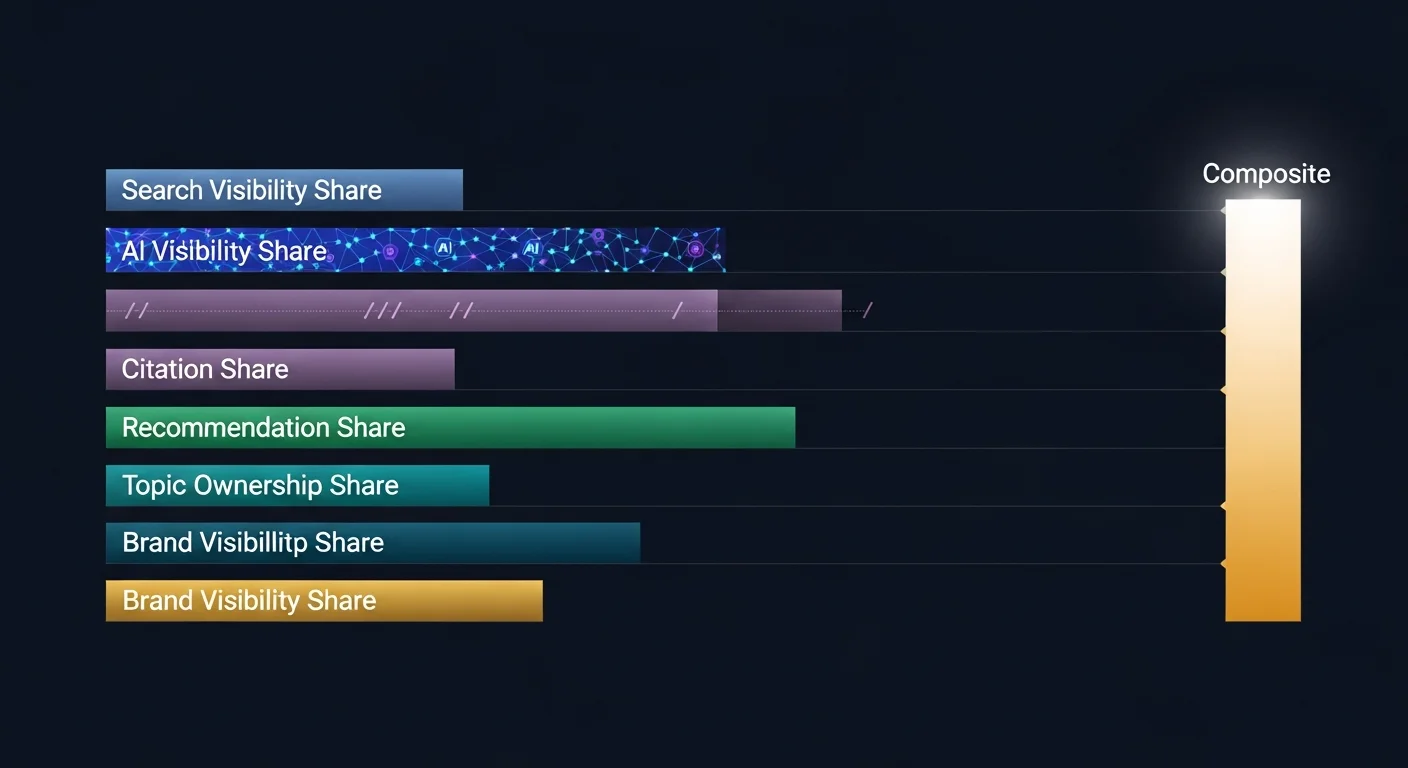
The six dimensions of Visibility Share combine to create a composite measure of competitive discoverability. No single dimension captures the complete picture - all six together reflect where an organization truly stands in the market.
The Visibility Share Formula
One of the most common questions executives ask is whether Visibility Share can be quantified. The answer is yes. At a conceptual level, Visibility Share is a composite of its six dimensions. The exact weighting varies by industry and category - but the framework remains consistent.
Conceptual formula
Industry weighting varies
A B2B software company may weight AI Visibility, Topic Ownership, and Recommendation Share more heavily. A consumer brand may weight Brand Visibility and Search Visibility more heavily. This is why Visibility Share should be viewed as a framework rather than a fixed calculation.
Visibility Share Benchmarks
As organizations begin measuring Visibility Share, a common question emerges: what does good look like? While benchmarks vary by category, organizations typically fall into one of four groups.
Emerging Organizations
Growing Organizations
Category Challengers
Category Leaders
Why Visibility Share Predicts Market Share
One of the most important questions executives ask when introduced to Visibility Share is whether it actually predicts business outcomes. The answer is increasingly yes - not because visibility guarantees success, but because visibility influences the conditions that make success possible. Organizations cannot generate pipeline without discovery. They cannot generate customers without consideration. They cannot gain market share without first gaining attention.
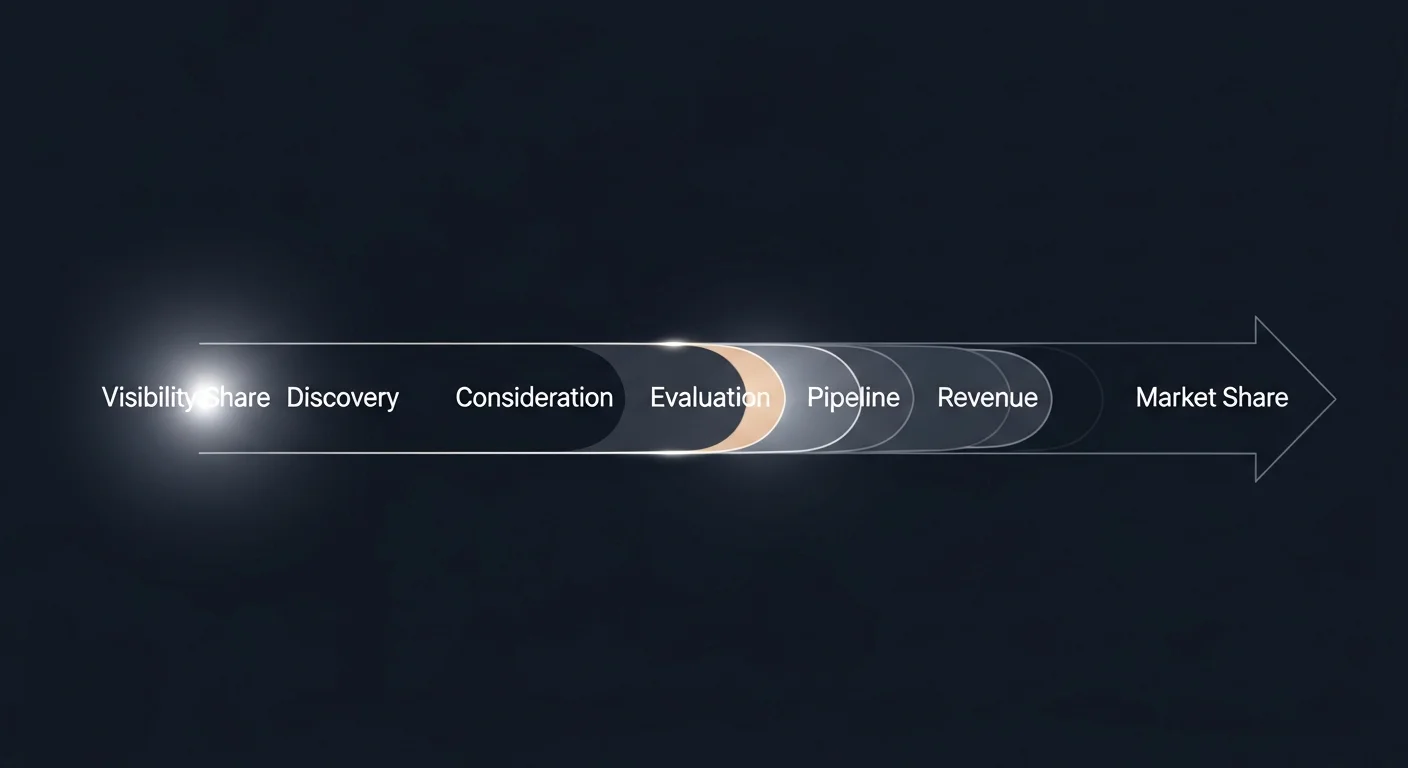
Visibility Share sits at the very beginning of the growth sequence. Changes in Visibility Share frequently appear months before changes in pipeline and revenue.
The visibility-to-market-share chain
Every stage depends on the stage before it. Improvements in Visibility Share frequently appear before improvements in revenue.
Market Share: lagging indicator
Market Share answers: "How many customers do we have?" It tells organizations what has already happened. Organizations that monitor only Market Share often react after changes occur.
Visibility Share: leading indicator
Visibility Share answers: "How likely are future customers to discover us?" It measures opportunity. Organizations that monitor Visibility Share can identify competitive shifts earlier.
Visibility Share in the Age of AI Search
The emergence of AI search is dramatically increasing the importance of Visibility Share. Historically, discoverability was distributed across many links. Buyers evaluated options themselves. Today AI systems increasingly act as intermediaries - they summarize, recommend, curate, and influence. This changes how visibility functions.
From Search Engines to Recommendation Engines
Traditional search engines primarily organized information. AI systems increasingly interpret it. Search engines often displayed 10 to 20 links per query. AI systems frequently display three to five recommendations. This creates recommendation scarcity - and scarcity increases the value of visibility. The shift from ranking competition to recommendation competition is one of the defining trends of the AI era.
AI Visibility Share Is Part of Overall Visibility Share
Many organizations think of AI visibility as a separate discipline. In reality, AI Visibility Share is one of the six components of Visibility Share. The same core principle applies: the question is not "are we visible?" but "how visible are we compared to competitors inside AI systems?"
AI Search Increases Visibility Concentration
AI systems recommend fewer options per query than traditional search engines. This creates a winner-takes-more dynamic. Organizations with strong AI Visibility Share become more visible. Organizations with weak AI Visibility Share become increasingly difficult to discover. This concentration effect is one reason why Visibility Share is becoming strategically important for executive teams.
Visibility Share for CMOs
Marketing leaders have always been responsible for creating visibility. Historically, however, they lacked a unified metric for measuring discoverability across channels. Visibility Share helps solve this problem by providing a strategic KPI that goes beyond activity metrics.
A Better Strategic KPI
Traffic, leads, and impressions explain activity. Visibility Share explains position. It helps answer whether you are gaining discoverability, whether competitors are becoming more visible, which topics create authority, and which investments increase competitive position.
Better Resource Allocation
Visibility Share provides a framework for investment decisions. Which topics deserve priority? Which content creates authority? Which channels drive discoverability? The objective becomes clear: increase competitive discoverability across the six dimensions.
Category Leadership
The strongest organizations do not just compete inside categories - they define them. Visibility Share helps marketers understand which conversations matter, which topics drive discoverability, and which concepts create the authority needed for category leadership.
Visibility Share for CEOs
For CEOs, Visibility Share provides a strategic view of competitive position. It helps answer questions that traditional reporting often misses - and it provides an early-warning system for market changes that lagging indicators like revenue and market share cannot.
"Are we becoming easier to discover than competitors?"
Visibility Share trend analysis shows whether overall discoverability is growing or declining relative to the competitive set.
"Are competitors gaining visibility in our category?"
Competitive Visibility Share benchmarking surfaces emerging threats before they show up in revenue or pipeline data.
"Is our visibility creating strategic asset value?"
Visibility should be viewed through the same lens as capital, talent, and technology. It creates opportunity, compounds over time, and influences future growth potential.
"Where should we invest to grow market position?"
Visibility Share identifies specific gaps - in AI Visibility, Topic Ownership, or Recommendation Share - that represent the highest-leverage investment opportunities.
Visibility Share for Revenue Teams
Revenue teams focus on predictability. Predictability depends on understanding future opportunity. Visibility Share helps revenue teams understand how discoverability may influence future pipeline creation - giving them visibility into demand creation at the earliest stages.
Demand Creation
Better Forecasting
Risk Identification
The Visibility Share Maturity Model
Organizations typically progress through six stages of measurement maturity. Understanding where an organization sits helps leaders identify the next strategic development stage.
Activity Metrics
Focus
What did we do?
Key metrics
Content production, campaigns, website activity
What it lacks
Measures effort, not outcomes or competitive position.
Performance Metrics
Focus
What happened?
Key metrics
Traffic, leads, revenue
What it lacks
Measures outcomes but not competitive context.
Attribution Metrics
Focus
What created results?
Key metrics
Channel attribution, campaign attribution, conversion attribution
What it lacks
Explains which channels drive outcomes - still internally focused.
Visibility Intelligence
Focus
Where are buyers discovering us?
Key metrics
Search visibility, AI visibility, Brand visibility
What it lacks
Direct visibility measurement begins. Still lacks competitive context.
Visibility Share
Focus
How much discoverability do we own?
Key metrics
Visibility Share, Recommendation Share, Citation Share, Topic Ownership
What it lacks
Competitive context added. Leading indicator value unlocked.
Decision Intelligence
Focus
What should we do next?
Key metrics
Growth signals, competitive trends, visibility opportunities
What it lacks
Visibility data feeds strategic action and growth decisions.
How RankWorks Measures Visibility Share
Traditional platforms measure pieces of discoverability. One platform measures rankings. Another measures traffic. Another measures attribution. RankWorks approaches discoverability differently - through Visibility Intelligence, evaluating visibility across search ecosystems, AI systems, content ecosystems, communities, publications, and buyer research environments. The objective is not merely understanding performance. It is understanding competitive discoverability.
Frequently Asked Questions About Visibility Share
Common questions from CMOs, CEOs, revenue leaders, and strategy teams about Visibility Share, how it differs from share of voice and market share, and why it is becoming one of the most important growth metrics of the AI era.
Still have questions?
Our SEO experts are here to help. Get personalized answers and a free consultation.
Key Takeaways
- 1
Visibility is becoming a strategic asset. Discoverability increasingly influences growth, market position, and competitive advantage. As buyer research fragments across search, AI systems, communities, and peer networks, controlling more of the discoverability landscape creates compounding advantages.
- 2
Visibility Share measures competitive discoverability. The objective is not simply measuring how visible an organization is. The objective is measuring how visible it is relative to competitors - because visibility only matters within a competitive environment where buyers compare alternatives.
- 3
Six dimensions compose the complete Visibility Share Framework. Search Visibility Share, AI Visibility Share, Citation Share, Recommendation Share, Topic Ownership Share, and Brand Visibility Share together reflect the full competitive discoverability picture. No single dimension tells the complete story.
- 4
AI search creates recommendation scarcity that raises the stakes. AI systems provide dramatically fewer options per query than traditional search engines. This binary dynamic - included or excluded - makes AI Visibility Share one of the most competitively important dimensions in modern markets.
- 5
Visibility Share predicts future market share. Changes in Visibility Share frequently appear months before changes in pipeline and revenue. Organizations that monitor Visibility Share gain earlier signals of future growth opportunities and competitive threats than those relying solely on lagging outcome metrics.
- 6
Visibility often precedes revenue. The sequence runs: Visibility Share, then Discovery, then Consideration, then Evaluation, then Pipeline, then Revenue, then Market Share. Every stage depends on the stage before it. This is what makes Visibility Share the most important leading indicator in the growth measurement stack.
- 7
The history of measurement is evolving. Organizations first measured activity, then performance, then attribution. The next evolution is competitive discoverability. Before organizations win customers, they must win discovery. Visibility Share measures who is winning that earlier, more important competition.
Continue Reading
Competitive Visibility Intelligence
The full framework for measuring relative discoverability, authority, and market position.
Brand Visibility Intelligence
The five-dimension framework that anchors Visibility Share within the broader growth system.
AI Visibility Framework
The five-layer progression from Presence to Influence within AI recommendation systems.
Decision Intelligence
How Visibility Share data feeds into strategic growth decisions and opportunity forecasting.