Marketing Attribution
Models, Measurement, Revenue Impact, and the Future of Attribution
Organizations invest millions across advertising, content, events, partnerships, and search. One question drives every budget meeting: which activities actually drive results? This guide explains what marketing attribution is, how every attribution model works, where attribution fails, and how modern revenue teams are building measurement frameworks that go beyond clicks and conversions.
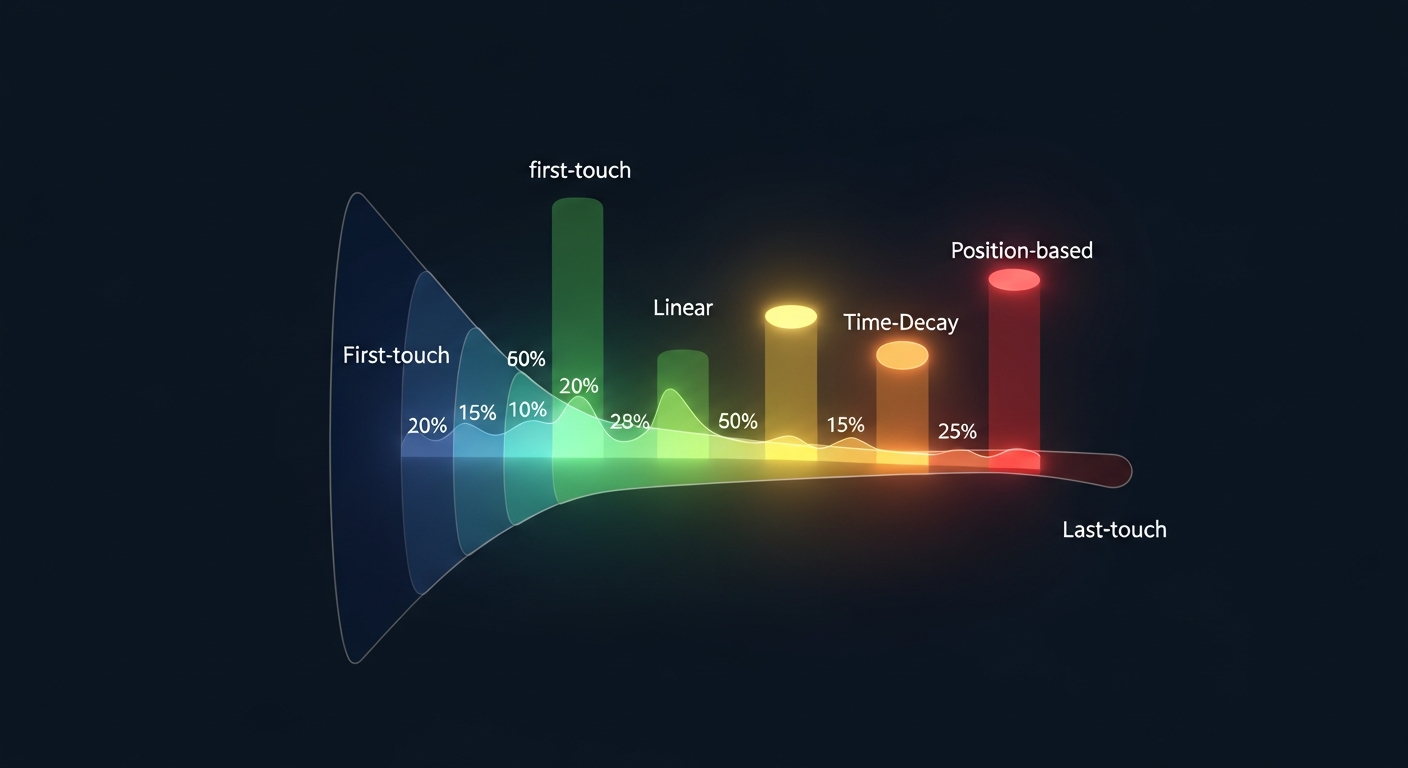
Each attribution model distributes credit differently - because each one is answering a different question about buyer behavior
Key Takeaways
Attribution assigns credit to marketing interactions that influence outcomes - leads, pipeline, and revenue
Every attribution model produces different answers from the exact same buyer journey
The Attribution Gap is the difference between measurable activity and actual influence
Dark social, AI search, and buying committees create influence attribution cannot see
Visibility typically occurs before attribution events - it must be measured separately
Leading teams combine Attribution, Visibility Intelligence, and Decision Intelligence
What Is Marketing Attribution?
Marketing attribution is the process of identifying and assigning value to the marketing activities that influence a desired outcome. The outcome may include website conversions, lead generation, opportunity creation, pipeline growth, revenue generation, or customer acquisition.
Attribution attempts to answer a deceptively simple question: what contributed to this result? This question appears straightforward. In practice, it is one of the most difficult measurement challenges in marketing - because most results are shaped by far more interactions than any attribution system can fully observe.
The Working Definition
Marketing attribution is the practice of determining which marketing interactions contribute to business outcomes and assigning credit accordingly. It helps organizations understand which channels perform best, which campaigns create influence, which content drives engagement, and which investments generate revenue.
Without attribution, organizations are forced to rely on assumptions. Attribution transforms assumptions into measurable insights - and those insights affect budget allocation, campaign decisions, revenue forecasting, and executive reporting.
Budget Allocation
Which channels get more investment and which get cut
Campaign Optimization
Which campaigns scale and which are wound down
Revenue Forecasting
Connecting marketing performance to pipeline predictions
Growth Planning
Which programs deserve expansion and prioritization
Executive Reporting
How marketing explains its contribution to leadership
Marketing Accountability
Connecting spend to outcomes with evidence
Why Marketing Attribution Exists
Historically, marketing performance was difficult to measure. Organizations spent money on advertising, events, sponsorships, content, and brand campaigns without clear visibility into what worked. Executives repeatedly asked: what worked, what did not work, and where should we invest next?
Marketing teams often struggled to provide objective answers. Attribution emerged as a way to connect activity with outcomes. Its original purpose was simple: create accountability.
The Accountability Problem
Every marketing investment competes for resources. Without attribution, decisions about which campaigns deserve funding, which channels deserve expansion, and which programs should be eliminated become subjective. Attribution provides evidence. Evidence improves decisions. This is why attribution became foundational to modern marketing.
The Modern Attribution Challenge
Today attribution influences significantly more than lead tracking - and the buyer journey it must measure has grown far more complex. Modern buyers interact with search engines, AI systems, communities, review platforms, websites, sales teams, industry publications, events, analysts, and peers. Some journeys involve dozens of touchpoints. Others involve hundreds.
As buyer behavior evolves, attribution models must evolve with it
Organizations need to measure not just channel performance but influence
Visibility and consideration occur before attribution events fire
The future belongs to teams that connect attribution with revenue intelligence
The Evolution of Marketing Attribution
The history of attribution mirrors the evolution of marketing itself. As buyer journeys became more complex, attribution models became more sophisticated - and more limited.
Single-Channel Era
Print, television, radio, and direct mail. Measurement was limited. Attribution relied on broad assumptions - primarily: did the campaign work?
Digital Attribution Era
Website analytics, click tracking, and conversion tracking gave marketers detailed behavioral data for the first time. Attribution became a core discipline.
Multi-Touch Era
Expanding buyer journeys required models capable of assigning credit across multiple interactions. Linear, time decay, and position-based models emerged.
Revenue Attribution Era
Organizations recognized that lead attribution alone was insufficient. The focus shifted toward pipeline attribution, opportunity attribution, and revenue impact.
Marketing Attribution Models Explained
An attribution model is a framework for assigning credit across the interactions that influence a conversion, opportunity, or revenue event. Different models answer different questions - and they can produce dramatically different conclusions from the exact same buyer journey.
The Attribution Model Problem
Consider a common B2B journey. A prospect discovers a company through Google, reads several blog articles, attends a webinar, downloads a guide, receives nurturing emails, engages with sales, and becomes a customer. Which interaction deserves credit? The answer depends entirely on the attribution model applied.
First-Touch Attribution
100% to the first interaction
Credit distribution across 5 touchpoints
Last-Touch Attribution
100% to the final interaction
Credit distribution across 5 touchpoints
Linear Attribution
Equal credit across all touchpoints
Credit distribution across 5 touchpoints
Time Decay Attribution
More credit to recent touchpoints
Credit distribution across 5 touchpoints
U-Shaped Attribution
40% first, 40% lead conversion, 20% middle
Credit distribution across 5 touchpoints
W-Shaped Attribution
Credit to first touch, lead creation, opportunity
Credit distribution across 5 touchpoints
Full Path Attribution
Across all milestones including closed revenue
Credit distribution across 5 touchpoints
Data-Driven Attribution
Algorithm-based credit from observed patterns
Credit distribution across 5 touchpoints
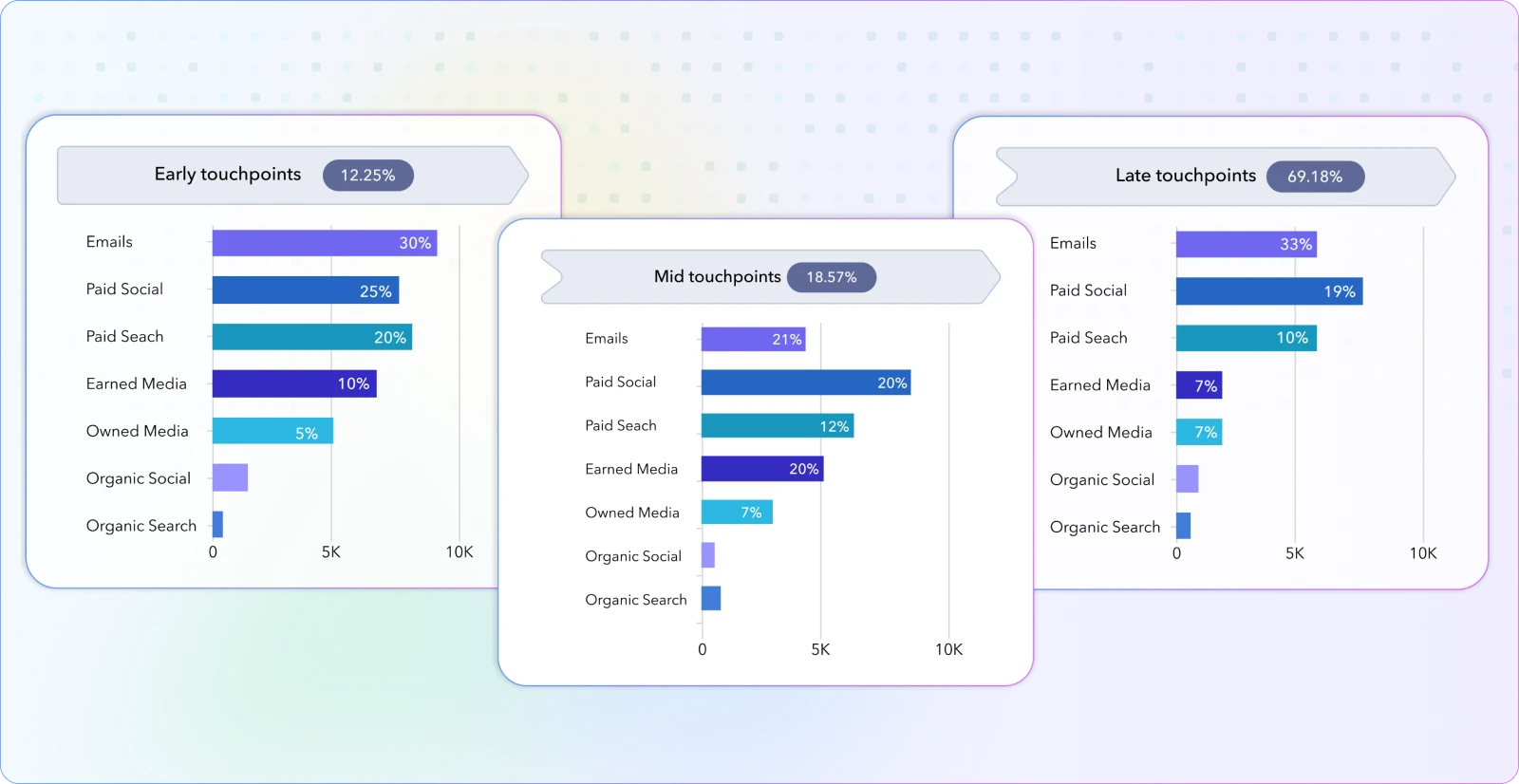
Multi-touch attribution distributes credit across all visible touchpoints rather than crediting a single interaction
Want a deeper breakdown of each model? See: Attribution Models Explained and Multi-Touch Attribution Guide
Attribution in B2B vs B2C
One of the biggest mistakes organizations make is assuming attribution works the same way across every market. B2B and B2C buying journeys differ significantly. Attribution requirements differ as well.
B2C Attribution
B2C journeys typically involve shorter decision cycles, higher transaction volumes, and fewer stakeholders. Examples include ecommerce, consumer subscriptions, and retail purchases. Attribution tends to be more direct - organizations can often connect interactions to purchases relatively quickly.
- Shorter buying cycles (hours to days)
- Single decision maker
- Higher transaction volume
- Click-to-conversion traceable
- Attribution systems designed for B2C work well
B2B Attribution
B2B buying journeys are significantly more complex. They involve multiple stakeholders, longer sales cycles, complex evaluation processes, and a single opportunity that may touch search, content, webinars, events, communities, sales interactions, and executive discussions over months.
- Buying cycles of weeks, months, or years
- Multiple stakeholders (3 to 20+ per deal)
- Lower transaction volume, higher deal value
- Influence tracked across accounts not individuals
- Attribution accuracy decreases as complexity rises

B2B deals involve buying committees where each stakeholder follows a separate research journey - attribution rarely connects them into a single account view
Why Most Attribution Models Fail
Attribution models provide useful insights. However, most share a common limitation: they simplify reality. Real buyer journeys are messy, nonlinear, and influenced by factors that are often impossible to measure directly.
Examples of influences that occur outside traditional attribution systems include peer recommendations, internal conversations, analyst reports, brand reputation, community influence, and AI-generated recommendations. Many of these never appear in a CRM or analytics platform.
The Attribution Gap
The Attribution Gap is the difference between measurable activity and actual influence. It represents everything that shapes buying decisions but remains partially visible, difficult to track, or entirely invisible within traditional attribution systems. Understanding this gap explains why attribution remains valuable while simultaneously becoming insufficient on its own.

The Attribution Gap: measurable touchpoints represent only part of what actually influenced the decision
Five Factors That Create the Attribution Gap
Cookie Loss and Privacy Changes
Privacy regulations and browser restrictions have reduced cross-site, cross-device, and cross-session tracking. Less data reaches attribution systems than it did five years ago.
Multi-Device Research Journeys
Buyers discover on mobile, evaluate on desktop, share with colleagues, and convert from a different browser or device entirely. Attribution may treat each session as a separate unknown user.
Dark Social
Slack messages, Teams discussions, private communities, email forwards, and peer conversations drive significant decisions. These interactions never appear inside attribution reports.
Buying Committees
B2B deals involve decision makers, budget owners, technical evaluators, and champions - each conducting separate research journeys that attribution rarely connects into one account view.
AI Search Discovery
Buyers ask ChatGPT, Gemini, and Perplexity for vendor shortlists before visiting any website. These discovery and evaluation moments are entirely invisible to traditional attribution.
Dark Social and Invisible Influence
One of the biggest contributors to the Attribution Gap is Dark Social. Dark Social refers to interactions that influence decisions but are difficult to attribute accurately. Organizations may understand what generated a lead. They often struggle to understand what generated belief.
Dark Social Channels
Private Slack Communities
Buying decisions and vendor recommendations discussed openly among peers
Microsoft Teams Discussions
Internal vendor research shared across buying committee members
WhatsApp and Direct Messages
Peer referrals and recommendations exchanged privately
Internal Email Chains
Content forwarded and discussed among stakeholders
Peer Referrals
Word-of-mouth from conferences, communities, and relationships
Why Influence Is Difficult to Measure
Consider a common B2B scenario. A buyer reads content for six months, hears peers discuss a vendor in a community, encounters the company repeatedly in different environments, uses ChatGPT for category research, attends a webinar, and receives an internal recommendation. Months later they request a demo.
Attribution systems often assign credit to the final measurable touchpoint - the demo request form, the webinar registration, or the Google search before the visit. The actual decision was shaped by dozens of experiences. Many of which never appear in any reporting system.
Attribution report says:
"Google Search generated this opportunity"
What actually happened:
6 months of content exposure + peer community discussions + AI search discovery + 3 internal stakeholder conversations + a referral from a known contact
The AI Search Attribution Problem
Artificial intelligence introduces an entirely new measurement challenge. Historically, attribution depended on clicks. Users clicked links, organizations tracked visits, and visits became measurable interactions. AI-powered search changes this process entirely.
Users increasingly receive answers before clicking. Systems like ChatGPT, Gemini, Claude, Perplexity, and Google AI Overviews now deliver vendor shortlists, comparisons, and recommendations directly. A buyer may discover a company, learn about a category, evaluate solutions, and create a mental shortlist - all without generating a single traditional attribution event.
The Clickless Discovery Problem
A buyer asks: "What are the best marketing attribution platforms?" The AI system provides recommendations with explanations. The buyer learns. The buyer evaluates. The buyer forms strong opinions. No website visit occurs. No conversion event fires. No attribution signal exists. Yet influence has clearly happened - and it may have shaped the eventual purchase decision more than anything traceable in a CRM.

Attribution vs Visibility
As attribution limitations become more apparent, organizations increasingly need a broader measurement framework. This is where the distinction between attribution and visibility becomes important.
Attribution
"What influenced this outcome?"
Attribution focuses on observable events. It measures conversions, leads, opportunities, and revenue. Attribution is an outcome measurement. It helps explain what happened after a buyer entered a measurable part of the journey.
- Conversions and form fills
- Lead source and channel
- Campaign contribution
- CRM-tracked touchpoints
- Revenue and pipeline
Visibility
"How discoverable are we before the outcome?"
Visibility focuses on discoverability. It measures how findable a brand is across search engines, AI systems, communities, publications, and recommendation environments. Visibility is an opportunity measurement - it explains why outcomes become possible.
- Search visibility and rankings
- AI citation and recommendation share
- Brand visibility and authority
- Topic ownership and coverage
- Competitive discoverability
Visibility Appears Before Attribution
The relationship between visibility and attribution typically follows this sequence. Attribution begins after discoverability. Visibility begins before it. This is why both measurements are necessary.

Visibility consistently precedes attribution events - organizations with higher visibility generate more of the outcomes attribution later measures
The Marketing Attribution Maturity Model
Organizations typically evolve through several stages of measurement maturity. Attribution remains foundational - it is simply no longer the final destination. The progression moves from activity measurement toward Decision Intelligence, where the question shifts from "what happened?" to "what should we do next?"
Activity Measurement
What did we do?
Performance Measurement
What happened?
Attribution
What influenced the outcome?
Visibility Intelligence
How discoverable are we?
Revenue Visibility
How does discoverability influence revenue?
Decision Intelligence
What should we do next?
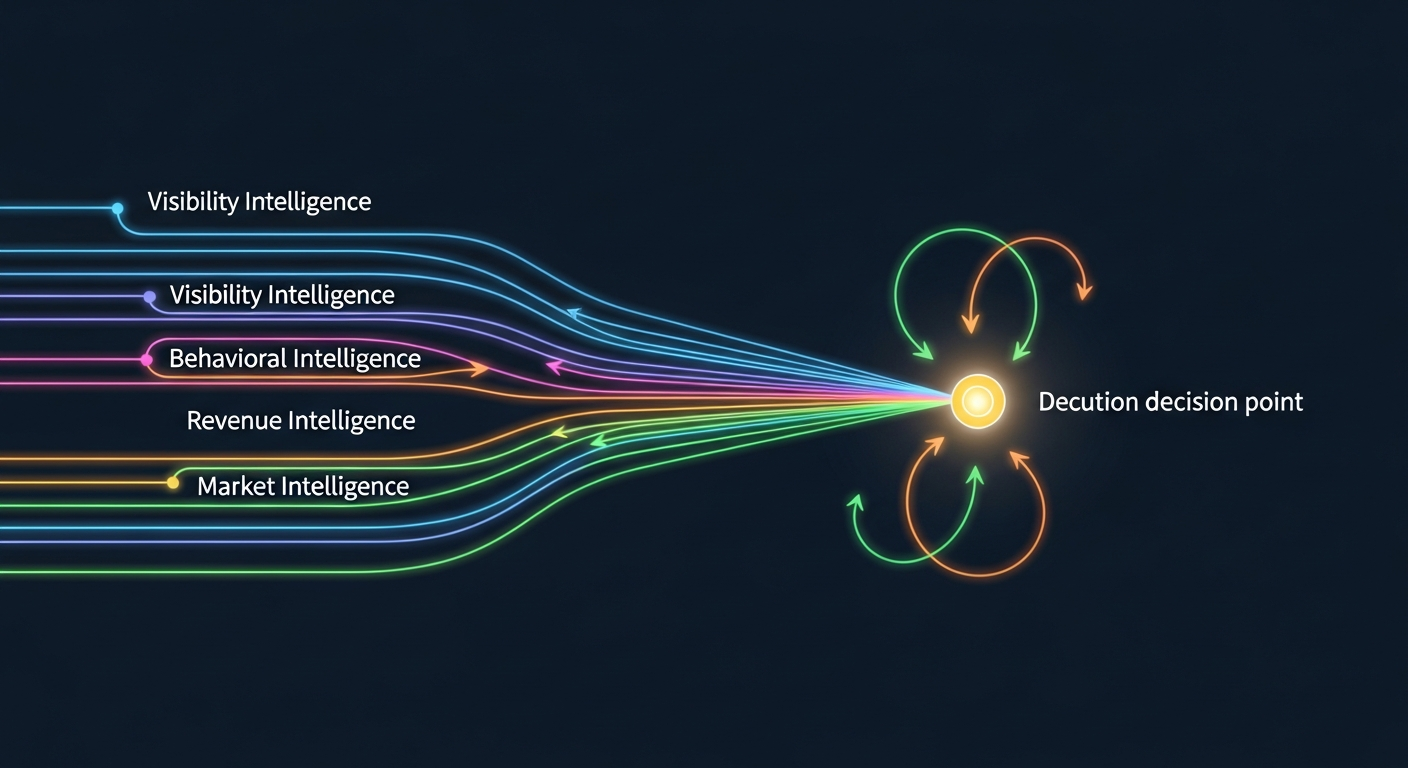
The measurement maturity progression - attribution is level three of six, not the final destination
From Reporting to Optimization
Decision Intelligence builds upon Attribution, Visibility Intelligence, and Revenue Visibility. The objective shifts from understanding performance to understanding what to do next. Which opportunities deserve pursuit? Which topics merit investment? Which visibility gaps are costing revenue?
Attribution Is the Foundation, Not the Ceiling
At RankWorks, attribution is viewed as an essential component of modern measurement - but only one component. Organizations need to understand attribution, visibility, influence, revenue impact, and competitive position together.
Rather than treating attribution as the end goal, we treat attribution as the foundation upon which Visibility Intelligence and Decision Intelligence are built. The objective is not merely understanding what happened. The objective is understanding what happens next.
Key Conclusions
Attribution Remains Foundational
Attribution helps connect marketing activity with business outcomes. Organizations should not abandon attribution - they should build upon it.
Modern Journeys Exceed Attribution's Scope
Buyer decisions are shaped by far more interactions than attribution systems can capture, especially in B2B.
The Attribution Gap Is Growing
AI search, communities, recommendations, and private conversations create influence that remains invisible to traditional measurement.
Visibility Must Be Measured Before Attribution
Discoverability frequently occurs before measurable attribution events. It requires its own measurement framework.
The Future Extends Beyond Attribution
Leading organizations combine Attribution, Visibility Intelligence, Revenue Visibility, and Decision Intelligence for a complete picture.
Explore the Full Attribution and Visibility Framework
Every topic in this guide has a dedicated deep-dive page. Start with the areas most relevant to your team.
Attribution Models Explained
First-touch to data-driven - every model compared
Multi-Touch Attribution
How MTA works, where it breaks down, what to do instead
Channel Attribution
Measuring performance across paid, organic, social, and email
Dark Social Attribution
Measuring the influence that attribution cannot see
Attribution vs Visibility
Why both measurements are necessary in modern B2B
Visibility Share
The metric that predicts market share before revenue does
AI Search Visibility
How to be found and cited in AI-powered search systems
AI Search Attribution
How to attribute conversions and pipeline influenced by AI search
Recommendation Share
Who gets recommended when buyers ask AI for shortlists
Competitive Visibility Intelligence
Tracking how discoverable you are vs. competitors
Revenue Visibility
Connecting discoverability to pipeline and revenue
Decision Intelligence
Moving from measurement to strategic action
The Visibility Gap
Why buyers choose competitors before your sales team engages
Attribution Board Reporting
Executive attribution frameworks CMOs actually use
How CMOs Use Attribution Data
Strategic attribution for executive decision-making
Attribution in the AI Search Era
Measurement frameworks for clickless buyer journeys
AI Visibility
Five layers of presence in AI-powered search environments
In-Depth Attribution Articles
Practical guides covering specific attribution challenges, tools, and implementation approaches for B2B revenue teams.
Campaign Attribution: Tying Campaigns to Revenue
How to connect individual campaigns to closed revenue using multi-touch models
Channel Attribution: Measuring Cross-Channel Influence
Measuring paid, organic, social, and email contribution to pipeline
Pipeline Attribution: Assigning Credit Across Marketing and Sales
How to allocate pipeline credit fairly between marketing and sales activities
Salesforce Campaign Attribution: Campaign Influence for ROI
Configuring Salesforce Campaign Influence to prove marketing ROI
Self-Reported Attribution: Filling Dark Social Gaps
Using "how did you hear about us?" survey data to capture untrackable influence
Offline Conversion Tracking: Field Sales to Digital Campaigns
Connecting in-person interactions and field sales activity to digital attribution
Revenue Attribution: Connecting Marketing to Closed Revenue
The full-funnel model for attributing closed-won revenue to marketing programs
Multi-Touch Attribution: Why It Breaks in B2B
The structural limits of MTA in long B2B cycles and practical alternatives
Attribution Models: Measuring What Actually Works
Comparing every attribution model and when each one produces reliable answers
Why Last-Click Attribution Is Lying to You
The systematic distortions last-touch attribution creates in B2B reporting
Marketing Mix Modeling vs. Attribution: Which to Use
When to use MMM, when to use attribution, and how to combine both
HubSpot Attribution vs. Dedicated Attribution Tools
Comparing native HubSpot attribution against standalone platforms
Beyond Marketing Attribution
What comes after attribution — visibility, influence, and decision intelligence
Marketing Attribution: The Complete B2B Guide
End-to-end attribution reference for B2B marketing and RevOps teams
Attribution Reporting for the CFO
How to present attribution data as a financial story, not a marketing one
Outbound Marketing Performance and Attribution
Measuring outbound campaign contribution to pipeline and revenue
Frequently Asked Questions
Direct answers to the most common questions about marketing attribution.
Frequently Asked Questions
Everything you need to know about our SEO services
Still have questions?
Our SEO experts are here to help. Get personalized answers and a free consultation.