What Is AI Search Visibility?
Every year, the way people search for information changes. For the first decade of modern search, users typed queries into a search engine and received a list of links to evaluate. For the next decade, that experience became more structured - featured snippets, knowledge panels, and rich results began answering questions directly within search results.
Today a more significant shift is underway. AI-powered systems - ChatGPT, Gemini, Claude, Perplexity, and AI Overviews - are increasingly used for research, comparison, and discovery. These systems do not return lists of links. They return answers. And within those answers, specific brands, products, and organizations are cited, referenced, or recommended.
AI Search Visibility measures whether your brand is part of those answers.
The RankWorks Definition
AI Search Visibility measures how discoverable, cited, and recommended a brand, product, or organization is within AI-powered search environments - including how accurately AI systems understand its capabilities, positioning, and value.
Discoverable
Can AI systems find, index, and access your content? Can they identify your brand when asked relevant queries?
Cited
Do AI systems reference your brand, content, or expertise when answering questions on topics you cover?
Recommended
Do AI systems include your brand in shortlists when buyers ask for vendor or solution recommendations?
The Discovery Shift
To understand why AI Search Visibility matters, it helps to understand what has changed in how people discover information. For most of the internet era, discovery meant search - typing a query and receiving a list of ranked pages. Visibility meant ranking. Higher position meant more visibility.
AI-powered search works differently. Users ask questions in natural language. AI systems interpret those questions, draw on trained knowledge and in some cases real-time retrieval, and construct synthesized answers. Those answers often include specific brands, products, or recommendations.
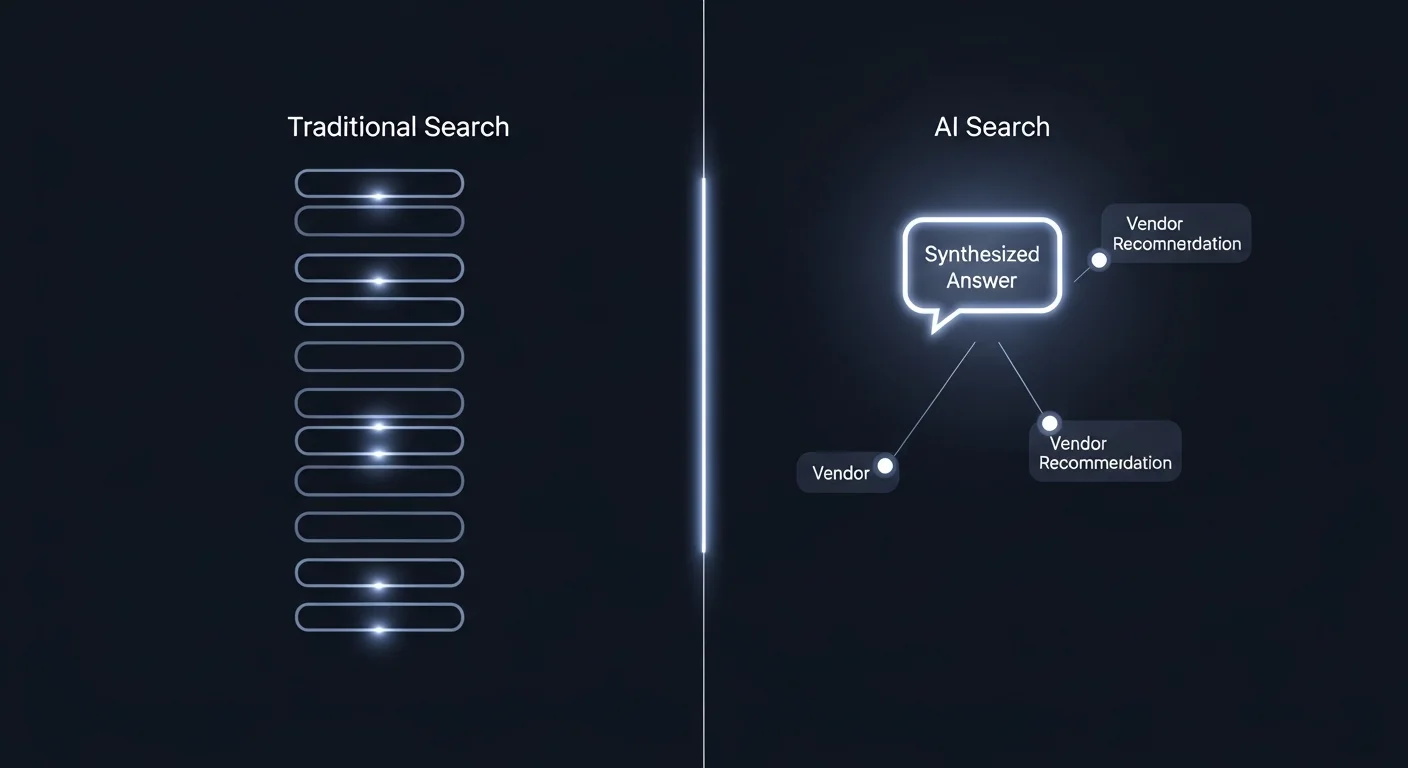
Traditional Search Discovery
AI-Powered Discovery
The Consideration Gap
In traditional search, buyer consideration begins on the search results page. In AI search, buyer consideration is already partially formed by the time they visit a website. Organizations not included in AI answers often miss consideration entirely - because the shortlist was created before any website was visited.
Why AI Search Visibility Matters Now
AI-powered search is not a future trend. Hundreds of millions of people use ChatGPT, Gemini, Perplexity, and similar tools regularly for research, comparisons, and decisions. AI Overviews appear above traditional search results for a growing percentage of commercial queries. Microsoft Copilot is embedded in productivity tools used by enterprise buyers daily.
For businesses, this creates a meaningful strategic challenge. Organizations that built strong visibility in traditional search did not necessarily build strong visibility in AI search. Many assumptions from the previous decade - content strategy, link building, keyword optimization - require rethinking in an environment where answers replace rankings.
ChatGPT
400M+ weekly active users
Widely used for vendor research, product comparisons, and B2B solution evaluation across all industries.
Gemini
Integrated with Google Search
AI Overviews now appear for millions of queries daily, placing AI citations above traditional organic results.
Perplexity
Research-first AI search
Positioned as a research tool and frequently used for technology comparisons and enterprise vendor assessments.
Claude
Enterprise research assistant
Used extensively by knowledge workers for complex research tasks including vendor evaluations and market analysis.
Microsoft Copilot
Embedded in productivity tools
Surfaces vendor and solution recommendations directly within the tools enterprise buyers use every day.
AI Overviews
Google AI answers
Replacing traditional snippet positions for many research queries, becoming new prime real estate for discovery.
AI Search Environments
Not all AI search environments work the same way. Understanding how different systems build their answers helps organizations prioritize where to build visibility.
Training-based Systems
ChatGPT, Claude, base Gemini
These systems draw primarily on knowledge encoded during training. Organizations frequently mentioned in high-quality sources during training are more likely to be accurately represented in model knowledge. Improving visibility in these systems requires sustained, long-term authority building - content, citations, and consistent mentions across the web.
Retrieval-Augmented Systems
Perplexity, AI Overviews, Bing Copilot
These systems combine trained knowledge with real-time web retrieval. They can cite recently published content, current reviews, and up-to-date authority signals. Organizations can improve visibility more quickly by publishing high-quality content that earns links and ranks well - since these systems actively retrieve and cite current sources.
Embedded AI Assistants
Microsoft Copilot, Salesforce Einstein, HubSpot Breeze
These systems operate within workflow tools where buyers spend their time. Copilot can surface vendor recommendations within Teams, Outlook, or Word during a buying process. Visibility in these systems depends on a combination of training data, web authority, and integrations with the relevant platform ecosystems.
The Five-Layer Framework
AI Search Visibility is not a single metric. It is a layered model with five interconnected components. Each layer builds on the previous one. Organizations that jump to later layers without addressing foundational layers often see unstable results.

Presence
Can AI Systems Find You?
Presence is the foundational layer. Before an AI system can cite or recommend an organization, it must be able to find and access information about it. This covers technical accessibility (robots.txt, crawlability), content indexation, and baseline model knowledge.
Key Questions
Watch Out
Organizations with strong traditional SEO sometimes assume they have strong AI presence. This assumption is often wrong - AI training data has different cutoffs and coverage patterns than search indexes.
Understanding
Do AI Systems Accurately Describe You?
The Understanding layer measures whether AI systems represent an organization accurately - including the right products, positioning, target market, and competitive advantages. Many organizations are present in AI knowledge but described incorrectly or outdated.
Key Questions
Watch Out
Inaccurate AI understanding can actively damage consideration. If an AI system describes your product incorrectly - wrong pricing tier, wrong use case, outdated features - it may exclude you from relevant shortlists even if you are technically present.
Citation
Do AI Systems Reference You?
Citation measures how frequently AI systems reference an organization as a credible source on relevant topics. Citations signal authority. Organizations with high citation rates have established enough credibility that AI systems treat them as trustworthy sources worth referencing.
Key Questions
Watch Out
Citation is not the same as recommendation. An organization may be cited as a source on industry research while never appearing in a vendor shortlist. Both citation and recommendation matter - they serve different parts of the buying journey.
Recommendation
Do AI Systems Recommend You?
The Recommendation layer measures whether AI systems include an organization in shortlists when buyers ask for vendor or solution recommendations. This is the layer that most directly connects AI Search Visibility to buyer consideration and pipeline.
Key Questions
Watch Out
AI recommendation scarcity is real. Systems typically provide three to five recommendations per query. This creates winner-takes-most dynamics where organizations with strong recommendation visibility gain disproportionate access to buyer consideration.
Influence
Are AI Recommendations Driving Outcomes?
Influence is the outcome layer. It measures whether AI citations and recommendations generate actual buyer behavior - visits, evaluations, pipeline events, and revenue. Influence closes the loop between AI Search Visibility and business results.
Key Questions
Watch Out
Organizations that measure citation and recommendation without connecting them to outcomes cannot evaluate ROI. The Influence layer requires attribution frameworks that can identify AI-sourced touchpoints in the buyer journey.
AI Search Visibility vs Traditional SEO
The arrival of AI search has prompted some to declare traditional SEO obsolete. That framing is wrong. Traditional SEO and AI Search Visibility measure different things and serve different parts of the buyer journey. Organizations should pursue both.
| Dimension | Traditional SEO | AI Search Visibility |
|---|---|---|
| What it measures | Rankings and organic traffic | Citation, recommendation, and influence |
| Discovery mechanism | Position on a results page | Inclusion in an AI-generated answer |
| Competition model | Rank higher than competitors | Be included when competitors may not be |
| Buyer experience | User evaluates multiple options | AI pre-filters and presents options |
| Primary signals | Links, content quality, technical health | Authority, mentions, accuracy, schema |
| Speed of change | Weeks to months | Months for authority, longer for model knowledge |
| Measurement | Rank trackers, GA4, Search Console | AI query testing, citation tracking, attribution |
They Are Complementary
Many authority signals that improve traditional SEO - high-quality content, authoritative backlinks, structured data, fast pages - also contribute to AI Search Visibility. The best approach builds a content and authority strategy that serves both simultaneously. Organizations that treat them as competing priorities often under-invest in both.
Measuring AI Search Visibility
Measuring AI Search Visibility requires a different approach from traditional SEO measurement. Rank trackers do not capture AI citations. Google Search Console does not show AI citation traffic. Organizations need purpose-built measurement processes.
AI Query Testing
Systematically querying AI systems with the types of questions your buyers ask - including vendor comparison queries, solution research queries, and category exploration queries - to identify when and how your brand appears.
Citation Frequency Tracking
Monitoring how often your brand, content, and expertise are cited across AI systems over time. Tracking citation trends helps identify whether authority is building or declining and which topics generate the most AI citations.
Competitive Recommendation Analysis
Comparing your recommendation inclusion rate against competitors for the same query types. Understanding relative recommendation share helps prioritize where to build authority and where competitive gaps exist.
Accuracy Assessment
Evaluating whether AI systems describe your brand, products, and positioning accurately. Inaccurate representations can actively harm consideration even when a brand appears in AI answers.
Influence Attribution
Connecting AI citation events to downstream outcomes. This requires tracking whether AI-sourced visitors convert, whether they create pipeline, and what revenue eventually traces back to AI-sourced discovery.
Optimization Strategies
AI Search Visibility is not improved through a single tactic. It requires a layered approach that addresses each of the five framework layers systematically.

Layer 1: Presence
Layer 2: Understanding
Layer 3: Citation
Layer 4: Recommendation
Layer 5: Influence
AI Search Visibility Across the Organization
For CMOs
Building AI-era discoverability into marketing strategy
Marketing leaders are increasingly responsible for visibility across both traditional and AI-powered channels. The question is no longer only "how do we rank?" but "how do we get cited and recommended?" AI Search Visibility adds a new dimension to content strategy, SEO, brand, and demand generation.
Content Strategy
Shift from keyword-targeting to authority-building. AI systems reward topical depth and original insight over high-volume keyword matching.
Brand Consistency
Consistent brand descriptions across all digital properties reduce the risk of AI misrepresentation - a significant source of AI visibility loss.
Analyst Relations
Inclusion in analyst reports directly influences AI recommendation training data. Analyst visibility has become a tier-one AI visibility signal.
Review Management
Platforms like G2, Capterra, and Trustpilot are frequently cited by AI systems. Active review management has direct AI visibility implications.
For CEOs
AI Search Visibility as strategic business infrastructure
AI Search Visibility is increasingly a strategic business concern, not just a marketing concern. As AI systems become more central to how buyers discover vendors, organizations with strong AI visibility gain structural advantages in market access. Organizations that build AI visibility early often establish category authority that becomes progressively harder for competitors to close.
Durable moats
Early category authority in AI systems tends to compound. AI models reinforce familiar brands over time, creating barriers to entry for late adopters.
Market access
Organizations not visible in AI search increasingly miss buyer consideration before any sales engagement begins - a structural market access risk.
Competitive intelligence
Monitoring competitor AI visibility provides early signals of competitive positioning shifts before they appear in traditional metrics.
For Revenue Teams
Connecting AI discovery to pipeline and growth
Revenue teams need accurate pipeline forecasts. As AI search influences more buyer journeys, understanding AI-sourced demand becomes relevant to forecasting quality. Organizations that can attribute pipeline back to AI-sourced discovery events gain better insight into what drives inbound quality.
AI Visibility and Pipeline Quality
AI Search Visibility Maturity Model
Organizations progress through several stages of AI Search Visibility maturity. Understanding each stage helps leaders identify where they stand and what the next step looks like.
Invisible
- Not indexed or presentAI systems cannot find your content or do not have accurate knowledge of your brand. You are absent from AI answers for relevant queries.
Present
- Accessible but minimalAI systems can access your content and have some basic knowledge of your brand, but rarely mention you in relevant queries.
Understood
- Accurately representedAI systems accurately describe your products, positioning, and category. You begin appearing in some relevant answers but inconsistently.
Cited
- Referenced as authorityAI systems regularly cite your content as a credible source for topics you cover. You have established topical authority in your key areas.
Recommended
- Shortlist inclusionAI systems include you in vendor shortlists and solution recommendations for relevant buyer queries. You generate AI-sourced consideration.
Influential
- Revenue-connected visibilityAI citations and recommendations drive measurable pipeline and revenue. You have full visibility from AI discovery to closed business.
How RankWorks Measures AI Search Visibility
RankWorks approaches AI Search Visibility as part of the broader Visibility Intelligence framework. The objective is not simply knowing whether citations exist - it is understanding competitive position, accuracy, recommendation share, and revenue impact.
By connecting AI Search Visibility with Recommendation Share, Visibility Share, and Revenue Visibility, organizations gain a continuous, measurable view from AI discovery to growth outcomes.
Presence Audit
Systematic testing across AI systems to identify what they know and do not know about your brand
Accuracy Assessment
Evaluating whether AI descriptions match your actual products, positioning, and capabilities
Citation Tracking
Monitoring citation frequency relative to competitors across query types and topic areas
Recommendation Share
Measuring how often you are included in shortlists versus competitors across AI platforms
Competitive Gaps
Identifying where competitors have stronger AI visibility and what authority signals drive it
Revenue Connection
Connecting AI citations and recommendation share to pipeline events and growth signals
Frequently Asked Questions
Frequently Asked Questions
Everything you need to know about our SEO services
Still have questions?
Our SEO experts are here to help. Get personalized answers and a free consultation.
Key Takeaways
AI Search Is Now Mainstream
Hundreds of millions of users regularly use ChatGPT, Gemini, Claude, and Perplexity for research and discovery. AI Overviews appear for a growing percentage of commercial queries. Organizations that ignore AI search visibility are ignoring a growing portion of their buyer discovery channel.
Five Layers Compose AI Search Visibility
Presence, Understanding, Citation, Recommendation, and Influence are distinct and measurable. Organizations that address only one or two layers often see unstable results. The full framework provides a systematic path from invisible to influential.
AI and Traditional SEO Are Complementary
Authority signals - content quality, authoritative backlinks, structured data - contribute to both traditional SEO and AI Search Visibility. A unified authority-building strategy serves both channels simultaneously and avoids the false choice between them.
Early Movers Build Durable Advantages
AI models reinforce familiar brands as training data accumulates over time. Organizations that build AI visibility early often establish authority that becomes increasingly difficult for competitors to close - creating compounding discoverability advantages.
Citations Are the New Rankings
In traditional search, ranking position determines visibility. In AI search, citation inclusion determines visibility. The fundamental competitive question shifts from "how do we rank higher?" to "how do we earn more citations?"
AI Visibility Connects to Revenue
AI-sourced discovery events can drive meaningful pipeline when organizations have the attribution infrastructure to measure them. Connecting AI Search Visibility to Revenue Visibility creates a complete view from discovery to growth.
Conclusion
The way buyers discover solutions is changing. For two decades, visibility meant ranking. Increasingly, visibility means being cited, referenced, and recommended in AI-generated answers that shape buyer consideration before a website is ever visited.
AI Search Visibility is not a replacement for traditional SEO. It is a parallel discipline with its own measurement framework, optimization strategies, and business implications. Organizations that build both will have structural advantages over those that build only one.
For organizations willing to measure it, build for it, and connect it to revenue, AI Search Visibility represents one of the most impactful growth investments available in 2026 and beyond.
Continue Reading
AI Visibility Platform
The RankWorks platform that tracks your brand across ChatGPT, Gemini, Claude, Perplexity, and AI Overviews - built on the AI Search Visibility framework.
AI Visibility Framework
The five-layer model - Presence, Understanding, Citation, Recommendation, Influence - explained in depth.
Recommendation Share
The metric that measures how frequently a brand is recommended relative to competitors across AI systems and other recommendation environments.
Visibility Share
The six-dimension framework for measuring total competitive discoverability across all channels including AI search.
Competitive Visibility Intelligence
Tracking competitor discoverability across search, AI, content, brand, and market dimensions.
Revenue Visibility
Connecting AI discoverability signals to pipeline and growth - the link between visibility and revenue.