
Why Recommendations Matter More Than Ever
Traditional Discovery Process
Buyers conducted research independently. Visibility depended primarily on rankings.
AI-Powered Discovery Process
The recommendation occurs before much of the research. Shortlists form before buyers visit a website.
Notice what changed. The recommendation now occurs before the website visit. The website is no longer the beginning of discovery - it is often the continuation of a discovery process that began with an AI recommendation, analyst report, or community endorsement.
Recommendations Shape Consideration
Organizations cannot be selected if they are not considered. Organizations cannot be considered if they are not discovered. Increasingly, organizations are discovered because they are recommended. Recommendation therefore sits directly between discovery and consideration - making it one of the strongest indicators of future opportunity.
AI Systems
ChatGPT, Gemini, Claude, Perplexity, and AI Overviews now recommend vendors, platforms, and solutions during buyer research queries.
Analyst Reports
Gartner, Forrester, and IDC shape enterprise shortlists. Organizations included in analyst recommendations gain significant consideration advantages.
Communities & Peers
Industry communities, review platforms, and peer networks increasingly influence purchasing decisions at every stage of the buyer journey.
The Shift From Rankings to Recommendations
For more than two decades, organizations competed for rankings. Search engines displayed lists. Users reviewed those lists. Visibility was largely determined by position. Today organizations increasingly compete for recommendation inclusion. The objective is no longer simply appearing. The objective is becoming one of the answers.
Rankings Create Opportunity
A ranking says: here are several options. The user decides what to explore. Rankings support discovery. They do not necessarily influence decisions.
Recommendations Create Preference
A recommendation says: these options are most relevant to your question. This introduces interpretation. And interpretation influences consideration.
Recommendation Scarcity Changes Everything
Traditional search engines often provide dozens of opportunities per query. AI systems frequently provide only three to five. This scarcity increases the stakes of every recommendation event.
Organizations must compete not only for visibility - they must compete for inclusion. The organizations included gain disproportionate consideration. The organizations excluded often disappear from the buying journey entirely.
The Recommendation Economy
One of the most important shifts occurring in digital discovery is the transition from the attention economy to the recommendation economy. Historically organizations competed for attention. The objective was simple: capture clicks, generate impressions, increase traffic. The internet rewarded visibility.
AI-powered discovery increasingly rewards recommendations. The key resource is no longer attention alone - it is trust. Recommendations occur when systems, communities, analysts, or individuals decide that certain options deserve consideration. Success depends on becoming recommendable. Not simply visible.
The Attention Economy
Shaped digital marketing for more than twenty years.
The Recommendation Economy
Reshaping digital discoverability now.
Why Recommendation Ownership Compounds
As recommendation systems become more influential, ownership of recommendation opportunities becomes increasingly valuable. The cycle works like this:
Recommendation Share as a Strategic Metric
Historically organizations measured rankings, traffic, leads, and revenue. These metrics remain important. However, they often miss an important layer of the buying journey - the recommendation layer. Recommendation Share provides visibility into this layer.
Recommendation Share is becoming a leading indicator precisely because of where recommendations sit in the buyer journey. They occur before most research begins. Organizations with strong Recommendation Share gain access to buyer attention at the earliest stage - which means earlier pipeline signals, earlier competitive intelligence, and earlier growth opportunities.
How often are we recommended?
Track recommendation frequency across AI systems, analyst reports, and community platforms relative to competitors.
Which competitors are recommended more?
Competitive context reveals whether you are gaining or losing recommendation ownership even when absolute volumes look stable.
Which topics drive recommendations?
Understanding which subject areas generate recommendations helps prioritize content strategy and category positioning.
Which channels influence recommendations?
Different recommendation environments carry different weights. AI systems, analyst reports, and peer communities each influence buyers differently.
Recommendation Share vs Traditional Metrics
Recommendation Share measures something fundamentally different from existing metrics. It measures selection - not merely exposure, awareness, or discoverability. Understanding how it differs from rankings, Share of Voice, Market Share, and Citation Share helps clarify what it uniquely contributes.
1Recommendation Share vs Rankings
Rankings and recommendations represent different forms of discoverability. Rankings provide access - they say here are the available choices, leaving evaluation to the user. Recommendations provide guidance - they say these options are most relevant, directly influencing which options get evaluated.
Rankings
Recommendation Share
The Recommendation Share Framework
Recommendation Share should not be viewed as a single measurement. Like Visibility Share, it is best understood as a framework with five interconnected dimensions. Together they create a complete picture of recommendation-driven discoverability.
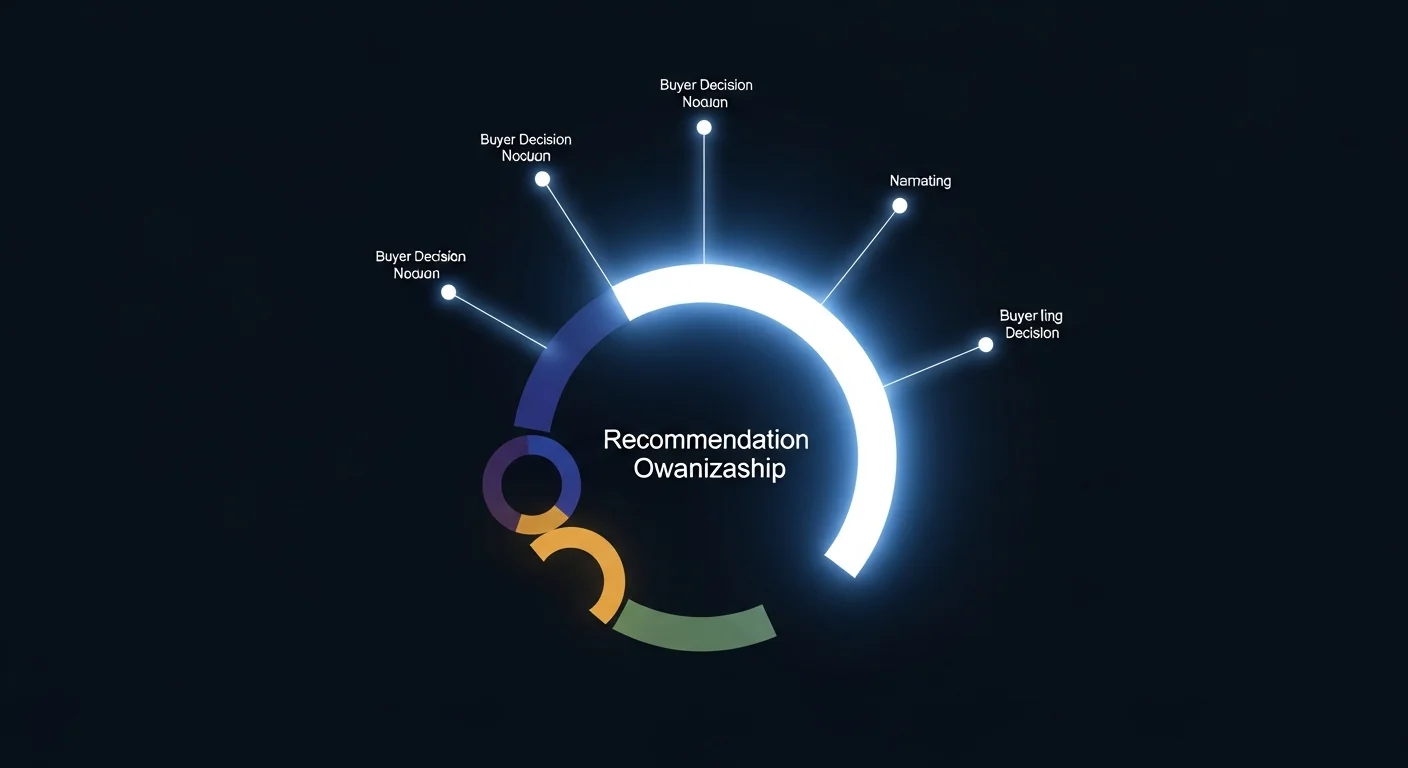
Recommendation Presence
Are You Included?
Presence measures whether an organization appears within recommendation environments. This is the foundational layer. Before dominating recommendations, an organization must first be included. Many organizations assume they are being recommended because they have strong brands. This assumption often creates blind spots. Presence must be measured.
Key Questions
Recommendation Frequency
How Often Are You Recommended?
Frequency measures the volume of recommendation appearances relative to competitors across AI search, analyst reports, community platforms, and review environments. Organizations that appear repeatedly gain stronger discoverability advantages. One recommendation creates awareness. Repeated recommendations create familiarity. Repeated familiarity creates trust that influences buying behavior.
Key Questions
Recommendation Quality
What Type of Recommendations Are You Receiving?
Not all recommendations carry equal influence. A vendor shortlist recommendation from an AI purchasing query carries more weight than a casual peripheral mention. Recommendation Quality evaluates the influence potential of each recommendation event. An organization may receive many low-impact recommendations while a competitor receives fewer but higher-quality endorsements - and creates greater business impact.
Key Questions
Recommendation Position
Where Do You Appear?
Position matters even within recommendation environments. Appearing first among three recommendations creates disproportionate visibility compared to appearing third. Appearing within the top recommendations creates more consideration than appearing as a footnote. Recommendation Position quantifies this advantage and helps organizations track whether they are moving toward or away from the most influential positions.
Key Questions
Recommendation Share in AI Search
The rise of AI-powered search is one of the primary reasons Recommendation Share is becoming strategically important. Historically, discoverability was distributed. Search engines presented multiple links. Users evaluated options independently. AI systems increasingly reduce that complexity - providing a curated set of recommendations rather than dozens of potential answers.
A more useful perspective is to view AI search not as a new kind of search engine, but as a recommendation engine. Users ask questions like "what are the best revenue visibility platforms?" or "which attribution tools should we evaluate?" These are recommendation requests. The AI system is not merely retrieving information - it is helping shape consideration.
ChatGPT
Increasingly used for vendor research, shortlist creation, and solution evaluation across B2B buying journeys.
Gemini
Integrated with Google Search, influencing both traditional and AI-powered discovery for millions of queries daily.
Perplexity
Positioned as a research tool, frequently consulted for technology comparisons and vendor evaluations.
Claude
Used by enterprise buyers for complex research tasks including vendor assessments and market analysis.
AI Overviews
Google AI Overviews appear above traditional results for many commercial queries, creating new recommendation real estate.
Copilot
Microsoft Copilot integrated across productivity tools increasingly surfaces vendor recommendations in workflow contexts.
Why AI Recommendations Create Competitive Urgency
Organizations included
Gain early access to buyer consideration, disproportionate shortlist presence, and compounding authority
Organizations excluded
Often disappear from the buying journey entirely before the first website visit occurs
Measuring Recommendation Share
Recommendation Share should not rely on a single source. Organizations should evaluate recommendation activity across multiple environments - AI systems, analyst reports, community platforms, review platforms, and industry publications - to build a complete picture of competitive recommendation-driven discoverability.
Recommendation Frequency
The foundational metric. Measures how often an organization appears during recommendation opportunities relative to competitors. Questions include: How frequently are we recommended? How often are competitors recommended? Which topics generate recommendations?
Recommendation Coverage
Measures the breadth of recommendation visibility. An organization appearing in AI search, analyst reports, and industry communities has broader coverage than one appearing only in a single channel. Coverage explains resilience - organizations visible across more environments are less exposed to single-channel risk.
Recommendation Position
Evaluates where an organization appears when recommendations occur. First, second, or third. Position influences visibility and engagement - organizations appearing earlier gain disproportionate attention. Recommendation Position helps organizations track whether they are moving toward the most influential positions over time.
Recommendation Consistency
Measures how reliably an organization appears over time. Some brands experience occasional recommendation spikes. Others appear repeatedly across environments. Consistent visibility generally creates stronger discoverability advantages than isolated events. Consistency often correlates with category authority.
Recommendation Velocity
One of the most useful emerging metrics. Velocity measures the rate at which recommendation visibility is increasing or decreasing. Organizations that monitor Recommendation Velocity often identify competitive shifts months before they appear in pipeline or revenue data - providing the earliest warning of market changes available.
Why Recommendation Share Predicts Revenue
Many traditional marketing metrics sit relatively far from revenue. Impressions, reach, and engagement approximate influence without directly measuring it. Recommendation Share sits much closer to consideration - which is where buying processes begin.
Most buying processes involve shortlists. Organizations evaluate a small set of options. Very few buyers evaluate every possible solution. Recommendations influence which organizations make the shortlist - and therefore which organizations ever get the opportunity to compete for revenue.
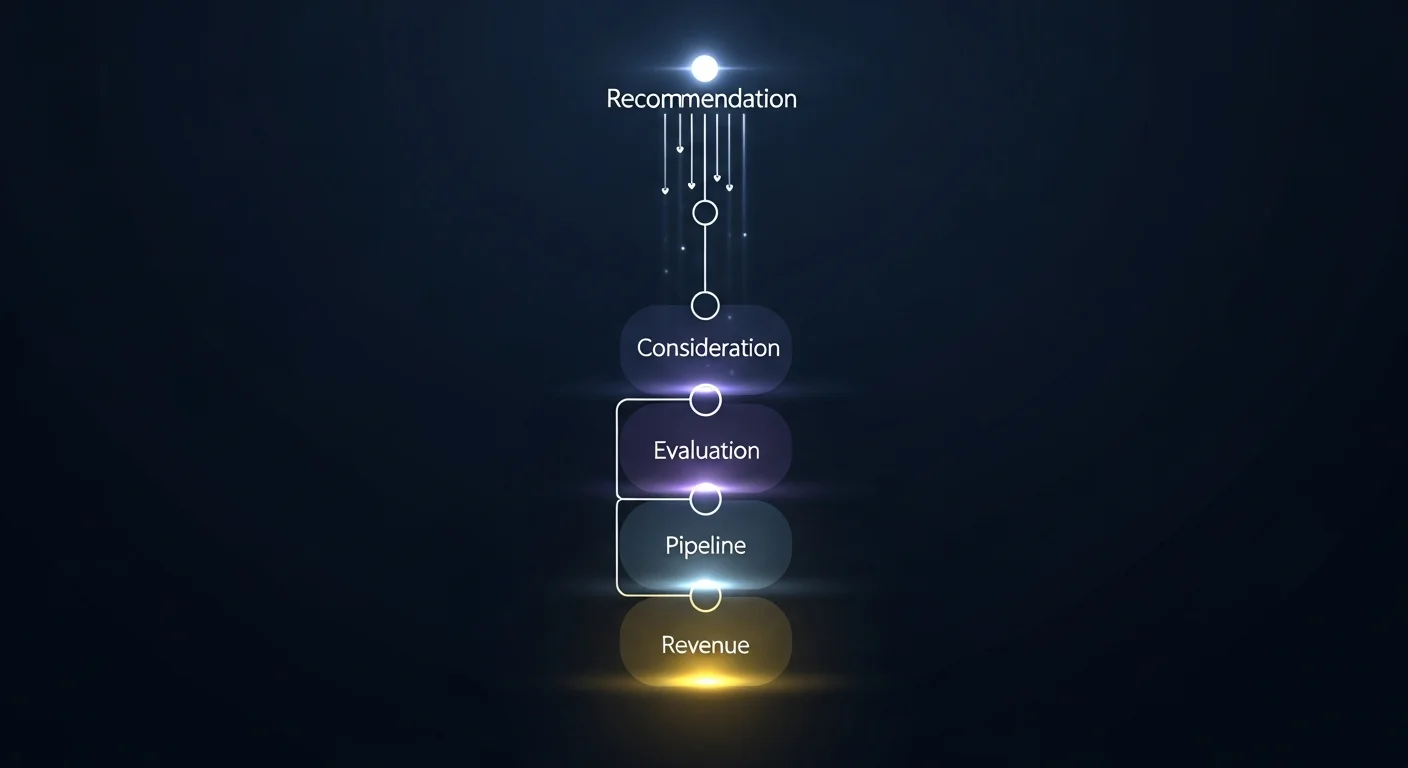
The Path From Recommendation to Revenue
Because recommendations occur early in this sequence, Recommendation Share frequently functions as a leading indicator of future pipeline and revenue.
Recommendation Share and Revenue Visibility
Recommendation Share does not directly create revenue. However, it creates the conditions necessary for revenue creation. Organizations with strong Recommendation Share frequently experience greater discoverability, more evaluation opportunities, and higher consideration rates - all of which contribute to stronger Revenue Visibility over time. For organizations connecting Revenue Visibility to its earliest leading indicators, Recommendation Share is one of the most valuable signals available.
Recommendation Share Across the Organization
For CMOs
Connecting content strategy to recommendation authority
Marketing leaders increasingly need visibility into recommendation-driven discovery. Historically CMOs focused heavily on rankings, traffic, and demand generation. AI-powered discovery introduces new questions: Are we being recommended? Which competitors are recommended more frequently? Which topics drive recommendations?
Content Prioritization
Recommendation analysis identifies high-value topics, authority opportunities, and visibility gaps - shifting content strategy from generating traffic toward building recommendation authority.
Category Positioning
Organizations increasingly compete for recommendation ownership. Recommendation Share helps CMOs evaluate category leadership and competitive positioning across AI systems and analyst environments.
For CEOs
Recommendation Share as a strategic business metric
For executives, Recommendation Share is not simply a marketing concern - it is a strategic business concern. AI systems increasingly influence how buyers discover, evaluate, and select vendors. Organizations that gain recommendation ownership gain access to future demand. Organizations that lose it may never enter consideration.
Competitive intelligence
Track whether competitors are gaining or losing recommendation ownership before changes appear in revenue.
Growth signals
Recommendation trends often appear before pipeline changes, giving executives earlier insight into market dynamics.
Strategic positioning
Category leaders in AI recommendations often develop durable discoverability advantages that become harder for competitors to close.
For Revenue Teams
Improving forecast accuracy with recommendation signals
Revenue teams are responsible for predictable growth. Predictability improves when organizations understand leading indicators. Recommendation Share provides visibility into future discoverability - and discoverability precedes pipeline. Demand often begins with discovery, and discovery increasingly begins with recommendations.
Recommendation Share as a Pipeline Signal
The Recommendation Share Maturity Model
Organizations typically evolve through several stages of discoverability maturity. Understanding these stages helps leaders evaluate where they are today and what the next step looks like.
Rankings
Focus: Visibility - Can buyers find us?
Awareness
Focus: Recognition - Do buyers know we exist?
Recommendations
Focus: Consideration - Are we being recommended?
Recommendation Share
Focus: Competitive ownership - How much recommendation visibility do we own?
Visibility Share
Focus: Total discoverability - How much discoverability do we own overall?
Decision Intelligence
Focus: Strategic action - What should we do next?
How RankWorks Measures Recommendation Share
Most organizations can identify whether recommendations occur. Far fewer understand recommendation ownership. RankWorks approaches Recommendation Share through the broader framework of Visibility Intelligence.
The objective is not simply counting recommendations. The objective is understanding competitive recommendation frequency, recommendation authority, recommendation trends, and the impact those recommendations have on consideration and pipeline.
By connecting Recommendation Share with Visibility Share, AI Search Visibility, Revenue Visibility, and Decision Intelligence, organizations gain a more complete understanding of growth opportunity.
AI Citation Share
How often referenced across ChatGPT, Gemini, Claude, Perplexity, and AI Overviews
Recommendation Frequency
How often recommended relative to competitors across all recommendation environments
Recommendation Velocity
Whether recommendation share is accelerating or decelerating over time
Competitive Ownership
What percentage of total recommendation opportunities you own versus competitors
Topic Authority
Which subject areas generate the strongest recommendation signals
Revenue Connection
How recommendation trends correlate with pipeline and growth signals
Frequently Asked Questions
Frequently Asked Questions
Everything you need to know about our SEO services
Still have questions?
Our SEO experts are here to help. Get personalized answers and a free consultation.
Key Takeaways
Recommendations Are the New Discovery Layer
Organizations increasingly compete for recommendation inclusion rather than rankings alone. AI systems, analyst reports, communities, and review platforms now shape buyer shortlists before a website visit occurs.
Recommendation Share Measures Competitive Consideration
The metric evaluates how frequently organizations are recommended relative to competitors. Visibility creates awareness. Recommendation Share measures whether that awareness converts to consideration.
AI Search Accelerates Recommendation Importance
AI-powered search creates scarcity - typically three to five recommendations per query. This concentration of influence makes Recommendation Share one of the most competitively important metrics in modern discovery environments.
Recommendation Share Predicts Opportunity
Recommendations frequently appear before measurable business outcomes. Organizations that monitor Recommendation Share gain earlier insight into future pipeline and competitive threats than those relying solely on lagging metrics.
Recommendation Ownership Creates Durable Advantage
Organizations that consistently earn recommendations develop compounding authority: recommendations generate customers, customers generate authority, authority generates more recommendations. Category leaders often strengthen over time.
Five Dimensions Compose the Complete Framework
Presence, Frequency, Quality, Position, and Competitive Share together provide a complete picture of recommendation-driven discoverability. Tracking one dimension without the others creates measurement blind spots.
Conclusion
The internet is entering a new phase. For decades, organizations competed primarily for visibility - traffic, rankings, clicks. Those metrics remain important. But they no longer tell the complete story.
The future of discoverability will increasingly be shaped by recommendations. Recommendations influence consideration. Consideration influences evaluation. Evaluation influences revenue. Recommendation Share provides a framework for understanding how much of that recommendation layer an organization actually owns.
As AI-powered discovery becomes more common, Recommendation Share will become one of the most important metrics available to marketers, revenue teams, and executives. Because in a world increasingly driven by answers rather than links, the organizations that earn recommendations will be the organizations that earn attention, consideration, and growth.
Continue Reading
Visibility Share
The six-dimension framework for measuring total competitive discoverability across all environments where buyers discover solutions.
AI Search Visibility
How brands become discoverable, cited, and recommended within ChatGPT, Gemini, Claude, Perplexity, and AI Overviews.
Competitive Visibility Intelligence
A framework for tracking competitor discoverability across search, AI, content, brand, and market dimensions.
Revenue Visibility
Connecting discoverability signals to pipeline and growth - the link between recommendation share and revenue outcomes.
AI Visibility Framework
The five-layer model explaining how organizations become visible, understood, cited, and recommended by AI systems.
Marketing Attribution Pillar
The full guide to marketing attribution, AI-driven discoverability, and modern measurement strategy.